"CBSE’s May 2025 tender required answer sheets to be scanned with automatic robotic scanners, spines preserved, at a minimum of 300 DPI.
It has been exposed that COEMPT scanned the answer sheets using mobile phones.
He has not had time to speak about 18.5 lakh children whose answer sheets were scanned with phones," Gandhi said.
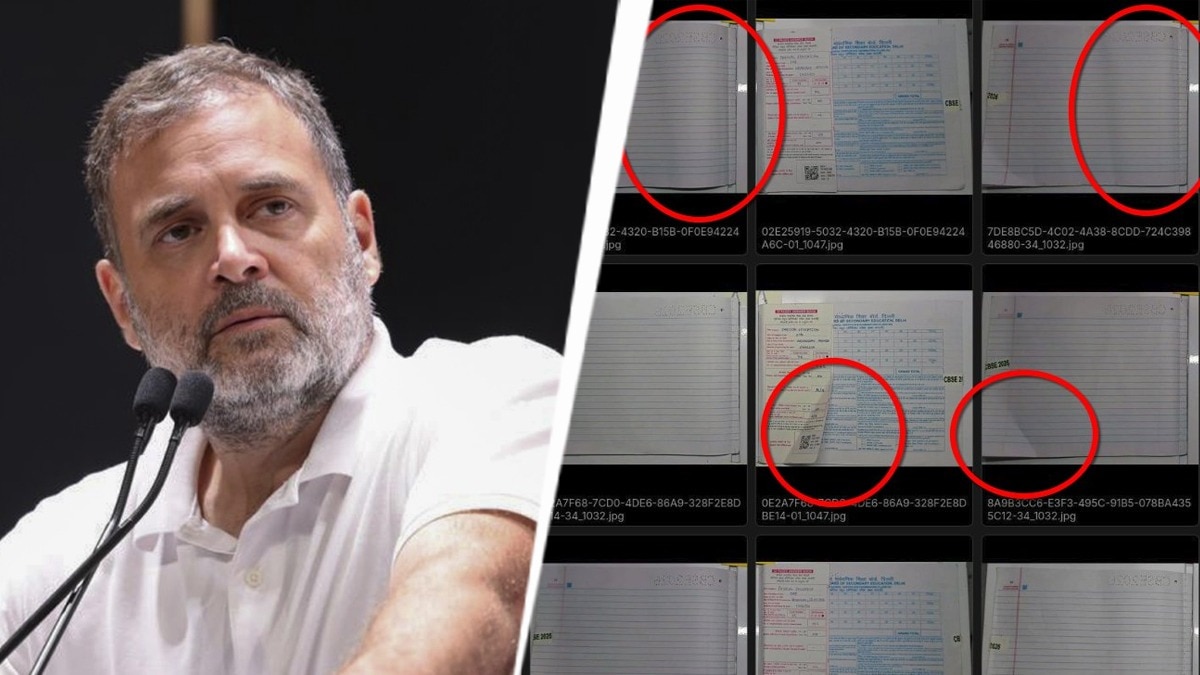
He observed visible drop shadows and fold marks on several scanned answer sheets.
More students reported receiving answer sheets that did not match their handwriting, answer patterns or presentation style.
Congress MP Rahul Gandhi stepped up his attack on the government and the CBSE over allegations of corruption in the board's tender process for the Class 12 on-screen marking (OSM) system, citing fresh claims that answer sheets were scanned using mobile phones instead of professional equipment.
After a sit-down chat with students who became the public face of the controversy over CBSE's first-ever digital evaluation exercise, Gandhi now amplified concerns raised by student researcher Sarthak Sidhant, whose document-based investigation blew the lid on how the board awarded the contract for the online marking portal.
Read Full Story
In a post on X, the Congress leader accused the private vendor responsible for digitising answer books, COEMPT Edu Teck, of using mobile phones to scan physical answer sheets after key technical requirements were diluted during the tender process.
"CBSE’s May 2025 tender required answer sheets to be scanned with automatic robotic scanners, spines preserved, at a minimum of 300 DPI. The tender re-issued in August quietly removed all of it," Gandhi wrote.
He alleged that the board tweaked the tender and diluted requirements to favour one particular firm, making it complicit in the alleged misconduct. Gandhi further claimed that every student whose marks were affected by evaluation errors was a victim of fraud.
"'Scanners' became generic. Resolution dropped to 200 DPI. Now we know what that meant in practice. It has been exposed that COEMPT scanned the answer sheets using mobile phones. The blurred copies, the missing pages, the unscanned books — they are not 'errors'. They are the predictable outcome of a contract written to fit a vendor. This is fraud," he said.
Taking aim at the government, he said Prime Minister Narendra Modi had remained silent on the issue and repeated calls for Education Minister Dharmendra Pradhan to step down.
"The Prime Minister had time to speak about mangoes. He has not had time to speak about 18.5 lakh children whose answer sheets were scanned with phones," Gandhi said.
The latest allegations stem from social media posts by 19-year-old ethical hacker Nisarga Adhikary, who highlighted more vulnerabilities in the OSM portal. Nisarga shared screenshots of scanned answer booklets and claimed that security safeguards could be bypassed, allowing "anyone on the internet" to access and download answer-sheet scans.
While examining the images shared online, Sarthak Sidhant pointed to another anomaly. He observed visible drop shadows and fold marks on several scanned answer sheets.
For the unversed, drop shadows are typically found on photographs or scans captured using handheld mobile devices rather than flatbed or automated scanners.
"Since the copies are out to the public view, do you mind explaining which copies when scanned through a scanner, have a drop shadow? And these 3 folds? Did you really use scanners?" Sarthak wrote on X.
The board’s first nationwide rollout of OSM was pitched as a technology-driven overhaul that would make evaluation faster, more transparent and less vulnerable to human error. Instead, it unleashed chaos.
What began as scattered complaints over unexpectedly low marks has, over the past two weeks, snowballed into one of the biggest credibility crises faced by the CBSE in recent years.
Within days of results being declared, social media was flooded with screenshots of answer books carrying blurred scans, missing pages, unchecked responses and marks that students claimed bore little resemblance to their academic record.
The anger was amplified by a sharp fall in Class 12 performance indicators. The pass percentage dropped to 85.2 per cent from 88.39 per cent last year, while compartment cases rose. Students across states alleged that scores in subjects such as Physics, Chemistry and Mathematics were inexplicably lower than expected.
Then came the answer-sheet horror stories.
advertisement
A Delhi student discovered that the Physics answer book uploaded against his roll number appeared to belong to somebody else. The CBSE later acknowledged the mix-up and issued the correct copy. But by then, the floodgates had opened. More students reported receiving answer sheets that did not match their handwriting, answer patterns or presentation style.
Adding to the turmoil was a re-evaluation portal that repeatedly crashed under demand, forcing the board to extend deadlines and issue clarifications.
Amid this, a bombshell dropped: that CBSE relaxed key eligibility norms while awarding the digitisation contract. Sarthak claimed his investigation revealed that certain technical and security requirements were diluted between the board's initial tender issued in May and a revised version released in August.
Separately, Nisarga Adhikary hacked the OSM portal twice, flagging major security flaws in the ecosystem. After denying lapses, CBSE on Sunday admitted to vulnerabilities in one of the associated portals and said cybersecurity teams, government experts and IIT specialists had been deployed to strengthen the system.
- Ends