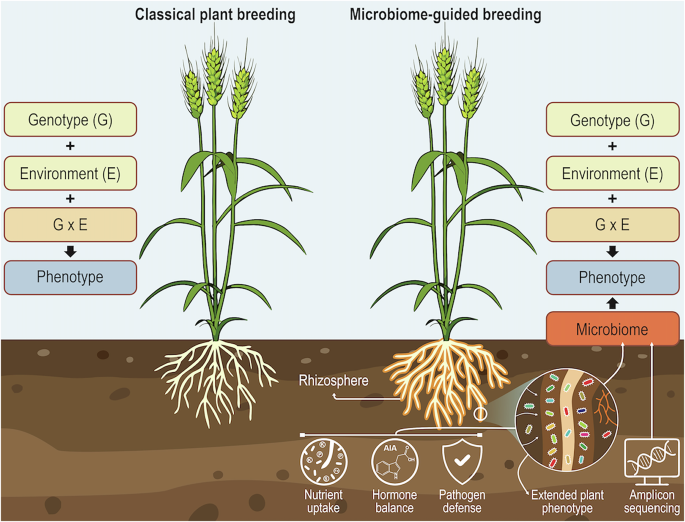
Broad approaches, such as selecting for root architectural traits that influence microbial recruitment, offer a scalable and high-throughput entry point, particularly for large breeding populations.
Similar principles have been discussed in previous syntheses and empirical studies emphasizing host genetic control of microbiome assembly and the use of plant traits to steer microbial recruitment3,11.
Incorporating microbiome profiling into breeding trials would allow breeders to identify genotypes that consistently benefit from specific microbial taxa or consortia15.
Here, microbiome profiling is proposed as a comparative and explanatory tool rather than an idealized or bias-free method.
Crucially, adding microbiome metrics to breeding programs does not meaningfully increase complexity.
Recent studies have emphasized that amplicon-based approaches are subject to methodological biases and limited predictive power in complex breeding scenarios, particularly across environments3,8. In this context, combining broad, trait-based selection strategies (e.g., root architectural traits influencing microbial recruitment) with more targeted, function- or taxa-focused microbiome approaches allows breeders to balance generalizable, high-throughput screening with crop- and trait-specific microbiome optimization. It is known that microbiome composition is strongly influenced by spatiotemporal dynamics, environmental context, and host–environment interactions, which can constrain the predictive value of single-time-point microbiome surveys.
Importantly, microbiome-informed breeding does not imply a single universal strategy applicable to all crops. Broad approaches, such as selecting for root architectural traits that influence microbial recruitment, offer a scalable and high-throughput entry point, particularly for large breeding populations. Similar principles have been discussed in previous syntheses and empirical studies emphasizing host genetic control of microbiome assembly and the use of plant traits to steer microbial recruitment3,11. However, more targeted strategies may be better suited for specific crops or agronomic goals, particularly when specific microbial functions or taxa are known to enhance key traits. For example, targeted recruitment or management of nitrogen-fixing or phosphorus-solubilizing bacteria can improve nutrient-use efficiency12, while selecting genotypes that preferentially associate with disease-suppressive microbial consortia can enhance resistance to soil-borne pathogens13. In addition, enrichment of drought-associated microbial guilds may contribute to improved stress tolerance under arid conditions14. Likewise, microbiome profiling using amplicon sequencing can provide different layers of information, ranging from the relative abundance of individual microbial taxa and functional groups to proportional shifts among dominant lineages and changes in the core community structure.
This includes a practical dimension, where microbiome-informed breeding could accelerate the development of microbial consortia with high field efficacy. Despite the proliferation of microbial-based agricultural inputs, inconsistent performance remains a major bottleneck. This inconsistency has been widely reported in the literature and reflects, in part, methodological constraints as well as ecological variability in plant–microbiome associations. One reason is that microbial inoculants interact differently with different plant genotypes. Incorporating microbiome profiling into breeding trials would allow breeders to identify genotypes that consistently benefit from specific microbial taxa or consortia15. Here, microbiome profiling is proposed as a comparative and explanatory tool rather than an idealized or bias-free method. This would facilitate the design of plant–microbe combinations optimized for specific environments, moving us toward a systems-level approach where plant genetics and microbial inputs are co-optimized rather than developed independently. Crucially, adding microbiome metrics to breeding programs does not meaningfully increase complexity. Rather, it adds explanatory power to existing trial designs and reduces unexplained variance.