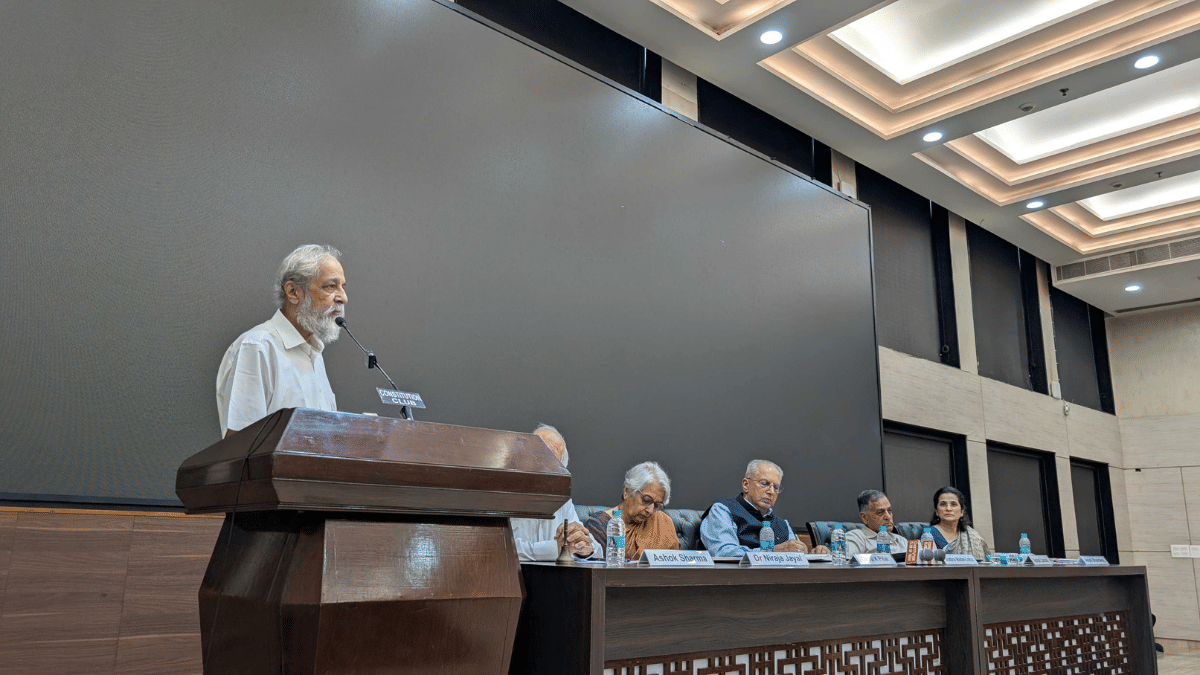
Justice Madan B. Lokur was speaking at a conclave on ‘One Nation-One Election, Federalism and Citizenship’, organised at the Constitution Club in Delhi.
New Delhi: A passport has effectively been reduced to a bus ticket, former Supreme Court judge Justice Madan B. Lokur said Saturday, adding that describing the passport as just a travel document is a “misreading” of the law.
In his address, Justice Lokur responded to the controversy that erupted after the Ministry of External Affairs (MEA) recently stated that a passport is primarily a “travel document” and not conclusive proof of Indian citizenship.
“How many people who are not citizens of India have been given Passports of India?
“Article 324 was not intended to give blanket power to the Election Commission,” the former judge said.
Justice Madan B. Lokur was speaking at a conclave on ‘One Nation-One Election, Federalism and Citizenship’, organised at the Constitution Club in Delhi. The conclave was organised jointly by the Constitutional Conduct Group and the Group on Federalism & Elections.
Speaking about the Election Commission of India in context of the Special Intensive Revision exercise, the judge also asserted that it may be becoming “an empire within an empire”, and spoke against the linking of access to government social welfare benefits to the SIR exercise.
New Delhi: A passport has effectively been reduced to a bus ticket, former Supreme Court judge Justice Madan B. Lokur said Saturday, adding that describing the passport as just a travel document is a “misreading” of the law.
Also at the conclave were former Home Secretary Gopal Pillai, former Chief Election Commissioner S. Y. Quraishi, former Election Commissioner Ashok Lavasa, former chairman of the Law Commission of India Justice A. P. Shah, political scientist Niraja Jayal, and transparency advocate Anjali Bhardwaj, among others.
In his address, Justice Lokur responded to the controversy that erupted after the Ministry of External Affairs (MEA) recently stated that a passport is primarily a “travel document” and not conclusive proof of Indian citizenship.
He referred to the Preamble of the Passports Act 1967, which says that it is a law to “provide for the issue of passports and travel documents, to regulate the departure from India of citizens of India and for other persons”.
So the Preamble and the law makes a distinction between a passport and a travel document, the former judge asserted, saying, “So, to say that a passport is nothing but a travel document is a complete misreading of the provisions of the Passports Act.”
“Since it is a complete misreading, a person who holds an Indian passport is a citizen of India,” he said.
Justice Lokur also referred to the reliance on Section 20 of the Passports Act, which allows the government to issue a passport or a travel document to someone who is not a citizen of India.
“How many people who are not citizens of India have been given Passports of India? We don’t know. I will be surprised if there is anybody who has been given an Indian passport and who is not a citizen of India,” he said.
‘Article 324 not blanket power’
Talking about the Special Intensive Revision (SIR) process in West Bengal, Justice Lokur referred to the disposal rate by the appellate tribunals set up in West Bengal in furtherance of the process, saying that the tribunals collectively are being able to dispose of only around 500 cases per day, while it has lakhs of cases pending before it.
He asserted that while the Constituent Assembly had referred to the phrase ‘Imperium in Imperio’ in reference to the judiciary, he said that unfortunately, it was the Election Commission of India that is becoming ‘Imperium in Imperio’, which means ‘an empire within an empire’.
“Article 324 was not intended to give blanket power to the Election Commission,” the former judge said.
Justice Lokur also pointed out that the Constitution of India gives certain fundamental rights to citizens and amongst the most important rights are the ones under Article 19 of the Constitution.
“These are only granted to citizens, not to anybody else… So if a person is declared as a person not being a citizen of India. Why? Because he or she doesn’t satisfy the requirements of the Election Commission of India, and therefore not allowed to vote, and therefore under Article 326 is perhaps not a citizen of India. Therefore, (he or she) is not entitled to any of the fundamental rights under Article 19,” Justice Lokur explained, asking, “Can you imagine that?”
He pointed out that there isn’t any document to show that a person is a citizen of India.
“So in effect all persons who have not been allowed to vote and therefore are not citizens of India… have been deprived of a fundamental constitutional right guaranteed under Article 19,” Justice Lokur said.
In the same vein, he spoke of the situation in Bihar and West Bengal, where people whose names are not in the electoral rolls are not entitled to certain government welfare schemes.
“Controversy about SIR and not being able to go on having fundamental rights, not getting welfare benefits—on that somebody has to be held accountable,” he said.
(Edited by Viny Mishra)
Also read: Electoral revision or citizenship proof? How journalist passport row has restoked SIR implication debate