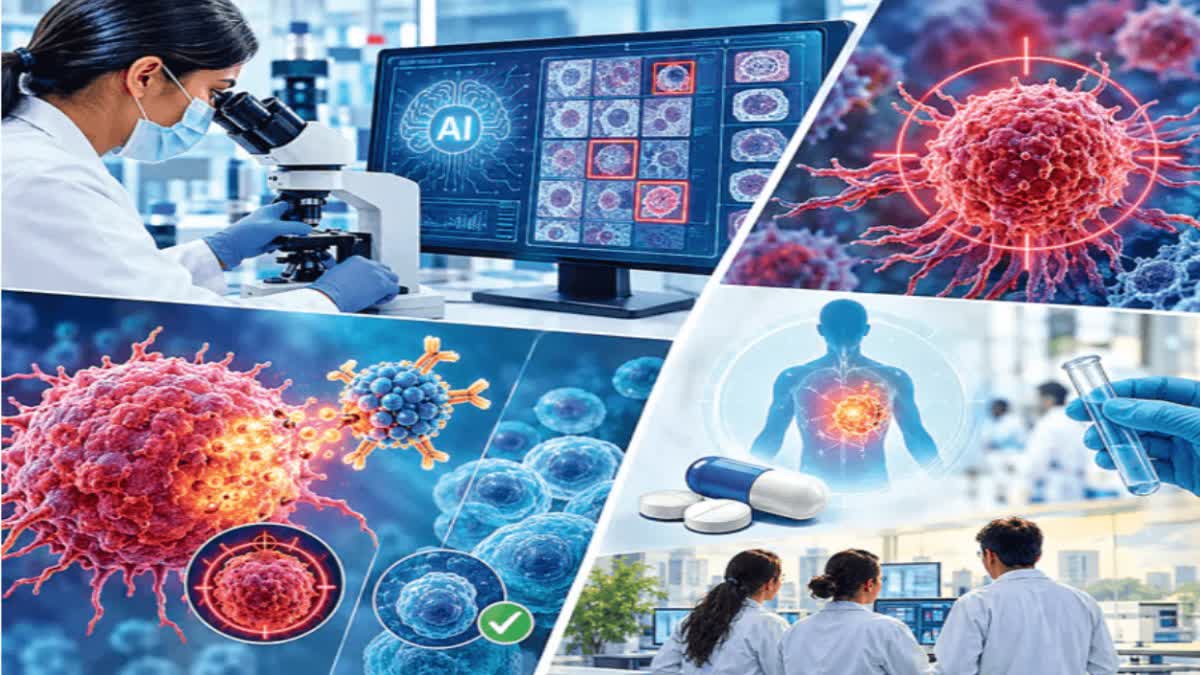
ETV Bharat / healthNew Weapons In The Fight Against Cancer: AI Technology To Detect Cancer Stem Cells EarlyScientists have found that Artificial Intelligence (AI) can help in identifying cancer stem cells at an early stage to check the risk of recurrence.
By collecting data from thousands of cells and analyzing it using machine learning and AI, they were able to identify unique features of cancer stem-like cells.
The usual chemotherapy drugs attack cancer cells, but they also damage healthy cells, giving patients a host of unpleasant side effects.
Moreover, it is difficult to distinguish stem cells from other cancer cells because they have similar characteristics.
Cancer stem cells grow slowly, though in some instances, they become active.
ETV Bharat / health
New Weapons In The Fight Against Cancer: AI Technology To Detect Cancer Stem Cells Early
Scientists have found that Artificial Intelligence (AI) can help in identifying cancer stem cells at an early stage to check the risk of recurrence. Recent developments include an artificial intelligence-based approach to predict the risk of recurrence after treatment and a new drug compound that targets only cancer cells and minimizes the damage to healthy cells.
"We found that patients with tumours that have many highly potent cancer stem cells are less likely to respond to treatment and have a greater risk of recurrence of cancer. Using this method, the researchers analyzed over 25,000 tumour samples from international cancer databases. This AI-based approach was helpful in analyzing large numbers of patient samples in settings without access to the advanced facilities needed for standard tests,” the scientists said. This research paper was recently published in the journal Nucleic Acids Research (NAR Cancer) affiliated to Oxford University.
The study used “single-cell RNA” analysis to look at individual cancer cells. By collecting data from thousands of cells and analyzing it using machine learning and AI, they were able to identify unique features of cancer stem-like cells. To achieve this, researchers from the SN Bose National Center for Basic Sciences and Ashoka University have jointly developed a method they called ‘AI-based Cancer Stem-like Cell Profiler and Neoplasm Deconvoluter’ (ACSCEND) . This tool can find cancer stem-like cells hidden inside tumours.
"So far, these findings are restricted to the research and laboratory stages. Their safety, efficacy and clinical utility can only be established after extensive clinical trials on patients have been completed," Dr. Senthil Rajappa, Senior Medical Oncologist, Basavatarakam Indo-American Cancer Hospital told Eenadu-ETV Bharat, adding, “These research findings are a ray of hope for future cancer treatments."
Another study by researchers from IASST-Guwahati and IIT-Guwahati synthesized a small-molecule compound called ‘RK-251’. The usual chemotherapy drugs attack cancer cells, but they also damage healthy cells, giving patients a host of unpleasant side effects. RK-251 attempts to solve this problem. Cancer cells have higher levels of ‘Reactive Oxygen Species’ (ROS) than normal cells. When RK-251 enters a cancer cell, it reacts with these ROS to release an anti-cancer agent called ‘NBD-HEX’. It targets the essential proteins for cancer cell growth. Laboratory tests showed the drug to be effective but researchers found it had little effect on healthy cells, where levels of ROS are low. Studies with zebrafish embryos also showed no significant toxicity. It was published in The Journal of Medicinal Chemistry of the American Chemical Society (ACS).
New Approach To Drug Development
"Identifying these cells could be a game-changer in the treatment of cancer. The study also looked at a drug targeting 'free radicals' which are found in large amounts in cancer cells. Preliminary tests on both, cells and animal models found the drug to work well against cancer cells with little impact on normal cells. “This could lead to less side effects from the treatment,” Dr. Senthil said.
Key Issue: How To Identify Stem Cells
Not all cancer cells are alike. Some are classified as ‘stem cells,’ possessing the ability to generate other cancer-causing cells. These cells can escape treatment and remain dormant in the body for long periods of time. They are difficult to find because they exist in very small numbers, often less than 1% of the total cells in a tumour. Moreover, it is difficult to distinguish stem cells from other cancer cells because they have similar characteristics.
Cancer stem cells grow slowly, though in some instances, they become active. Consequently, certain treatments designed to destroy rapidly dividing cancer cells may not be very effective against them. Research indicates that the disease could potentially recur in the future from these residual cells. Another significant aspect is that these stem cells possess the ability to prevent treatment drugs from entering, expel drugs that have entered, and evade the body's immune system.