NASA’s Transiting Exoplanet Survey Satellite (TESS) has discovered a planet in a way it was never designed to.
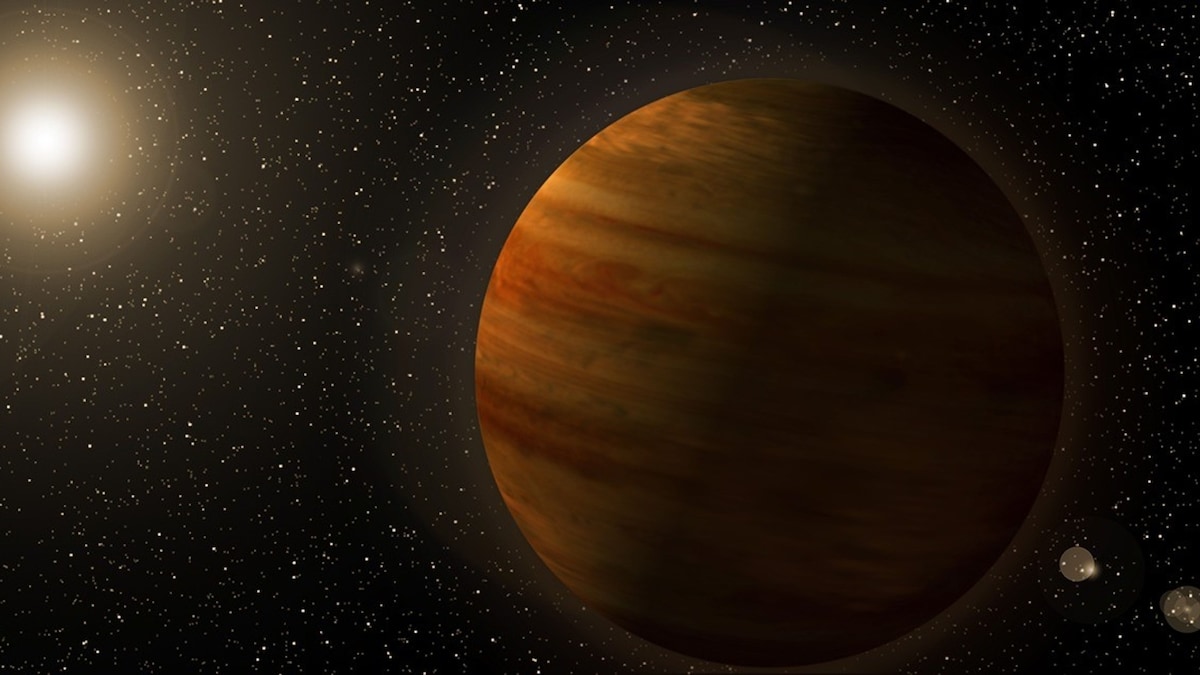
For the first time, the mission identified a planet orbiting a distant star using ripples in space-time, rather than its usual planet-hunting technique, NASA reported.Unlike the close-in transiting planets that TESS typically discovers, the newly identified planet is a super-Jupiter that orbits far from its host star once every 180 days, according to a team from Queen’s University Belfast.The planet, named Gaia23bra b, has a mass about 1.6 times that of Jupiter.
Planets of this size and mass are commonly referred to as super-Jupiters.
The discovery implies that there are probably other so-called microlensing planets hiding in TESS’s data that we hadn’t previously thought to look for.”Astronomers first detected signs of Gaia23bra b in 2023 using the European Space Agency’s now-retired Gaia space telescope.
The planet is located nearly 40,000 light-years from Earth, far beyond TESS’s typical search range of around 150 light-years.
NASA’s Transiting Exoplanet Survey Satellite (TESS) has discovered a planet in a way it was never designed to. For the first time, the mission identified a planet orbiting a distant star using ripples in space-time, rather than its usual planet-hunting technique, NASA reported.Unlike the close-in transiting planets that TESS typically discovers, the newly identified planet is a super-Jupiter that orbits far from its host star once every 180 days, according to a team from Queen’s University Belfast.The planet, named Gaia23bra b, has a mass about 1.6 times that of Jupiter. Planets of this size and mass are commonly referred to as super-Jupiters. It is also an exoplanet, the term used for any planet located outside our solar system.Describing the findings, Diana Dragomir, a professor at the University of New Mexico in Albuquerque and co-author of the study, said that when TESS was launched, no one expected it to be capable of discovering this type of planet.She added, “At 1.6 times Jupiter’s mass and a similar orbital distance, it would be extremely unlikely to find such a planet via the primary detection method TESS was designed for. The discovery implies that there are probably other so-called microlensing planets hiding in TESS’s data that we hadn’t previously thought to look for.”Astronomers first detected signs of Gaia23bra b in 2023 using the European Space Agency’s now-retired Gaia space telescope. Gaia’s alert system identified a star that suddenly brightened, an effect that can occur when a foreground star passes in front of a more distant star and magnifies its light through gravitational microlensing.Researchers later examined archived TESS data and found that the spacecraft had recorded the same event.The team’s analysis, published on July 1 in The Astrophysical Journal Letters, revealed that Gaia23bra b orbits an orange dwarf star with about 80% of the Sun’s mass. The planet is located nearly 40,000 light-years from Earth, far beyond TESS’s typical search range of around 150 light-years.