ETV Bharat / technologyNASA's James Webb Telescope Reveals 16.5 Million Stars Hidden Within Cigar GalaxyScientists used NASA’s James Webb Space Telescope to image edge-on starburst galaxy Messier 82 and trace its evolutionary history.
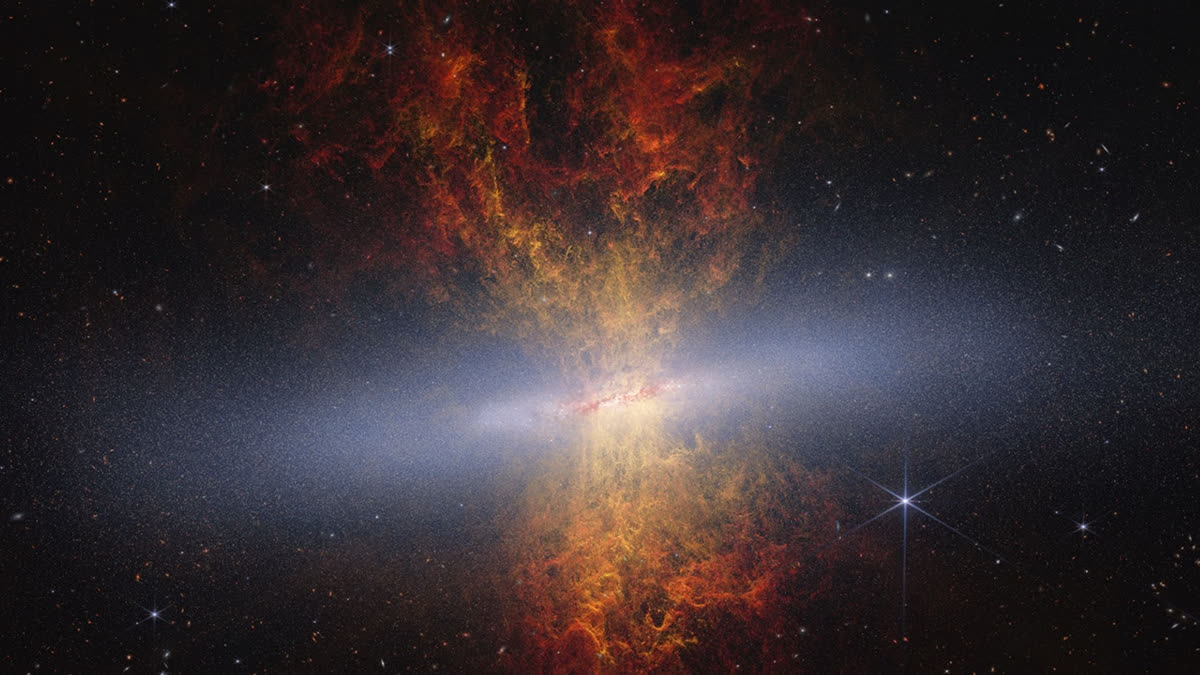
This Webb and Hubble composite image includes 16.5 million stars (blue-white), dust grains (red-orange), and ionized hydrogen gas (yellow).
( Image Credit: NASA, ESA, CSA, Adam Smercina (STScI, Tufts), Thomas Williams (University of Manchester); Image Processing: Alyssa Pagan (STScI) )Hyderabad: The National Aeronautics and Space Administration's (NASA) James Webb Space Telescope has imaged an edge-on spiral galaxy, Messier 82 (M82), also known as the Cigar Galaxy.
Located 12 million light-years from Earth, M82 is undergoing a burst of rapid star formation likely triggered by a past galaxy interaction.
He noted the galaxy offers a simultaneous window onto many astrophysical questions in a way no other nearby galaxy can.
ETV Bharat / technology
NASA's James Webb Telescope Reveals 16.5 Million Stars Hidden Within Cigar Galaxy
Scientists used NASA’s James Webb Space Telescope to image edge-on starburst galaxy Messier 82 and trace its evolutionary history. This Webb and Hubble composite image includes 16.5 million stars (blue-white), dust grains (red-orange), and ionized hydrogen gas (yellow). ( Image Credit: NASA, ESA, CSA, Adam Smercina (STScI, Tufts), Thomas Williams (University of Manchester); Image Processing: Alyssa Pagan (STScI) )
Hyderabad: The National Aeronautics and Space Administration's (NASA) James Webb Space Telescope has imaged an edge-on spiral galaxy, Messier 82 (M82), also known as the Cigar Galaxy. Located 12 million light-years from Earth, M82 is undergoing a burst of rapid star formation likely triggered by a past galaxy interaction. This intense phase is expected to last only a few hundred million years in astronomical terms, and its unusual nature, combined with its proximity, makes it a unique subject of study.
Astronomers recently used the James Webb Space Telescope's Near InfraRed Camera (NIRCam) instrument to complete a 65-hour imaging survey of the galaxy, uncovering previously unseen details, including its distended disk structure and millions of individual stars, which is expected to help scientists piece together the galaxy's formation history and current processes.
Exploring an Astrophysical Puzzle
Principal investigator Adam Smercina, a NASA Hubble Fellow at the Space Telescope Science Institute, described M82 as "a beautiful mess" whose evolutionary history remains poorly understood, including what triggered its elevated star formation rate. He noted the galaxy offers a simultaneous window onto many astrophysical questions in a way no other nearby galaxy can.
Earlier observatories, including Hubble and the retired Spitzer telescope, had their view limited by the galaxy's thick dust, but Webb's extended observation time and infrared sensitivity allowed it to pierce through that covering material.
Millions of stars revealed