News tech NASA Skyfall Helicopters: 19-Inch Antenna, Six Inches Of Clearance- Get Ready For 2028 MissionNASA Skyfall Helicopters: 19-Inch Antenna, Six Inches Of Clearance- Get Ready For 2028 MissionCurated By :,Powered by:Last Updated: August 17, 2026, 14:00 ISTSkyFall's radar antenna needed 19 inches of length and had six inches of clearance.
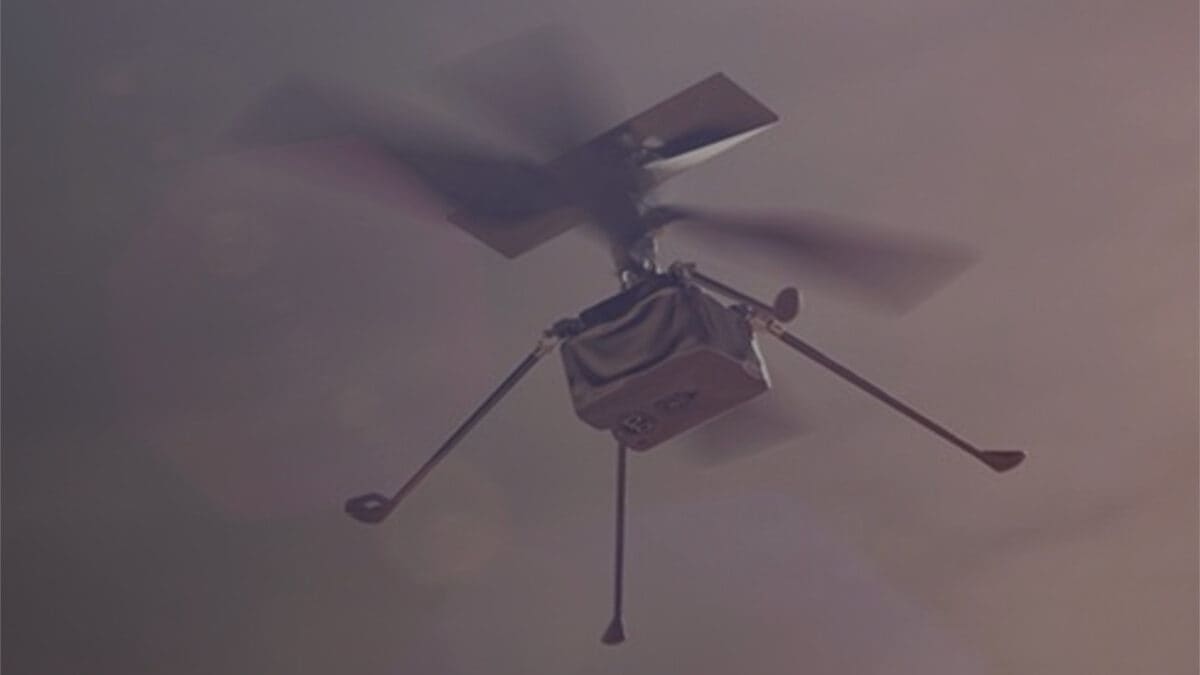
NASA has released an artist’s impression of its three SkyFall helicopters at work above the Martian surface, green waves fanning out from their antennas as they scan for buried ice.
The gap between the Martian ground and the base of the helicopter’s fuselage is roughly six inches.
The ProblemYou cannot simply shorten the antenna without losing sensitivity, and you cannot fly higher, because detecting shallow subsurface ice requires flying close to the ground.
The answer to what lies beneath the Martian surface is four years out.
News tech NASA Skyfall Helicopters: 19-Inch Antenna, Six Inches Of Clearance- Get Ready For 2028 Mission
NASA Skyfall Helicopters: 19-Inch Antenna, Six Inches Of Clearance- Get Ready For 2028 Mission
Curated By :
,
Powered by:
Last Updated: August 17, 2026, 14:00 IST
SkyFall's radar antenna needed 19 inches of length and had six inches of clearance. JPL's fabric solution weighs 150 grams and folds every time it lands.
To find water ice beneath the Martian regolith, SkyFall's ground-penetrating radar has to operate across an ultra-wide band from 500 to 2,500 megahertz.
NASA has released an artist’s impression of its three SkyFall helicopters at work above the Martian surface, green waves fanning out from their antennas as they scan for buried ice.
The image is striking. The engineering behind those antennas is better.
To find water ice beneath the Martian regolith, SkyFall’s ground-penetrating radar has to operate across an ultra-wide band from 500 to 2,500 megahertz. A conventional antenna for that frequency range measures about 19 inches, or 48.3 centimetres.
The gap between the Martian ground and the base of the helicopter’s fuselage is roughly six inches.
The Problem
You cannot simply shorten the antenna without losing sensitivity, and you cannot fly higher, because detecting shallow subsurface ice requires flying close to the ground.
Adrian Tang, SkyFall’s ground-penetrating radar lead instrument scientist at JPL, has put it plainly: the only way to detect shallow subsurface ice remotely is to fly close to the ground. Flying low and slow, he says, a SkyFall helicopter could capture radar images that resolve the fine layering where dry soil gives way to ice, detecting its presence and mapping its extent.
So the antenna has to be long enough to work, short enough to fit, and survive being dragged across rocks on landing. Dozens of times, because SkyFall is expected to make dozens of flights.
The Solution Weighs As Much As Two Violin Bows
JPL engineers built a downsized Vivaldi antenna out of fabric.
Component Detail Base material Polyester sheath Outer layers Vectran, the same material used for the landing airbags on Spirit and Opportunity Shape retention Flexible fibreglass tape springs Mounting Lightweight magnesium structure Total weight About 150 grams, or 5 ounces
NASA’s own comparison for that weight is slightly more than two violin bows.
The antenna stows before the helicopter’s initial mid-air takeoff and unfurls once it is flying. On landing it folds. On the next takeoff it springs back into shape. It has to do that repeatedly without losing its form, which is the part that took the engineering.
It cleared testing at JPL in California this month.
What The Radar Will Actually See
The 500 to 2,500 megahertz range corresponds to wavelengths between roughly 60 and 12 centimetres, and the two ends do different jobs.
Wavelength What it reveals Longest, about 60cm Penetrates several yards below the surface Shortest, about 12cm Fine detail on upper layers and surface texture
In the released image, the green frequency waves represent subsurface radar collection. The red beams represent near-infrared imagery gathered from regolith and other surface features.
Each of the three helicopters carries four instruments, covering subsurface and infrared mapping, visible light imagery and temperature monitoring.
Why Ice Is The Point
This is not curiosity-driven mapping. SkyFall is scouting for water ice at candidate landing sites for the first crewed missions to Mars.
Water is the single heaviest thing you would otherwise have to carry from Earth, and it is not only for drinking. Split it and you have breathable oxygen and rocket propellant. A landing site with accessible shallow ice is a fundamentally different proposition from one without.
Which is why the antenna problem mattered enough to solve. Orbital instruments cannot resolve shallow ice at the scale required. Only something flying low can.
The Mission
Detail Information Launch Late 2028, aboard NASA’s Space Reactor-1 Freedom Departure for Mars December 2028 Arrival 2030 Helicopters Three Instruments each Four Deployment Mid-air, described by NASA as daring Managed by NASA’s Jet Propulsion Laboratory Built with AeroVironment of Arlington, Virginia Landing site Not yet selected
The mid-air deployment is exactly what it sounds like. The helicopters take off from the descending spacecraft rather than landing first and then launching, which is why the antenna has to stow before that initial takeoff.
Site selection is still open. NASA is targeting flat, low-elevation areas free of major geological obstacles, ideally with interesting subsurface features within or near the landing ellipse.
What Ingenuity Proved
Ingenuity was a technology demonstrator with one job: establish that powered, controlled flight is possible in an atmosphere roughly one percent as dense as Earth’s.
It flew 72 times over nearly three years, far beyond its original brief, and proved something additional along the way. An aerial view generates genuinely useful data, helping the Perseverance team plan faster routes and pick locations worth investigating.
SkyFall differs in two ways that matter.
It carries science instruments rather than proving a concept. Four per helicopter, three helicopters.
It does not need a rover. Ingenuity relayed everything through Perseverance. SkyFall is designed to transmit directly to spacecraft in Mars orbit, which removes the dependency that limited where Ingenuity could go.
One Number Worth Noting
AeroVironment’s original SkyFall concept, revealed with JPL, proposed six scout helicopters.
The mission NASA is flying carries three.
Concepts are routinely trimmed on their way to becoming missions, and there is nothing unusual about it. But it is a reminder that what launches in late 2028 is the version that survived the budget, not the version that was drawn.
Arrival is 2030. The answer to what lies beneath the Martian surface is four years out.
News18 Newsletter Handpicked stories, in your inbox A newsletter with the best of our journalism submit
Key Questions Answered Powered by Ask News18 What challenges did engineers overcome for the antenna design? Engineers had to design an antenna that was long enough to function effectively for ground-penetrating radar, yet short enough to fit within the helicopter's six inches of clearance. The antenna also needed to be durable enough to withstand being dragged across rocks during landing. Powered by Ask News18
First Published: August 17, 2026, 14:00 IST
Disclaimer: Comments reflect users’ views, not News18’s. Please keep discussions respectful and constructive. Abusive, defamatory, or illegal comments will be removed. News18 may disable any comment at its discretion. By posting, you agree to our Terms of Use and Privacy Policy Loading comments...