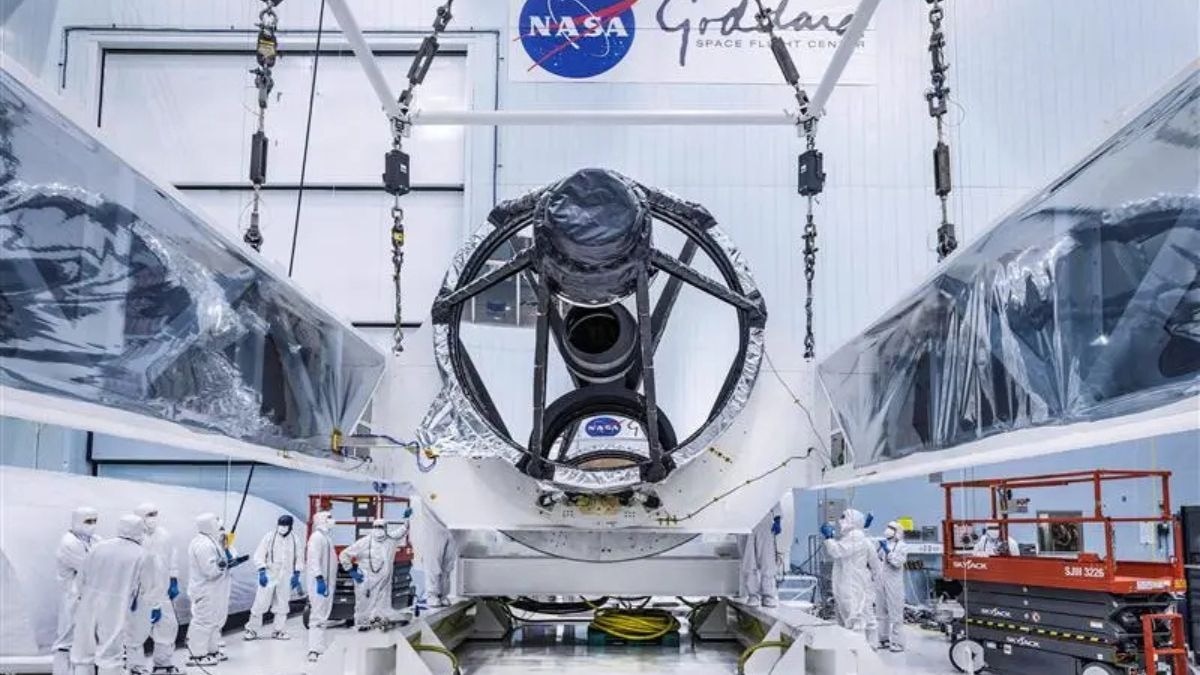
Currently, Nasa’s Nancy Grace Roman Space Telescope is undergoing final preparations at the Goddard Space Flight Center in Maryland.
The countdown is on for the Nancy Grace Roman Space Telescope.
An artist’s impression of the Nancy Grace Roman Space Telescope as it prepares to map the cosmos.
Nasa has announced that the Nancy Grace Roman Space Telescope is set to launch on August 30, 2026.
The Nancy Grace Roman Space Telescope will provide us with a clearer picture of our place in the cosmos.
The universe is preparing to reveal its deepest secrets, and the countdown has officially begun. A Nasa mission is arriving eight months ahead of schedule, marking a significant milestone in our quest to understand the vast, dark corners of space.
Currently, Nasa’s Nancy Grace Roman Space Telescope is undergoing final preparations at the Goddard Space Flight Center in Maryland.
Engineers are meticulously packing the observatory for its journey to the Kennedy Space Center in Florida.
Read Full Story
Once it arrives, the telescope will enter the Payload Hazardous Servicing Facility. The countdown is on for the Nancy Grace Roman Space Telescope. Nasa confirmed the mission will launch on August 30 to unlock the mysteries of dark energy and distant worlds. (Photo: Nasa)
.
This specialised building is designed for the safe handling of spacecraft that contain hazardous materials, such as rocket fuel.
At this facility, teams will conduct thorough inspections to ensure that every component survives the transit across the country without damage.
The engineers will perform powered testing and launch rehearsals to verify that the observatory is ready for its complex mission.
A critical part of this process involves loading approximately 1,100 litres of hydrazine fuel into the tanks.
Hydrazine is a propellant commonly used in spacecraft to perform manoeuvres and maintain the correct orientation in space.
DESTINATION L2
After the testing phase, the telescope will be shielded by a protective fairing. Think of this fairing as a massive, aerodynamic nose cone that protects the delicate telescope from the intense pressure and heat experienced during the rocket launch through the atmosphere.
It will then be integrated with a SpaceX Falcon Heavy rocket and moved to Launch Pad 39A.
The rocket will propel Roman to the second Sun-Earth Lagrange point, or L2. This is a special location in space, situated about 1.5 million kilometres away from Earth. An artist’s impression of the Nancy Grace Roman Space Telescope as it prepares to map the cosmos. (Photo: Nasa)
At L2, the gravitational pull of the Sun and the Earth balance out with the motion of the spacecraft.
This allows the telescope to remain in a stable position with minimal fuel consumption.
advertisement
It is about four times farther away from Earth than the distance between us and the Moon, providing an unobstructed view of the deep universe.
Nasa has announced that the Nancy Grace Roman Space Telescope is set to launch on August 30, 2026.
A NEW WINDOW INTO THE UNKNOWN
Once it reaches its destination, the Roman telescope will begin its five-year mission to survey vast sections of the sky. It is designed to peer through cosmic dust using crisp infrared vision.
By detecting infrared light, which has longer wavelengths than visible light, the telescope can see objects that are hidden behind thick clouds of gas and dust. Infrared sensors will allow the Nancy Grace Roman Space Telescope to capture stunning images of distant galaxies and hidden stars. (Photo: Nasa)
Scientists aim to study dark energy, a mysterious force that is causing the expansion of the universe to accelerate.
The mission will also hunt for planets outside our solar system, known as exoplanets, and observe black holes.
The Nancy Grace Roman Space Telescope will provide us with a clearer picture of our place in the cosmos.
- Ends
Published By: Radifah Kabir Published On: Jun 4, 2026 19:53 IST