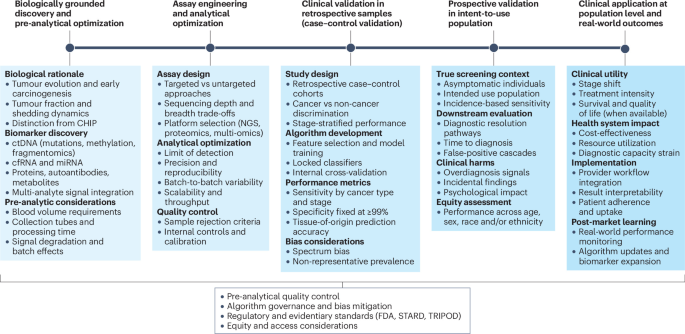
Wan, J. C. M., Sasieni, P. & Rosenfeld, N. Promises and pitfalls of multi-cancer early detection using liquid biopsy tests.
Huang, C. C. et al.
Owens, L., Gulati, R. & Etzioni, R. Stage shift as an endpoint in cancer screening trials: implications for evaluating multicancer early detection tests.
Multiyear clinical outcomes of cancers diagnosed following detection by a blood-based multicancer early detection test.
Sempere, L. F. Ethical considerations and implications of multi-cancer early detection screening: reliability, access and cost to test and treat.
World Health Organization. Global health estimates: leading causes of death. The Global Health Observatory https://www.who.int/data/gho/data/themes/mortality-and-global-health-estimates/ghe-leading-causes-of-death (WHO, 2025).
Zhang, L. et al. CanScreen5, a global repository for breast, cervical and colorectal cancer screening programs. Nat. Med. 29, 1135–1145 (2023).
Pinsky, P. F. Principles of cancer screening. Surg. Clin. North Am. 95, 953–966 (2015).
Santamaria, S. et al. New insight in early detection and precision medicine in small cell lung cancer: liquid biopsy as innovative clinical tool. Crit. Rev. Clin. Lab. Sci. 62, 404–428 (2025).
Rous, B., Clarke, C. A., Hubbell, E. & Sasieni, P. Assessment of the impact of multi-cancer early detection test screening intervals on late-stage cancer at diagnosis and mortality using a state-transition model. BMJ Open 15, e086648 (2025).
Li, S. et al. Clinical validation of a noninvasive multi-omics method for multicancer early detection in retrospective and prospective cohorts. J. Mol. Diagn. 27, 657–670 (2025).
Lemmo, D. et al. Iterative situated engagement perspective: meaning-making challenges across cancer screening phases. Cancers 17, 2007 (2025).
Klein, E. A., Church, T. R., Clarke, C. A. & Hubbell, E. Modeled benefit of individual cancer signal origin prediction for multi-cancer early detection. Cancer Res. Commun. 5, 814–824 (2025).
Goswami, P. K., Kumar, R., Kumar, D. & Dhiman, S. Analytical techniques as indicators of biomarkers in proteomics cancer diagnosis. Anticancer Agents Med. Chem. 26, 186–201 (2026).
Dama, E. et al. A plasma 9-microRNA signature for lung cancer early detection: a multicenter analysis. Biomark. Res. 13, 74 (2025).
Brito-Rocha, T. et al. Multi-cancer early detection via a DNA methylation multiplex ddPCR-based blood test. Int. J. Cancer 157, 1006–1019 (2025).
Wan, J. C. M., Sasieni, P. & Rosenfeld, N. Promises and pitfalls of multi-cancer early detection using liquid biopsy tests. Nat. Rev. Clin. Oncol. 22, 566–580 (2025).
USPST. Recommendations. U.S. Preventive Services Task Force https://www.uspreventiveservicestaskforce.org/uspstf/topic_search_results?topic_status=P (2025).
Wan, J. C. M. et al. Liquid biopsies come of age: towards implementation of circulating tumour DNA. Nat. Rev. Cancer 17, 223–238 (2017).
Diaz, L. A. Jr & Bardelli, A. Liquid biopsies: genotyping circulating tumor DNA. J. Clin. Oncol. 32, 579–586 (2014).
Bettegowda, C. et al. Detection of circulating tumor DNA in early- and late-stage human malignancies. Sci. Transl. Med. 6, 224ra24 (2014).
Shen, S. Y. et al. Sensitive tumour detection and classification using plasma cell-free DNA methylomes. Nature 563, 579–583 (2018).
Heitzer, E., Haque, I. S., Roberts, C. E. S. & Speicher, M. R. Current and future perspectives of liquid biopsies in genomics-driven oncology. Nat. Rev. Genet. 20, 71–88 (2019).
Schwarzenbach, H., Nishida, N., Calin, G. A. & Pantel, K. Clinical relevance of circulating cell-free microRNAs in cancer. Nat. Rev. Clin. Oncol. 11, 145–156 (2014).
Schmitt, A. M. & Chang, H. Y. Long noncoding RNAs in cancer pathways. Cancer Cell 29, 452–463 (2016).
Qi, P. & Du, X. Circulating long non-coding RNAs in cancer: current status and future perspectives. Mol. Cancer 15, 39 (2016).
Lu, J. et al. MicroRNA expression profiles classify human cancers. Nature 435, 834–838 (2005).
Iyer, M. K. et al. The landscape of long noncoding RNAs in the human transcriptome. Nat. Genet. 47, 199–208 (2015).
Esteller, M. Non-coding RNAs in human disease. Nat. Rev. Genet. 12, 861–874 (2011).
Rifai, N., Gillette, M. A. & Carr, S. A. Protein biomarker discovery and validation: the long and uncertain path to clinical utility. Nat. Biotechnol. 24, 971–983 (2006).
Lennon, A. M. et al. Feasibility of blood testing combined with PET-CT to screen for cancer and guide intervention. Science 369, eabb9601 (2020).
Kulasingam, V. & Diamandis, E. P. Strategies for discovering novel cancer biomarkers through utilization of emerging technologies. Nat. Clin. Pract. Oncol. 5, 588–599 (2008).
Johnson, P. J. The role of serum alpha-fetoprotein estimation in the diagnosis and management of hepatocellular carcinoma. Clin. Liver Dis. 5, 145–159 (2001).
Duffy, M. J. CEA as a marker for colorectal cancer: is it clinically useful? Clin. Chem. 47, 624–630 (2001).
Cohen, J. D. et al. Detection and localization of surgically resectable cancers with a multi-analyte blood test. Science 359, 926–930 (2018).
Bast, R. C. Jr et al. A radioimmunoassay using a monoclonal antibody to monitor the course of epithelial ovarian cancer. N. Engl. J. Med. 309, 883–887 (1983).
Zhou, W., Sailor, M. J. & Fang, X. Extracellular vesicle-based liquid biopsies in cancer: opportunities and challenges. Nat. Nanotechnol. 18, 230–245 (2023).
Zhang, W. et al. Liquid biopsy for cancer: circulating tumor cells, circulating free DNA or exosomes? Cell. Physiol. Biochem. 41, 755–768 (2017).
Théry, C. et al. Minimal information for studies of extracellular vesicles 2018 (MISEV2018): a position statement of the International Society for Extracellular Vesicles and update of the MISEV2014 guidelines. J. Extracell. Vesicles 7, 1535750 (2018).
Melo, S. A. et al. Glypican-1 identifies cancer exosomes and detects early pancreatic cancer. Nature 523, 177–182 (2015).
Kalluri, R. & LeBleu, V. S. The biology, function, and biomedical applications of exosomes. Science 367, eaau6977 (2020).
Liu, M. C. et al. Sensitive and specific multi-cancer detection and localization using methylation signatures in cell-free DNA. Ann. Oncol. 31, 745–759 (2020).
Sahoo, K. et al. Artificial intelligence in cancer epigenomics: a review on advances in pan-cancer detection and precision medicine. Epigenetics Chromatin 18, 35 (2025).
Huang, C. C. et al. Artificial intelligence in cancer diagnosis and prognosis: opportunities and challenges. Cancer Lett. 562, 216149 (2023).
Cristiano, S. et al. Genome-wide cell-free DNA fragmentation in patients with cancer. Nature 570, 385–389 (2019).
Elguoshy, A., Zedan, H. & Saito, S. Machine learning-driven insights in cancer metabolomics: from subtyping to biomarker discovery and prognostic modeling. Metabolites 15, 514 (2025).
Feng, Z. & Pepe, M. S. Adding rigor to biomarker evaluations—EDRN experience. Cancer Epidemiol. Biomark. Prev. 29, 2575–2582 (2020).
Doubeni, C. A. et al. Development and evaluation of safety and effectiveness of novel cancer screening tests for routine clinical use with applications to multicancer detection technologies. Cancer 128, 883–891 (2022).
Zafar, S. et al. Emerging biomarkers for early cancer detection and diagnosis: challenges, innovations, and clinical perspectives. Eur. J. Med. Res. 30, 760 (2025).
Yang, Z., Zhou, J. C., Chen, R. & Wei, W. W. Dentification and correction of the lead-time bias and length bias in cancer screening studies. Zhonghua Yu Fang Yi Xue Za Zhi 53, 1183–1187 (2019).
Kamineni, A. et al. Evaluation of harms reporting in U.S. cancer screening guidelines. Ann. Intern. Med. 175, 1582–1590 (2022).
Weberpals, J. et al. Immortal time bias in pharmacoepidemiological studies on cancer patient survival: empirical illustration for beta-blocker use in four cancers with different prognosis. Eur. J. Epidemiol. 32, 1019–1031 (2017).
Guittet, L. et al. Should we screen for colorectal cancer in people aged 75 and over? A systematic review - collaborative work of the French geriatric oncology society (SOFOG) and the French federation of digestive oncology (FFCD). BMC Cancer 23, 17 (2023).
Feng, X. et al. Cancer stage compared with mortality as end points in randomized clinical trials of cancer screening: a systematic review and meta-analysis. JAMA 331, 1910–1917 (2024).
Dai, J. Y. et al. Strong association between reduction of late-stage cancers and reduction of cancer-specific mortality in meta-regression of randomized screening trials across multiple cancer types. J. Med. Screen. 31, 211–222 (2024).
Owens, L., Gulati, R. & Etzioni, R. Stage shift as an endpoint in cancer screening trials: implications for evaluating multicancer early detection tests. Cancer Epidemiol. Biomark. Prev. 31, 1298–1304 (2022).
Kahwati, L. C. et al. Blood-Based Tests for Multiple Cancer Screening: A Systematic Review (Agency for Healthcare Research and Quality, 2025).
Callister, M. E. J., Crosbie, E. J., Crosbie, P. A. J. & Robbins, H. A. Evaluating multi-cancer early detection tests: an argument for the outcome of recurrence-updated stage. Br. J. Cancer 129, 1209–1211 (2023).
Shaukat, A. et al. Long-term mortality after screening for colorectal cancer. N. Engl. J. Med. 369, 1106–1114 (2013).
Shaukat, A. et al. Endoscopic recognition and management strategies for malignant colorectal polyps: recommendations of the US Multi-Society Task Force on Colorectal Cancer. Gastroenterology 159, 1916–1934.e2 (2020).
Buskermolen, M. et al. Colorectal cancer screening with faecal immunochemical testing, sigmoidoscopy or colonoscopy: a microsimulation modelling study. BMJ 367, l5383 (2019).
Bretthauer, M. et al. Effect of colonoscopy screening on risks of colorectal cancer and related death. N. Engl. J. Med. 387, 1547–1556 (2022).
Bibbins-Domingo, K. et al. Screening for colorectal cancer: US Preventive Services Task Force Recommendation Statement. JAMA 315, 2564–2575 (2016).
Loberg, M. et al. Long-term colorectal-cancer mortality after adenoma removal. N. Engl. J. Med. 371, 799–807 (2014).
Levin, T. R. et al. Effects of organized colorectal cancer screening on cancer incidence and mortality in a large community-based population. Gastroenterology 155, 1383–1391.e5 (2018).
Chung, D. C. et al. A cell-free DNA blood-based test for colorectal cancer screening. N. Engl. J. Med. 390, 973–983 (2024).
Shaukat, A. et al. Clinical validation of a circulating tumor DNA-based blood test to screen for colorectal cancer. JAMA 334, 56–63 (2025).
Hackshaw, A., Clarke, C. A. & Hartman, A. R. New genomic technologies for multi-cancer early detection: rethinking the scope of cancer screening. Cancer Cell 40, 109–113 (2022).
Lippi, G. & Mattiuzzi, C. The global burden of pancreatic cancer. Arch. Med. Sci. 16, 820–824 (2020).
Ramai, D. et al. Epidemiology and socioeconomic impact of pancreatic cancer: an analysis of the Global Burden of Disease Study 1990–2019. Dig. Dis. Sci. 69, 1135–1142 (2024).
He, R. et al. Global burden of pancreatic cancer attributable to metabolic risks from 1990 to 2019, with projections of mortality to 2030. BMC Public Health 24, 456 (2024).
Ojha, S., Sessions, W., Zhou, Y. & Aung, K. L. ctDNA in pancreatic adenocarcinoma: a critical appraisal. Curr. Oncol. 32, 589 (2025).
Shumka, N. & Karagyozov, P. I. Cystic tumors of the pancreas: current perspectives on diagnosis and management. World J. Gastroenterol. 31, 111393 (2025).
Ho, A. L. K. & Smyth, E. C. A global perspective on oesophageal cancer: two diseases in one. Lancet Gastroenterol. Hepatol. 5, 521–522 (2020).
Sung, H. et al. Global cancer statistics 2020: GLOBOCAN estimates of incidence and mortality worldwide for 36 cancers in 185 countries. CA Cancer J. Clin. 71, 209–249 (2021).
Liu, C. Q. et al. Epidemiology of esophageal cancer in 2020 and projections to 2030 and 2040. Thorac. Cancer 14, 3–11 (2023).
Rojanasopondist, P., Kaz, A., Yu, M. & Grady, W. M. Emerging biomarkers for managing Barrett’s esophagus. Gastrointest. Endosc. Clin. North Am. 36, 149–170 (2026).
Hennedige, T. & Venkatesh, S. K. Imaging of hepatocellular carcinoma: diagnosis, staging and treatment monitoring. Cancer Imaging 12, 530–547 (2013).
Ahmed, T. M. et al. Hidden in plain sight: commonly missed early signs of pancreatic cancer on CT. Abdom. Radiol. 49, 3599–3614 (2024).
Woolf, K. M. et al. False-negative rate of endoscopic ultrasound-guided fine-needle aspiration for pancreatic solid and cystic lesions with matched surgical resections as the gold standard: one institution’s experience. Cancer Cytopathol. 121, 449–458 (2013).
Straum, S., Wollan, K., Rekstad, L. C. & Fossmark, R. Esophageal cancers missed at upper endoscopy in Central Norway 2004 to 2021—a population-based study. BMC Gastroenterol. 24, 279 (2024).
Chadwick, G. et al. A population-based, retrospective, cohort study of esophageal cancer missed at endoscopy. Endoscopy 46, 553–560 (2014).
Brito-Rocha, T., Constancio, V., Henrique, R. & Jeronimo, C. Shifting the cancer screening paradigm: the rising potential of blood-based multi-cancer early detection tests. Cells 12, 935 (2023).
Schrag, D. et al. Blood-based tests for multicancer early detection (PATHFINDER): a prospective cohort study. Lancet 402, 1251–1260 (2023).
Nima et al. Safety and performance of a multi-cancer early detection (MCED) test in an intended-use population: initial results from the registrational PATHFINDER 2 study. Ann. Oncol. 36, 59–60 (2025).
Buchanan, A. H. et al. Multiyear clinical outcomes of cancers diagnosed following detection by a blood-based multicancer early detection test. Cancer Prev. Res. 17, 349–353 (2024).
National Institutes of Health. FDA-approved tests. Early Detection Research Network https://edrn.cancer.gov/about-edrn/fda-approved-tests/ (2026).
Neal, R. D. et al. Cell-free DNA-based multi-cancer early detection test in an asymptomatic screening population (NHS-Galleri): design of a pragmatic, prospective randomised controlled trial. Cancers 14, 4818 (2022).
Sasieni, P. et al. Effect of screening with multicancer early-detection test on late-stage cancer diagnosis. N. Engl. J. Med. 395, 1374–1386 (2026).
Neal, R. D. et al. Performance of a multi-cancer early detection test in the randomized controlled NHS-Galleri trial. Nat. Med. 32, 3770–3780 (2026).
Rubinstein, W. S. et al. Cancer screening with multicancer detection tests: a translational science review. CA Cancer J. Clin. 74, 368–382 (2024).
Crowley, E., Di Nicolantonio, F., Loupakis, F. & Bardelli, A. Liquid biopsy: monitoring cancer-genetics in the blood. Nat. Rev. Clin. Oncol. 10, 472–484 (2013).
Genovese, G. et al. Clonal hematopoiesis and blood-cancer risk inferred from blood DNA sequence. N. Engl. J. Med. 371, 2477–2487 (2014).
Razavi, P. et al. High-intensity sequencing reveals the sources of plasma circulating cell-free DNA variants. Nat. Med. 25, 1928–1937 (2019).
Phallen, J. et al. Direct detection of early-stage cancers using circulating tumor DNA. Sci. Transl. Med. 9, eaan2415 (2017).
Li, W. et al. Plasma cfDNA: a promising biomarker for early cancer detection. Trends Mol. Med. 27, 882–894 (2021).
Lam, N. Y. L., Rainer, T. H., Chiu, R. W. K. & Lo, Y. M. D. EDTA is a better anticoagulant than heparin or citrate for delayed blood processing for plasma DNA analysis. Clin. Chem. 50, 256–257 (2004).
Jahr, S. et al. DNA fragments in the blood plasma of cancer patients: quantitations and evidence for their origin from apoptotic and necrotic cells. Cancer Res. 61, 1659–1665 (2001).
Bronkhorst, A. J., Aucamp, J. & Pretorius, P. J. Cell-free DNA: preanalytical variables. Clin. Chim. Acta 450, 243–253 (2015).
Jaiswal, S. & Ebert, B. L. Clonal hematopoiesis in human aging and disease. Science 366, eaan4673 (2019).
Wolde, T., Bhardwaj, V. & Pandey, V. Current bioinformatics tools in precision oncology. MedComm 6, e70243 (2025).
Pedro, B. A. & Wood, L. D. Early neoplastic lesions of the pancreas: initiation, progression, and opportunities for precancer interception. J. Clin. Invest. 135, e191937 (2025).
Lotterhos, K. E., Moore, J. H. & Stapleton, A. E. Analysis validation has been neglected in the Age of Reproducibility. PLoS Biol. 16, e3000070 (2018).
White, T. & Algeri, S. Estimating the lifetime risk of a false positive screening test result. PLoS ONE 18, e0281153 (2023).
Sierra, M. S. et al. Assessing the rates of false-positive ovarian cancer screenings and surgical interventions associated with screening tools: a systematic review. BMJ Oncol. 3, e000404 (2024).
Lennon, A. M. et al. Outcomes following a false-positive multi-cancer early detection test: results from DETECT-A, the first large, prospective, interventional MCED study. Cancer Prev. Res. 17, 355–359 (2024).
Sempere, L. F. Ethical considerations and implications of multi-cancer early detection screening: reliability, access and cost to test and treat. Camb. Q. Healthc. Ethics 34, 489–498 (2025).