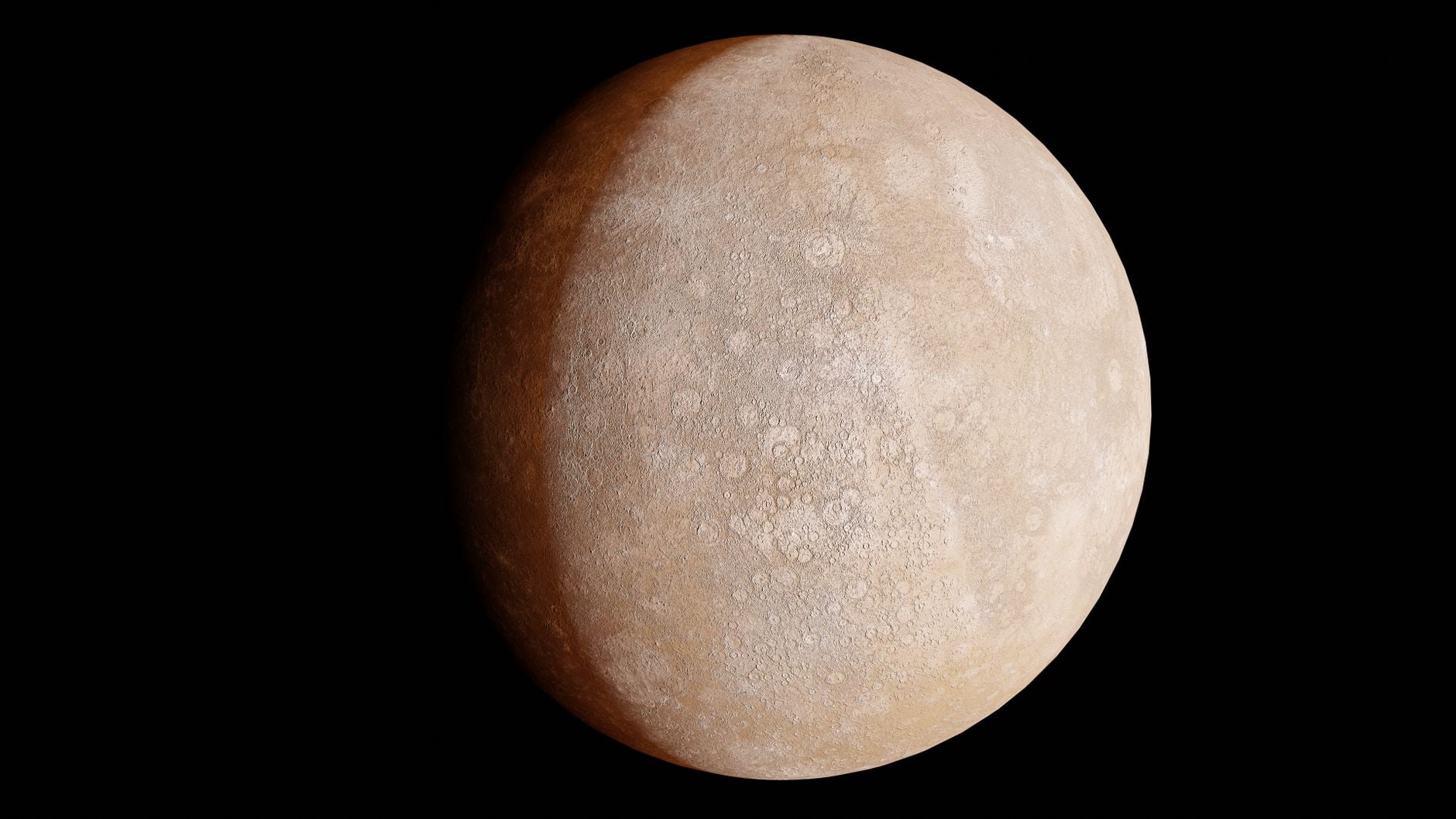
Long, curving cliffs cut through craters and plains because the small planet lost internal heat, contracted and forced sections of its crust over one another.
It describes an estimated reduction in the planet’s radius over billions of years, not seven kilometres shaved from its diameter.
Its metallic core has a radius of about 2,074 kilometres, roughly 85 per cent of the planet’s radius, according to NASA’s Mercury overview.
Planets retain heat from their formation, the separation of materials in their interiors and the decay of radioactive elements.
Early estimates based on that incomplete coverage suggested the planet’s radius had decreased by roughly one to two kilometres.
Mercury carries the record of planetary cooling across its surface. Long, curving cliffs cut through craters and plains because the small planet lost internal heat, contracted and forced sections of its crust over one another.
The widely quoted description is that Mercury has shrunk by as much as seven kilometres. That figure comes from a 2014 analysis of observations made by NASA’s MESSENGER spacecraft, but it needs two qualifications. It describes an estimated reduction in the planet’s radius over billions of years, not seven kilometres shaved from its diameter. It is also the high end of a scientific argument that remains active.
What is not seriously in doubt is the underlying picture. Mercury cooled, its interior occupied less volume, and its rigid outer shell had to fit around a smaller world. The disagreement concerns how much shortening the visible geology records.
How a cooling planet makes a cliff
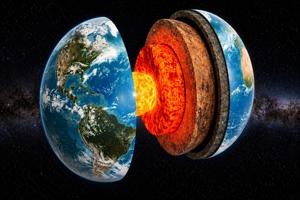
Mercury is unusual even among rocky planets. Its metallic core has a radius of about 2,074 kilometres, roughly 85 per cent of the planet’s radius, according to NASA’s Mercury overview. Evidence indicates that part of this enormous core is still molten. The rocky mantle and crust above it form an outer shell only about 400 kilometres thick.
Planets retain heat from their formation, the separation of materials in their interiors and the decay of radioactive elements. As Mercury lost that heat, its mantle and core cooled. Growth of a solid inner core may also have contributed to the reduction in volume. The process was not simply the iron core drawing inward while the rest of the planet stayed put. Cooling affected the interior as a system, and the rocky shell responded to the resulting global compression.
Mercury does not have Earth’s network of mobile tectonic plates. Its lithosphere behaves broadly as a single plate, so it cannot distribute compression through plate boundaries. Instead, thrust faults developed. One block of crust was pushed up and over another. Where such a fault breaks the surface, it produces a steep, often curved landform known as a lobate scarp.
The word “wrinkling” captures the basic geometry, though it understates the scale. MESSENGER images show scarps hundreds of kilometres long. NASA’s general description says some extend for hundreds of miles and rise as much as a mile. Enterprise Rupes, the largest mapped fault scarp on the planet, is about 1,000 kilometres long and has more than three kilometres of relief in places.
Seven kilometres was an estimate, not a direct measurement
Mariner 10 made three Mercury flybys in 1974 and 1975, but photographed less than half of the surface. Early estimates based on that incomplete coverage suggested the planet’s radius had decreased by roughly one to two kilometres. MESSENGER changed the available evidence. It flew past Mercury three times and then orbited the planet from 2011 until 2015, returning the near-global images and topography needed for a much wider tectonic inventory.
In a 2014 Nature Geoscience paper, Paul Byrne and colleagues counted not only prominent lobate scarps but long belts of ridges and other shortening structures. They estimated that the observed deformation was consistent with a reduction in radius of as much as seven kilometres, compared with the 0.8 to three kilometres reported in earlier photogeological studies.
No instrument directly measured Mercury at two ancient dates and subtracted one radius from the other. Researchers infer contraction from the accumulated shortening recorded in folds and faults, then scale those measurements across the planet. The answer changes when the geological catalogue changes, when a surface feature is assigned one fault rather than several, or when the assumed angle of an unseen fault is adjusted.
The same landscape supports a much smaller estimate
Thomas Watters offered a substantially different reading in a 2021 paper in Communications Earth & Environment. He argued that some positive-relief features included in the larger inventories were not demonstrably created by deep tectonic deformation. Wrinkle ridges in smooth volcanic plains, for example, can also reflect local subsidence, loading and bending of the lithosphere.
Watters assigned one principal fault to each clearly contractional landform and excluded structures he considered local or ambiguous. That approach produced a radius reduction of about one to two kilometres. In this interpretation, a heavily fractured surface layer and insulating material around the core helped Mercury retain heat, allowing its interior to cool and contract slowly.
The difference is large, but it is not a simple contest between old and new numbers. A smaller catalogue contains features that are easier to defend as global thrust faults, while a broader catalogue attempts to capture shortening that may be distributed through less obvious ridges. Both approaches must make assumptions about structures that cannot be excavated or measured directly.
A 2026 analysis brought the estimate back near six kilometres
The newest substantial contribution makes the seven-kilometre headline more defensible, while also showing why it should remain qualified. In April 2026, Adrien Broquet and Jeffrey Andrews-Hanna published a machine-learning-assisted analysis in the Journal of Geophysical Research: Planets. Their method used topography to estimate ridge heights, removed small secondary features close to longer primary structures and accounted for the directions in which faults released strain.
When the catalogue included wrinkle ridges, the resulting estimate was about 6.3 kilometres of global contraction. When those ridges were excluded, it fell to about 1.2 kilometres. The authors also calculated that most rapid contraction occurred between about 4.1 and 3.9 billion years ago, followed by much lower rates.
This is a useful result because it exposes the hinge in the debate. The question is not whether Mercury’s scarps exist or whether cooling contributed to them. It is whether the smaller ridges in its volcanic plains preserve part of the planet-wide loss of volume or mostly record local flexure and shallow faulting.
“Is shrinking” does not mean anyone watched it happen
Most of Mercury’s contraction belongs to deep geological time. There is nevertheless evidence that tectonic movement continued much later than the main early pulse. A 2023 Nature Geoscience study identified small troughs called grabens on top of many larger contractional structures. Because small features are readily erased by impacts, their preservation was interpreted as evidence of geologically recent movement.
That paper supports prolonged, slow cooling and contraction. It does not document a present-day Mercury quake, nor does it establish an annual shrinkage rate that could be watched from Earth. In planetary geology, “recent” can cover hundreds of millions of years. Present-tense shorthand should not be mistaken for a live measurement.
The next close look is approaching
The contraction estimate matters because it places limits on Mercury’s thermal history. A planet that lost six or seven kilometres of radius must have shed and reorganised more internal heat than one that lost only one or two. The timing also bears on when its inner core began to solidify and how Mercury has sustained a weak global magnetic field despite its small size.
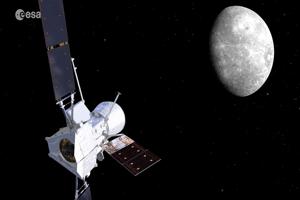
The joint ESA-JAXA BepiColombo mission is now approaching Mercury and is scheduled to begin entering orbit in November 2026. Its two orbiters are expected to start full science operations in April 2027. High-resolution stereo imaging, laser altimetry, gravity measurements and magnetic observations should give researchers a better view of the scarps and the interior that produced them.
Mercury’s cliffs are the physical record of a world adjusting to lost heat. Some run farther than the distance between major cities and rise higher than many terrestrial mountains, yet together they encode a change of only a fraction of one per cent in the planet’s radius. Mercury has contracted. Whether the best total is closer to one kilometre or seven remains written, imperfectly, in its wrinkles.