The biggest selling point of this MacBook Pro is Apple's new M6 chip, which we've already seen in the recent Mac mini.
Basically, you don't need to throw out your M5 MacBook Pro anytime soon.
Those are the current top-end options since Apple hasn't yet launched faster M6 Pro or Max chips yet.
Beyond the new M6 chip, the 14-inch MacBook Pro has all of the same hardware as the previous systems.
At 3.4 pounds, it's not significantly different from the slimmer 3-pound 14-inch PROLED MacBook Pro.
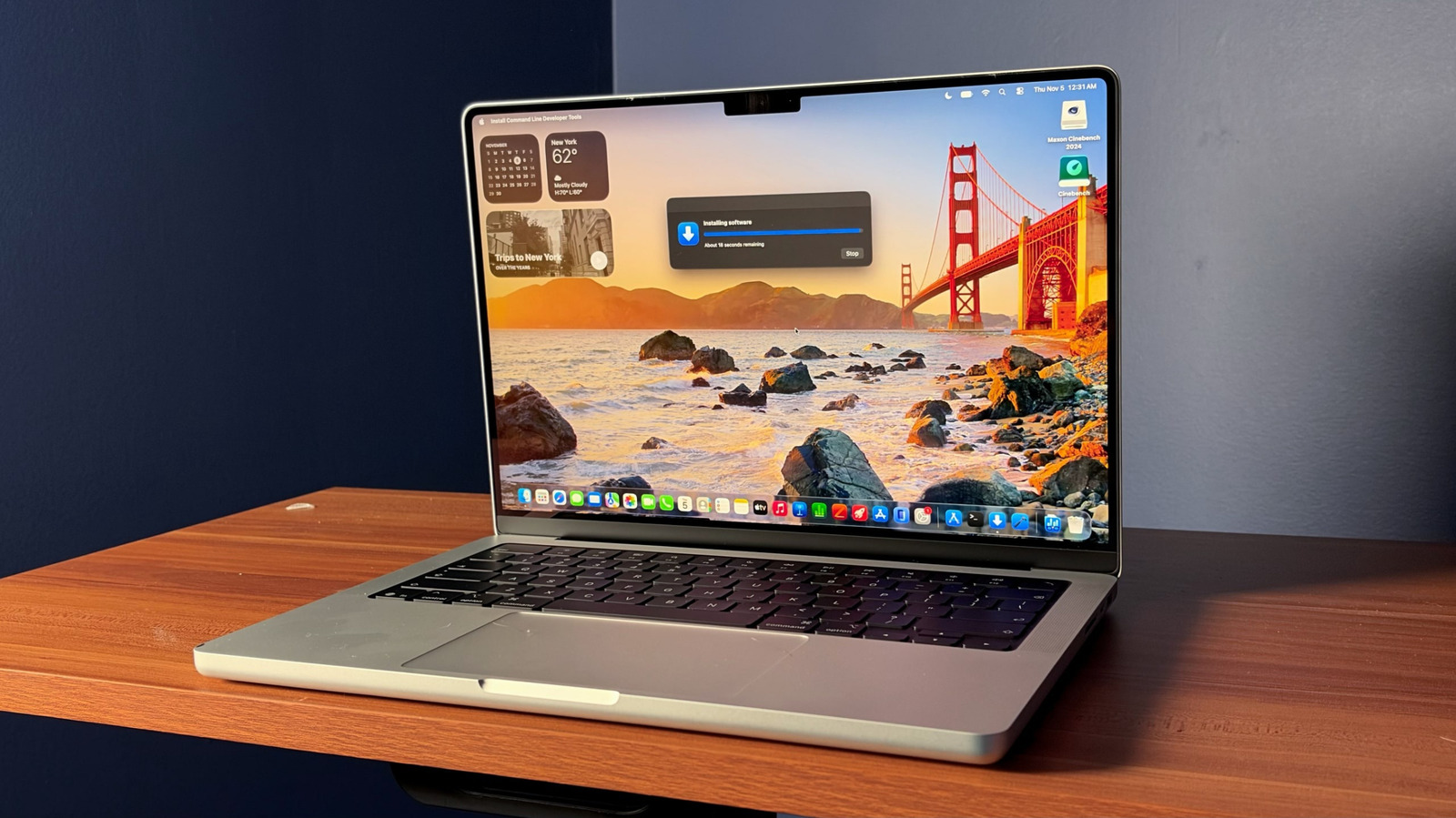
The biggest selling point of this MacBook Pro is Apple's new M6 chip, which we've already seen in the recent Mac mini. It's a 12-core CPU, 12-core GPU system-on-a-chip, which is slightly more powerful than last year's M5 chip and its 10 CPU cores and 10 GPU cores. The CPU is made up of two super cores for single-threaded work, four performance cores for more intensive multithreaded tasks and six efficiency cores for background tasks. The M6 chip also features dual 16-core neural engines for the first time, which helps to make it twice as fast at AI tasks compared to the M5 chip, according to Apple.
Apple's own benchmarks suggest otherwise modest gains for the M6 chip. The company claims that it's 11.7x faster at 3D rendering compared to the M1 MacBook Pro, while the M5 chip is 9.2x faster than that older system. The M6 is reportedly 3.2x faster while playing Cyberpunk 2077 compared to the M1 system, whereas the M5 was 2.5x faster. Basically, you don't need to throw out your M5 MacBook Pro anytime soon.
Just like with the Mac mini, you'll have to bump up to the M5 Pro or M5 Max chips if you want more power, as those have significantly more CPU and GPU horsepower. Those are the current top-end options since Apple hasn't yet launched faster M6 Pro or Max chips yet. You also get faster RAM performance by jumping to the M5 Pro or Max. The M6 tops out at 32GB of RAM running at 170 GB/s, while the M5 Pro can fit in 64GB at 307 GB/s.
Beyond the new M6 chip, the 14-inch MacBook Pro has all of the same hardware as the previous systems. There's the MiniLED Liquid Retina screen with a 120Hz ProMotion refresh rate, sturdy unibody case and healthy port selection (three Thunderbolt 4 USB-C ports, a MagSafe charging connection, HDMI, headphone jack and an SD card slot). At 3.4 pounds, it's not significantly different from the slimmer 3-pound 14-inch PROLED MacBook Pro.
Though we've seen most of this hardware before, I don't mean to dismiss it. There's certainty in battle-tested hardware designs, and for years Apple has schooled most PC makers when it comes to overall hardware quality.