Trump said US is considering to change the name of Lake Ontario.
Thank you for your attention to this matter!âTrump's remark came amid a growing war of words between Washington and Ottawa after Canadian Prime Minister Mark Carney walked away from trade negotiations with the Trump administration late Friday.
In fact, I have never even thought of doing such a stupid thing.
I love French Canadians!â he added.Canada is preparing retaliatory tariffs against the US as the dispute widened.
And Russia.âTrump, meanwhile, accused Canada of exploiting the US and criticised its tariffs on American agricultural products.
Trump said US is considering to change the name of Lake Ontario.
Carney rejects US trade demands
Trade tensions deepen
Trump, Ontario premier trade barbs
Auto industry at centre of dispute
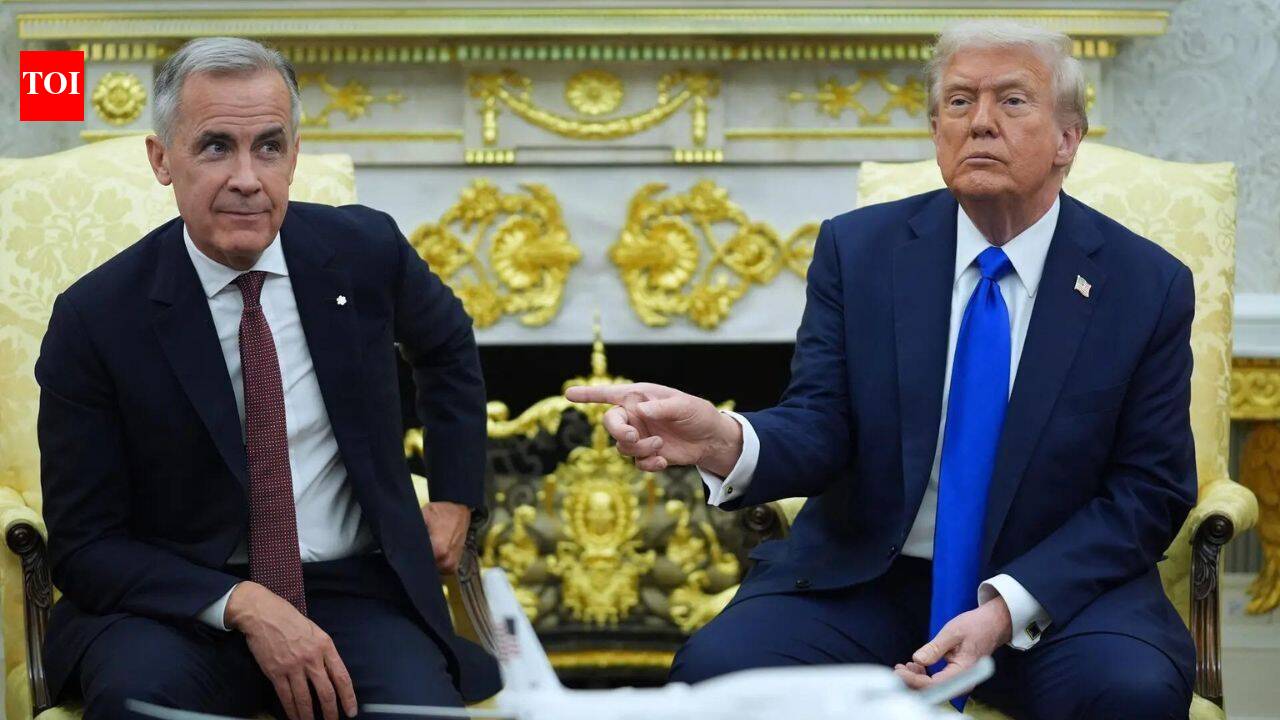
President Donald Trump on Tuesday said the United States was âgiving serious considerationâ to renaming Lake Ontario as Lake America, amid escalating trade dispute with Canada.In a post on Truth Social, Trump wrote, âThe United States is giving serious consideration to changing the name of Lake Ontario to Lake America in that we donât expect to doing much business with Ontario any longer. Thank you for your attention to this matter!âTrump's remark came amid a growing war of words between Washington and Ottawa after Canadian Prime Minister Mark Carney walked away from trade negotiations with the Trump administration late Friday. The move was followed by Trump's threatened 50% tariffs on about $20 billion worth of Canadian goods.Trump also pushed back against Carney's comments on French-language protections in Canada, saying in another Truth Social post, saying, âI would never interfere with Canadians speaking French! In fact, I have never even thought of doing such a stupid thing."âThis lie was made up by a weak and ineffective Prime Minister in an attempt to gain political support, which he has totally lost, from the people of Quebec. I love French Canadians!â he added.Canada is preparing retaliatory tariffs against the US as the dispute widened. Trump had earlier told Canadian leaders to âfall in lineâ or face consequences âfar worseâ than existing tariffs, while Carney accused Washington of trying to subordinate Canada.Trump has also threatened 50% tariffs on Canadian vehicles, auto parts and steel. Carney said the US proposals would damage key Canadian industries.âWe learned during the negotiations that the Americans want to destroy our major industries, including autos, steel and aluminum,â Carney said. âThat was one of the main reasons we said no. It was a bad deal.âCarney said Canada would not accept âan attitude at the negotiation table that Canada is a subsidiary of the United Statesâ and indicated that Ottawa could move away from matching US tariffs dollar for dollar, instead focusing on targeted measures to protect Canadian workers and businesses.He also criticised Washington's position on French-language and cultural protections, saying US negotiators viewed the French language as an âirritantâ.âFor Americans, French language, Francophone culture, Canadian culture, these are irritants,â Carney said in French at a news conference in Quebec. âHere in Quebec, here in Canada, these are rights.âThe dispute threatens one of the world's largest trading relationships, with the US and Canada closely linked through supply chains in automobiles, energy, agriculture and manufacturing.Carney questioned Washington's reliability as a trading partner, saying Canada was finding reliable partners âeverywhere in the world, except in the United States. Except in the United States. And Russia.âTrump, meanwhile, accused Canada of exploiting the US and criticised its tariffs on American agricultural products. He has also warned that tariffs on Canada's auto industry could take effect next year.Carney said the proposed US auto measures could gradually dismantle Canadian vehicle production, calling the existing cross-border industry âthe most successful automotive partnership in history.âOntario Premier Doug Ford has also joined the confrontation, saying Canadians were prepared to bear economic costs rather than give in to US pressure.âWeâre all in,â Ford told The Associated Press. âUp here, weâre at a fever pitch; everyoneâs in for an economic war. They know theyâre going to have to sacrifice.âTrump responded by attacking Ford personally, calling him âthe less charismatic, intelligent, and overall unimpressive brother of the late, great, Rob Ford,â and again referring to Carney as âGovernor Carneyâ.Ford dismissed the remarks, saying, âIf you think an insult from him hurts me? Well, bring it on, buddy, Iâm ready.âDespite political differences between Ford's Progressive Conservative Party and Carney's Liberal Party, the dispute has underscored broad political opposition in Canada to Trump's trade demands.Ford warned that Ontario could take further measures if the dispute worsens, including restricting electricity and critical mineral supplies to the US.âWe power 1.5 million homes and businesses,â Ford said. âEverythingâs on the table. Iâll do whatever it takes.âHe has previously used electricity exports as leverage, with Ontario imposing a 25% surcharge on electricity supplied to Michigan, Minnesota and New York during an earlier phase of the dispute.Ford also accused Trump of seeking to weaken Canadian industries and shift production to the US.âHe wants to bleed out every single sector and bring them down to the US,â Ford said.The automotive sector has emerged as one of the biggest flashpoints. Ontario is the centre of Canada's vehicle manufacturing industry, with major automakers including Ford, General Motors and Stellantis operating plants in the province.The industry is deeply integrated with US manufacturing, with auto parts crossing the border multiple times during production. Trump's threat of 50% tariffs on Canadian vehicles and parts could therefore affect manufacturers and workers on both sides of the border.US Trade Representative Jamieson Greer defended Washington's position, saying âthe only reason Canada has auto production in the first placeâ was the 1960s Auto Pact, under which Canada used access to its market to encourage vehicle production.Ford also said he had opposed a preliminary trade agreement being considered by Carney and rejected the idea of restoring American liquor to Ontario stores as part of a deal.âI wasnât going to put the booze back on the shelves,â Ford said. âI was ready to go out there and call a press conference ⦠and say Iâm not buckling over.âThe dispute has also raised concerns over Canadian sovereignty after Carney said Washington had sought language that could restrict Canada's ability to negotiate trade agreements with other countries.