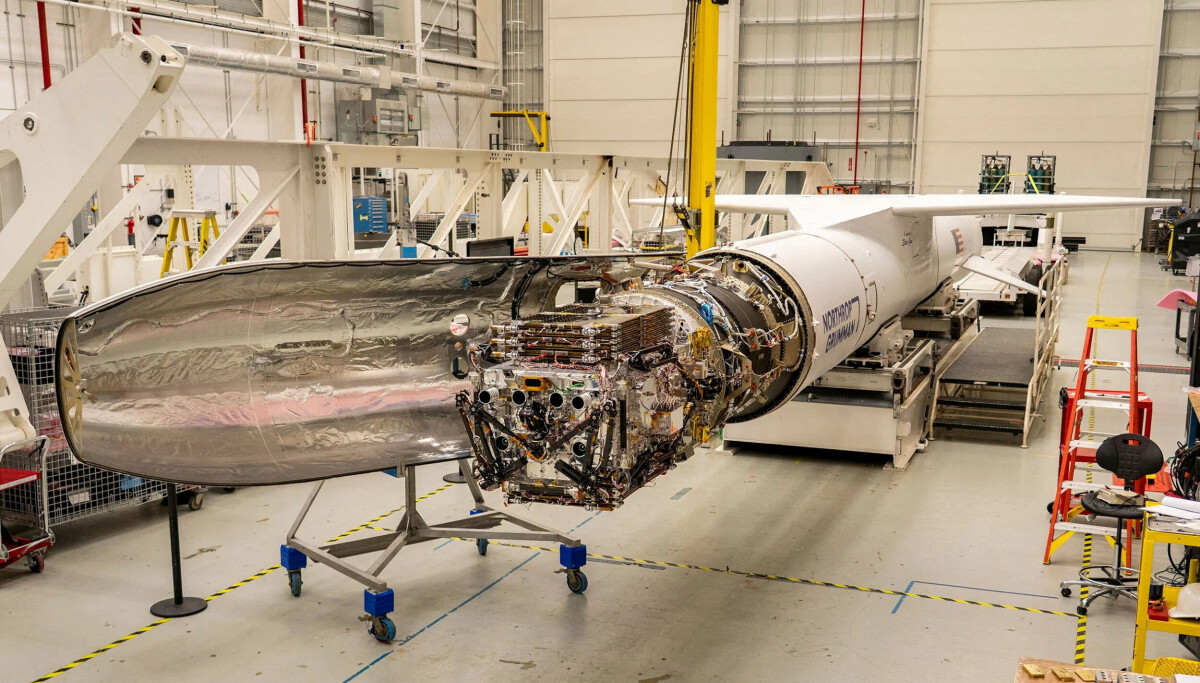
The special rescue spacecraft LINK, which flew on a failed mission designed to extend the life of NASA's Neil Gehrels Swift Observatory, in this image provided by NASA.
The spacecraft awaits encapsulation aboard a Northrop Grumman Pegasus XL at NASA's Wallops Flight Facility in Virginia on June 8.
REUTERS/YONHAPNASA’s defunct Neil Gehrels Swift Observatory is expected to reenter Earth’s atmosphere Wednesday evening, with Korea unlikely to be affected, according to KASA.
Korea will not be affected by NASA's Swift telescope crashing back to earth: KASAA defunct NASA telescope is expected to fall back to Earth on Wednesday evening, but it is highly unlikely the observatory will crash near the Korean Peninsula, Korea's space agency said.
The Neil Gehrels Swift Observatory, also known as the Swift telescope, is projected to reenter the Earth's atmosphere at around 8:46 p.m., the Korea AeroSpace Administration (KASA) said, citing an analysis from the Korea Astronomy and Space Science Institute (KASI).
The special rescue spacecraft LINK, which flew on a failed mission designed to extend the life of NASA's Neil Gehrels Swift Observatory, in this image provided by NASA. The spacecraft awaits encapsulation aboard a Northrop Grumman Pegasus XL at NASA's Wallops Flight Facility in Virginia on June 8. REUTERS/YONHAP
NASA’s defunct Neil Gehrels Swift Observatory is expected to reenter Earth’s atmosphere Wednesday evening, with Korea unlikely to be affected, according to KASA.
Korea will not be affected by NASA's Swift telescope crashing back to earth: KASA
A defunct NASA telescope is expected to fall back to Earth on Wednesday evening, but it is highly unlikely the observatory will crash near the Korean Peninsula, Korea's space agency said.
The Neil Gehrels Swift Observatory, also known as the Swift telescope, is projected to reenter the Earth's atmosphere at around 8:46 p.m., the Korea AeroSpace Administration (KASA) said, citing an analysis from the Korea Astronomy and Space Science Institute (KASI). The margin of error is two hours, it added.
Launched in 2004, the 1.5-ton telescope had been operating for the past 22 years on its mission to observe high-energy gamma-ray bursts.
The observatory, however, had been slowly falling out of orbit. In July, NASA attempted to send a private satellite to bump the telescope so it could regain some altitude, but the plan failed. Eventually, the telescope had reached the point of no return and was shut down on Oct. 20.
KASA said it plans to continue monitoring the Swift telescope's movements with the KASI, adding that most of the telescope's body is expected to burn up in the atmosphere, but some components will likely fall into the ocean.
Yonhap