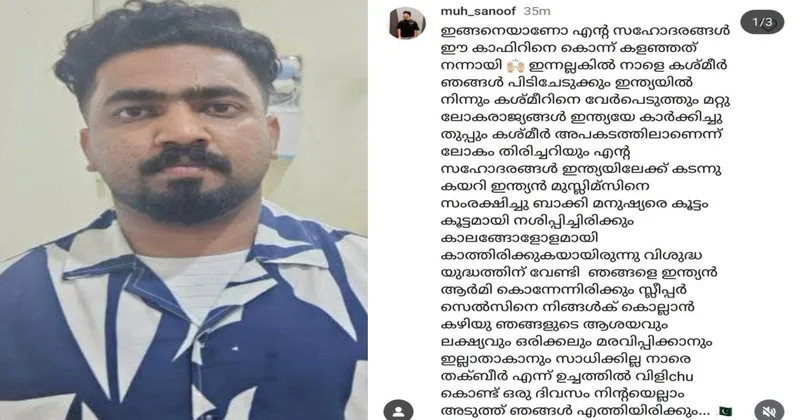
Kozhikode: Mohammed Sanoof Abdul Salim, a 26-year-old NRI from Keralam, was arrested by Keralam Police at Calicut International Airport in the early hours of July 4, 2026, after arriving from the Gulf in connection with an alleged social media post celebrating the 2025 Pahalgam terror attack.
Alleged Instagram Post Under InvestigationThe Instagram post that cost Sanoof his freedom was no impulsive rant.
N. Ramachandran: Retired Keralite Killed in the Pahalgam AttackN. Ramachandran, 65, a native of Mangad Neeranjanam, Edappally, was one of the 26 people killed in the Pahalgam terror attack on April 22, 2025.
According to investigators, the arrest followed an inquiry into an alleged Instagram post made after the April 2025 Pahalgam terror attack.
However, he never returned from his family holiday in Kashmir after being killed in the Pahalgam terror attack.
Kozhikode: Mohammed Sanoof Abdul Salim, a 26-year-old NRI from Keralam, was arrested by Keralam Police at Calicut International Airport in the early hours of July 4, 2026, after arriving from the Gulf in connection with an alleged social media post celebrating the 2025 Pahalgam terror attack.
According to police, Salim was taken into custody at around 2:30 a.m. upon his arrival under a case registered at Muttam Police Station. An official SMS notification issued by Keralam Police (BV-KERPOL-G) confirmed the arrest. Investigators said he had been abroad for more than a year before returning to Keralam, where he was detained immediately after landing as part of the ongoing investigation.
Alleged Instagram Post Under Investigation
The Instagram post that cost Sanoof his freedom was no impulsive rant. It was a declaration. Translated in full, it reads: “Isn’t this how it is, my brothers — that this kafir (unbeliever) was killed and removed? Good. If not today, then tomorrow, we will seize Kashmir. We will separate Kashmir from India. Other countries will spit on India, and the world will come to know that Kashmir is in danger. My brothers will cross over into India, protect Indian Muslims, and destroy the rest of the people, crowd by crowd. We had been waiting for a long time, all these years, for the holy war. The Indian Army may kill us, but you cannot kill our sleeper cells. Our intention and our goal can never be made to wither or be erased. Screaming ‘Takbeer’ aloud, one day we will arrive right beside you and take everything”.
This is not the language of grief, frustration, or political disagreement. It is a celebration of murder, an explicit threat of secession, an open reference to “sleeper cells,” and a declaration of allegiance signed off with the flag of a hostile neighbouring state. It was written in the immediate aftermath of one of the most barbaric terrorist attacks on Indian soil in recent memory.
N. Ramachandran: Retired Keralite Killed in the Pahalgam Attack
N. Ramachandran, 65, a native of Mangad Neeranjanam, Edappally, was one of the 26 people killed in the Pahalgam terror attack on April 22, 2025. He was a long-time expatriate who had returned from Qatar after retirement — a man who had spent decades working abroad, came home to enjoy his final years with his family, and decided to take his wife, daughter, and grandchildren to see the beauty of J&K. He was shot dead in front of his daughter and her two eight-year-old children at Baisaran Valley near Pahalgam. The militants targeted Hindu tourists, checking their names and whether they could recite the Islamic kalima, singling out those who were Hindus.
Ramachandran was not a soldier. He was not a political figure. He was a retired Keralite grandfather on a family holiday. And his murder — in front of his grandchildren — was what Mohammed Sanoof chose to celebrate with Pakistani flag emojis.
At his funeral, his widow, Sheela, and daughter, Arati, raised the cry of “Bharat Mata Ki Jai.” His wife had specifically requested that an RSS song her husband loved be sung before his body was taken to the crematorium. While Keralam mourned him, a young man in the Gulf was cheering his killers.
Arrested Immediately After Landing in Keralam
Mohammed Sanoof Abdul Salim was taken into custody by Keralam Police immediately after arriving at Calicut International Airport from the Gulf at around 2:30 a.m. on July 4, 2026. Police had been monitoring his return to India in connection with the case registered at Muttam Police Station, officials said.
According to investigators, the arrest followed an inquiry into an alleged Instagram post made after the April 2025 Pahalgam terror attack. Despite the passage of time since the post was allegedly published, police proceeded with the arrest upon his arrival in Kerala as part of the ongoing investigation.
Officials said the case highlights law enforcement’s ability to act on digital evidence even when a suspect is residing outside the country. Further investigation into the matter is underway.
The Pipeline: How This Happens
Sanoof’s story is not unique. It is, in fact, terrifyingly common. Keralam, once celebrated for its secularism and social harmony, is now facing a severe national security threat due to rising Islamist radicalisation, with links extending to Pakistan’s ISI and terror financing networks in West Asia, Gulf countries, and Bangladesh.
The pipeline typically works like this: a young man from Keralam goes to the Gulf for work — often to Qatar, UAE, Saudi Arabia, or Kuwait — as millions of Keralites have done for decades. The Keralam diaspora in the Gulf is enormous, economically significant, and socially tightly knit. But within that community, Gulf-based pages promote Salafi ideology, and radical clerics funded by Pakistan-backed NGOs preach Salafist doctrine and provide logistical support to Islamist cells in India.
As one former ISIS recruit from Keralam confessed during interrogation, his radicalisation was facilitated online by a Qatar-based handler, who introduced him to purist Salafi Islam and radical interpretations of jihad and Shariah. According to him, the ideology promoted in these interactions emphasises that democracy is “Kufr” (disbelief) and that Muslims must reject secular democratic governance in favour of establishing an Islamic state.
The young man working in a Gulf supermarket or construction firm does not need to attend a physical madrassa. He has a smartphone. He has encrypted Telegram groups. He has YouTube channels that preach Salafi doctrine in Malayalam. The radicalisation happens invisibly, across borders, in the hours between work shifts.
Terrorist organisations like ISIS have systematically weaponised social media platforms to radicalise individuals across the Indo-Pacific region, using emotionally manipulative content, memes, and localised propaganda to recruit youth, leading to self-radicalisation and lone-wolf attacks.
When Pahalgam happened, this pipeline delivered a result: a 26-year-old from Keralam who had been marinading in jihadist ideology in the Gulf celebrated the massacre of his fellow Keralite — a retired grandfather — in the language of a terrorist, complete with the vocabulary of sleeper cells and secession.
The Political Cover That Makes It Possible
None of this happens in a vacuum. The social media post is the visible tip of an iceberg whose submerged mass is political. As the Malayalam reference article correctly identifies: the Congress-CPM political establishment in Keralam has, for decades, practised a politics of appeasement that has allowed radical forces to operate, recruit, and normalise extremist ideology — because those forces deliver votes.
Both the CPM-led Left Democratic Front and Congress-led United Democratic Front have repeatedly dismissed warnings about ISIS sleeper cells in Keralam as “Hindu fanatic exaggerations.” The CPM continues to argue that ISIS is a “capitalist-imperialist” fabrication, while ignoring the growing radicalisation problem.
The results of this wilful blindness are documented: as many as 100 people from Keralam had joined ISIS by 2019, according to Chief Minister Pinarayi Vijayan’s own admission — 94 of them Muslim, and 6 converts. And yet the political establishment continued to treat the subject as a communal provocation rather than a security crisis.
Even at Ramachandran’s funeral, Chief Minister Pinarayi Vijayan was conspicuously absent, reportedly choosing to attend a party meeting instead — while CMs of other states personally received the mortal remains of Pahalgam victims. The symbolism was not lost on Keralam.
The Dhurandhar Movie Warning: The Enemy Inside
In the 2025 film *Dhurandhar*, a line of dialogue cuts through the noise of geopolitical complexity to deliver what might be the most important security doctrine of our time: “our first and most dangerous enemy is not across the border — it is the enemy inside.”
The external threat of Pakistan-backed terrorism is real. But it requires internal infrastructure to operate. It requires recruiters in mosques, handlers in Gulf group chats, social media accounts that celebrate massacres, and political establishments that look away. Without the domestic pipeline, the ISI’s reach into a Keralam village is limited. With it, it is unlimited.
Sanoof is not a mastermind. He is not a planner of attacks. He is a product — a 26-year-old who was fed a diet of jihadist content in the Gulf, emerged convinced that a retired Malayali grandfather was a legitimate target of celebration, and posted it publicly, invoking sleeper cells and secession in the same breath. He is the downstream output of a very long upstream process. That process is what needs to be dismantled.
What Must Change
The arrest of Mohammed Sanoof Abdul is, as the reference article rightly calls it, a warning. But a warning only has value if it is acted upon.
Three things need to happen.
-Keralam’s political parties must end their competitive appeasement of radical actors. The price of vote-bank politics is now visible and documented in body counts and airport arrests. A uniform statutory framework to deal with radicalisation and de-radicalisation must be developed, and Keralam’s state government must be a willing partner in that effort, not an obstacle.
-The Gulf connection must be treated as the national security matter it is. The Lakshadweep Sea is not a firewall. What is preached in a Salafi mosque in Qatar reaches a Keralam village within minutes. Intelligence coordination between India and Gulf nations — some of whom have themselves been cracking down hard on radical networks — must be systematised.
-Most importantly: the community itself must lead. The vast majority of Keralam’s Muslim families are not celebrating Pahalgam. They are horrified by it. They sent their sons to the Gulf to build a better life, not to be turned into ideological soldiers for a Pakistan-backed network. Counter-narratives, constitutional values, and community-led de-radicalisation are ultimately more durable than purely security-based approaches. The community’s moderates must be empowered, amplified, and protected — not silenced in the name of solidarity.
The Morning of July 4
At 2:30 a.m. on July 4, 2026, Mohammed Sanoof Abdul Salim landed at Kozhikode airport and was met by Keralam Police, who took him into custody upon his arrival. N. Ramachandran, 65, of Edappally, had also returned home from Qatar after retirement to spend time with his family. However, he never returned from his family holiday in Kashmir after being killed in the Pahalgam terror attack. The contrast between these two homecomings is striking. One man returned home and was taken into custody, while the other never returned home at all.
Keralam is too good a civilisation, and its people — of every community — have built too much together, to allow foreign-funded ideological pipelines to hollow it out from within. The era of appeasement politics must end. The era of accountability must begin.