45 junction.
45 junction, KBR Park entrance, Jubilee Hills Check Post, Agrasen Island and roads connecting towards Banjara Hills.
Authorities identified major choke points at KBR Park junction, Road No.
45 junction, BVB Junction, Agrasen Island, Basavatarakam Circle and Venkatagiri, with thick inflow and outflow during peak hours.
“At KBR Park junction, we have put in a 20‑second pedestrian signal to allow pedestrians to cross.
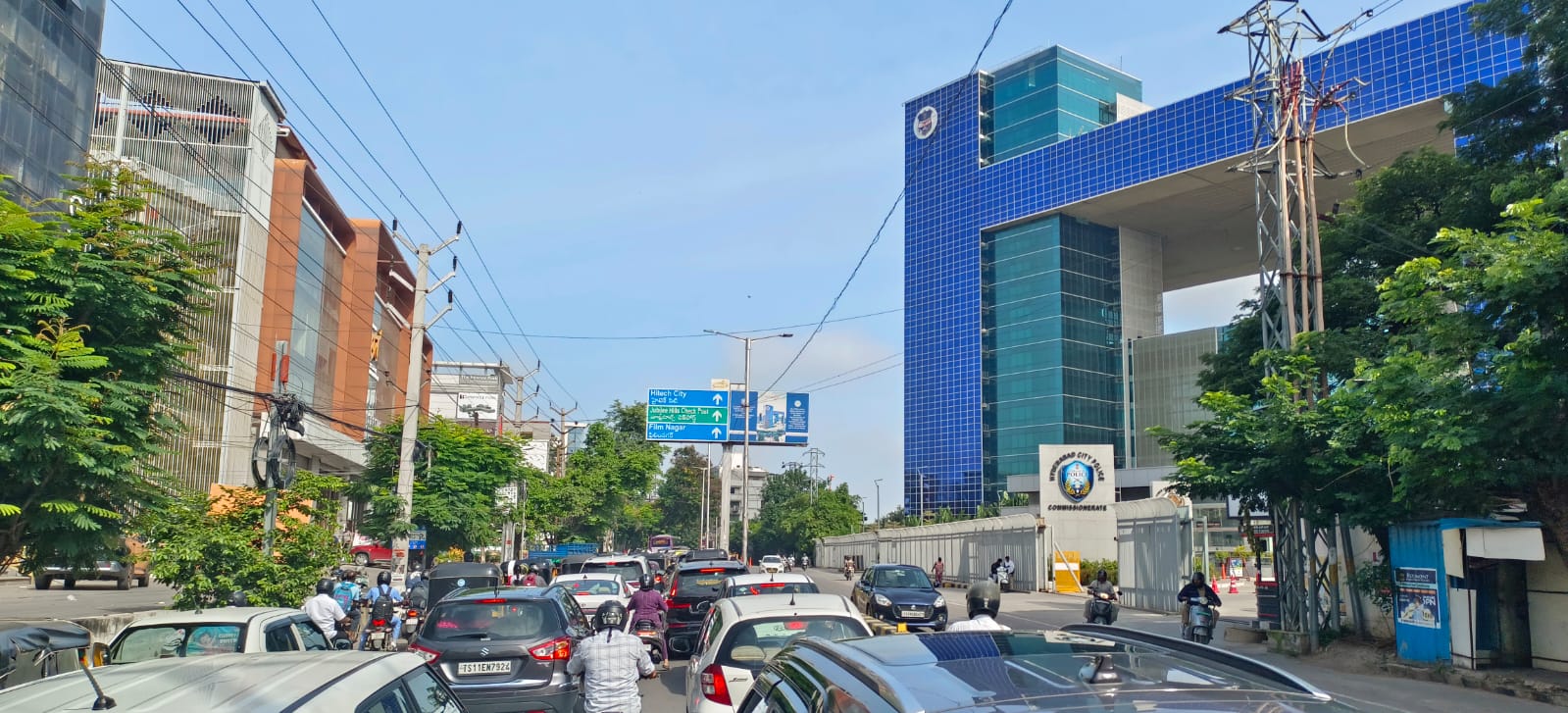
Hyderabad: The KBR Park one‑way traffic system got off to a turbulent start on Tuesday morning, with thousands of motorists facing prolonged delays, confusing lane changes and heavy traffic on stretches around Jubilee Hills and Banjara Hills. The morning saw a sharp increase in travel times as large volumes of vehicles entered the newly designated one‑way loop.
Several regular commuters, accustomed to the old routes, were forced to move through unfamiliar entry, exit and lane‑change points, resulting in vehicles slowing down, changing lanes and, at some locations, forming queues.
In the evening, however, things eased as the return traffic from Hitec City was managed efficiently by the police at Road No. 45 junction. Commuters heading from the Durgam Cheruvu cable bridge were alerted with multiple signboards and officials and the return route was more familiar.
Traffic came to a standstill at various points during the morning, particularly around Road No. 45 junction, KBR Park entrance, Jubilee Hills Check Post, Agrasen Island and roads connecting towards Banjara Hills. Commuters said journeys that normally take 15 to 30 minutes took considerably longer.
One commuter reported spending 45 minutes travelling from the eye hospital side towards Filmnagar. “It was painful. There was constant bumper‑to‑bumper traffic, and it was chaotic. But the traffic police helped me take the correct turn towards the left lane so that I could exit towards Filmnagar properly,” he said.
The five‑km diversion around the park is part of measures linked to the H‑CITI project, which involves a series of flyovers and directional underpasses being constructed to ease traffic.
The congestion was not simply the result of the new route. The sheer volume of vehicles using the corridor during peak hours, combined with drivers trying to understand the new arrangement, created several temporary choke points. Motorists approaching lane‑change locations often had to move across lanes to reach their intended exits, slowing the flow of traffic behind them.
Authorities identified major choke points at KBR Park junction, Road No. 45 junction, BVB Junction, Agrasen Island, Basavatarakam Circle and Venkatagiri, with thick inflow and outflow during peak hours. Road No. 45, with one portion heading towards Gachibowli via Cable Bridge and the other towards Jubilee Hills Check Post, experienced hurdles with lane changes.
In the evening, return traffic from Hitec City was managed efficiently by police at Road No. 45 junction. Commuters heading from the Durgam Cheruvu cable bridge were alerted with multiple signboards and officials not to take a right turn towards Jubilee Hills Check Post.
At Agrasen Island, where underpass construction has begun, several commuters heading towards Road No. 10 took the left lane while others took the right, which minimised congestion during peak evening hours.
Traffic police personnel were deployed at key junctions, entry and exit points and other critical locations to guide motorists and manage the flow.
Hyderabad police commissioner V. C. Sajjanar told Deccan Chronicle: “Commuters today faced some confusion regarding the route and how to move, which was expected. We have already placed signboards across the park and at entry points, and we are increasing them to create more awareness.”
“I have been monitoring the traffic flow using drones, and after the peak traffic hours from 9 am to 12 noon, the flow was smooth. We expect the public to get used to this route in another three to four days, and after that the flow will be much better,” Sajjanar added.
Cyberabad traffic authorities said inflow from Jubilee Hills towards Madhapur had reduced by at least 20 per cent after the diversions.
Hyderabad traffic joint commissioner Joel Davis said pedestrians would not be abandoned. “At KBR Park junction, we have put in a 20‑second pedestrian signal to allow pedestrians to cross. But we observed that the time is not enough for older civilians, so we are planning to increase it to 30 seconds from tomorrow.”
Police had previously conducted two rounds of trial runs before finalising the plan, and consultations were held with residents, walkers, welfare associations, hospitals and commercial establishments in the area.
For motorists, Tuesday’s congestion was as much an adjustment period as it was a test of the new system. With thousands of vehicles using roads that already operate close to capacity, even small hesitations or incorrect lane movements quickly created a chain reaction.