AdvertisementAdvertisementThese remarks came after Iran’s security chief Mohsen Rezaei laid out Tehran’s seven conditions to end its war with the United States.
What’s the latest in the Iran war?
What are Iran’s conditions to resume peace talks with the US?
On Saturday (September 19), Iran announced that it had sent seven conditions to the US to end the war in West Asia.
Moreover, the US State Department warned Americans to reconsider travelling to West Asia, adding that the Iran war could quickly worsen.
After Iran laid down seven new conditions for peace talks with the US, Donald Trump has said that he’s in ‘decision mode’ and ‘very big things’ could come in the near future. These remarks come amid signs of fresh escalation in the war, which is now in its seventh month. However, some analysts believe that it could be intimidation tactics
What are the seven conditions Tehran laid down for talks with the US?
Is Donald Trump planning a new campaign against Iran?
These are the two big questions on Monday (September 21) as war clouds once again loom large over West Asia after Tehran claimed it had received intelligence that Washington was preparing for a renewed bombing campaign against the Islamic Republic.
When asked about the state of the conflict in the region, the US president told Fox News that “very big things are going to happen in the not-so-distant future” and that the options he was considering were “wiping Iran out, letting them rot economically or making a deal”.
Advertisement
Advertisement
These remarks came after Iran’s security chief Mohsen Rezaei laid out Tehran’s seven conditions to end its war with the United States.
So, what’s going on? What’s the latest in the Iran war?
We explain.
What are Iran’s conditions to resume peace talks with the US?
On Saturday (September 19), Iran announced that it had sent seven conditions to the US to end the war in West Asia. The conditions were laid down by head of Iran’s Supreme National Security Council, Mohsen Rezaei, as the war drags on in the seventh month.
“Seven conditions of Iran for starting any negotiation have been announced to the US government. Tehran’s message is clear and unambiguous; if Washington wants to get out of the quagmire it has created itself and not get more entangled in it, it has no choice but to accept Iran’s rights and conditions,” he posted on X on Sunday.
Earlier, he had told Al Jazeera that Tehran had conveyed its terms to the US through Qatari mediators, but warned that the Islamic Republic was more battle-hardened now than in the first 40 days of the war.
The terms laid down by Rezaei are:
Advertisement
Advertisement
1. An end to the war on all fronts, including, in particular, Lebanon.
2. The release of its frozen funds that run into billions of US dollars.
3. An end to the naval blockade on Iranian ports.
4. An end to US interference in Iran’s internal affairs.
5. An end to US cooperation with “the opponents of our revolution”.
6. An end to all US attacks on Iranian territory.
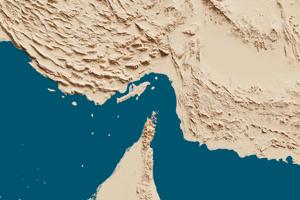
7. Opening of the Strait of Hormuz.
Most of the terms laid down by the Iranian leader are similar to the ones in the memorandum of understanding (MoU), which was signed in June. Adel Abdel Ghafar, a senior fellow focusing on the Middle East at the Australian Strategic Policy Institute, told Al Jazeera that while little had changed in Iran’s demands, the timing mattered.
“With the Islamabad MoU dead and … Rezaei delivering the conditions through Qatar, Iran is putting the onus back on Washington and doing it publicly, for maximum effect.”
US President Donald Trump returns to the White House in Washington, DC from Camp David. Reuters
How has Trump responded to Iran’s terms?
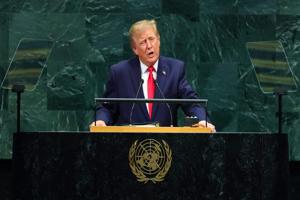
On Sunday (September 20), US President Trump cut short his visit to Camp David, the presidential retreat, and returned to Washington, DC.
Later, he told a Fox News reporter he’s in a “deciding mode” on Iran, forecasting “very big things” to come in the near future as he considers his options in the war.
Fox’s Trey Yingst said that he was informed by the US president that there were a handful of choices to consider: “Wiping out Iran”, “letting them rot economically” or striking a deal.
“My question is, if and when do I blow the entire nation up? They better behave,” Trump told Yingst.
Yingst said the president also told him he'd probably be open to meeting with Iranian President Masoud Pezeshkian, who is expected to attend the United Nations General Assembly in New York this week.
These remarks come after Trump told Axios last Thursday that he was facing the “big decision” on whether to “annihilate” the Iranian regime. “I have a big decision coming up. Do I want to go in and annihilate them [the Iranian regime] or do I not? It’s a big decision. Anything could happen with me,” said the US president to the American media outlet last week.
Advertisement
Advertisement
While Trump has made threatening remarks in public, the spokesman of Qatar’s foreign ministry noted that they received assurances from the US administration that Washington wants to reach an agreement.
“We have heard assurances from US administration officials that Washington wants to reach an agreement,” the spokesman said, adding, “We need a regional solution that achieves stability and an international understanding that protects waterways such as Hormuz.”
People drive near a billboard depicting US President Donald Trump on a building in Tehran, Iran. Reuters
So, will there be peace? Will both sides agree to negotiations?
That’s an answer that remains unknown for now.
However, there are signs of a possible escalation of violence. Iran has said that it has received information that the US, with the backing of some regional countries, was preparing to resume military actions against it.
“According to information received, the criminal America has once again decided to resume measures against Iran, with the green light of some regional countries, at a joint meeting in a European country,” Iran’s military command said in a statement.
Rezaei also responded by saying: “If the Americans are serious, let their soldiers come and enter Iran. Why do they not come in?”
There are also reports of movement involving B-1 bombers at RAF Fairford in the UK.
Moreover, the US State Department warned Americans to reconsider travelling to West Asia, adding that the Iran war could quickly worsen. “This military conflict has the potential to escalate rapidly. Americans outside the Middle East should seriously reconsider travel to and through the region,” the State Department said late Saturday in a post on X.
In addition to Trump returning to Washington, Israeli Prime Minister Benjamin Netanyahu is also reportedly cutting short his US tour; he’s cancelling the Texas leg, and flying directly back to Tel Aviv from New York, according to some reports.
A possible escalation in the war comes after the US State Department warned Americans to reconsider travelling to West Asia. File image/Reuters
While analysts have noted that these move certainly indicate a possibility of fresh violence in the region, it could also be sabre rattling.
Advertisement
Advertisement
As Mark Pfeifle, a Republican strategist and former White House and national security official, told Al Jazeera, he believes that both countries are still willing to strike a deal. “Sometimes in diplomacy it’s what’s taken off the table,” he told Al Jazeera.
“Rezaei left off reparations and reconstruction money, which tells me that there’s a concrete sign that amongst all the rhetoric, which is still very strident, that the pressure campaign that the US is putting on Iran is having some effect,” he said. “And it tells me that both sides are still looking for room to negotiate in the coming weeks.”
According to columnist & strategic affairs commentator Sonam Mahajan, the choice isn’t between peace and war. She wrote on X, “Trump has three choices on Iran. The first, and in my reading the most likely, is an extension of the current game. Sustained pressure, economic attrition, brinkmanship and intermittent offensives, without crossing the threshold into an all-out war. The second is a very real possibility. A return to negotiations, with Washington and Tehran using the pressure they have accumulated to extract concessions and eventually work towards a deal. The third is the least likely, but by far the most consequential. The unimaginable prospect of an American decision to pursue regime destruction, taking the confrontation into an entirely different strategic category.
“For now, I see the first as the likeliest course, the second as a credible alternative, and the third as the extreme scenario hanging over both. The real question is whether sustained pressure eventually creates the conditions for a deal, or whether the cycle of escalation pushes the two sides somewhere neither intended to go.”
With inputs from agencies