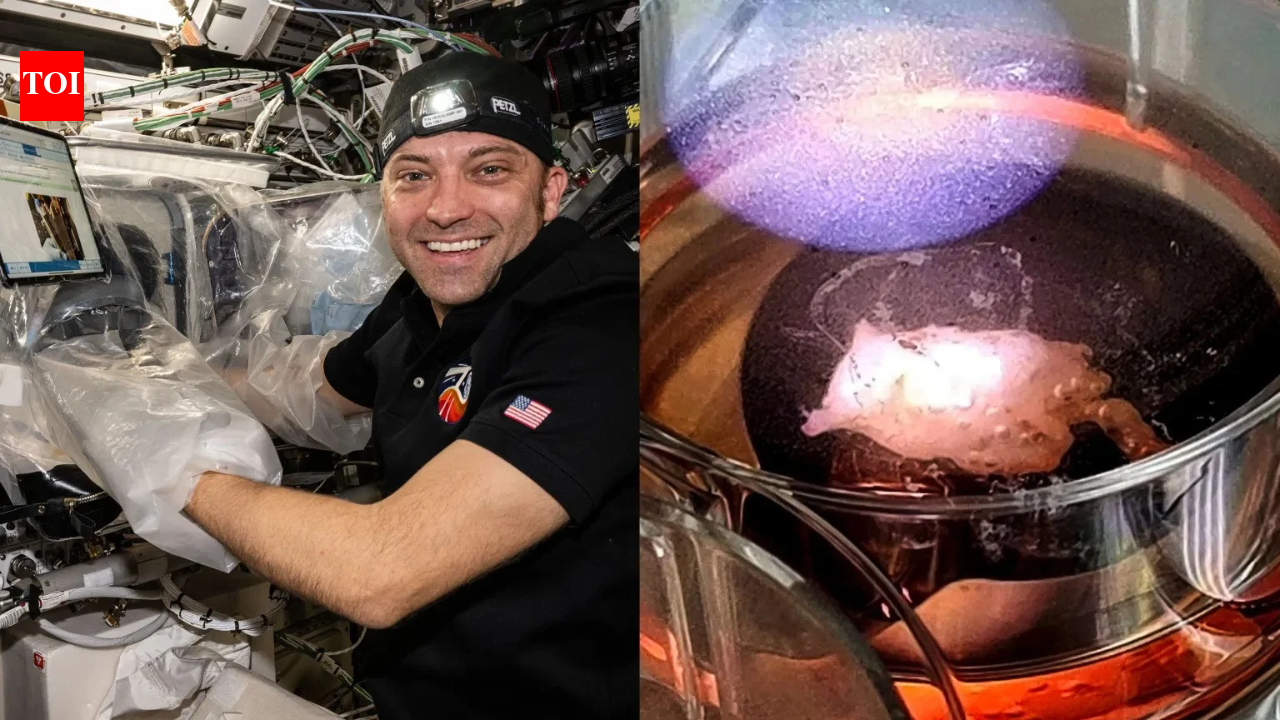
During the mission, cosmonaut Oleg Kononenko used the system to conduct experiments that involved human cartilage tissue and a rodent thyroid gland.
Researchers were testing whether tissue structures could be assembled in microgravity without the same support structures that are required on Earth.
The first successful orbital printing of human heart tissue using the BFF came much later than 2018.
The returned material was a three-dimensional human heart tissue sample produced as part of a research investigation.
The research continues to focus on whether microgravity can make it easier to manufacture thicker, more complex biological structures that are difficult to produce on Earth.
At left, NASA astronaut Matthew Dominick works on the BFF-Cardiac investigation aboard the International Space Station. At right, cardiac tissue is 3D bioprinted for the investigation | NASA
At left, NASA astronaut Matthew Dominick works on the BFF-Cardiac investigation aboard the International Space Station. At right, cardiac tissue is 3D bioprinted for the investigation | NASA
Microgravity offered a different way to build tissue
Christina Koch handles media bags that enable the manufacturing of organ-like tissues using the BioFabrication Facility (BFF), a 3-D biological printer on the International Space Station | NASA
NASA's heart-tissue milestone came in 2024
A Russian bioprinter called Organ.Aut arrived at the International Space Station aboard the Soyuz MS-11 spacecraft on December 3, 2018. During the mission, cosmonaut Oleg Kononenko used the system to conduct experiments that involved human cartilage tissue and a rodent thyroid gland. The equipment was developed around magnetic levitation rather than the extrusion-based printing methods that were commonly associated with conventional 3D printers. Researchers were testing whether tissue structures could be assembled in microgravity without the same support structures that are required on Earth. A technical description of the project says that the Organ.Aut system was designed for magnetic levitational biofabrication and contained sealed experimental chambers in which tissue spheroids could be assembled under microgravity conditions. The space experiments were conducted during Expedition 58-59 in December 2018. NASA later described Organ.Aut as the first bioprinter that was sent to the space station and said it was used to culture cartilage cells in space using a magnetic field.Freshly printed biological material can sag or collapse before cells have time to form stable structures on Earth. Conventional approaches can use scaffolds or thickening materials to hold a printed structure in place, but those additions can affect the biological properties of the tissue.Microgravity changes that problem, since researchers can work with softer biological materials and investigate whether cells can form three-dimensional structures more naturally without normal Earth gravity pulling the material downward. NASA later explained that the BioFabrication Facility was developed around this idea. The system uses living cells and bioinks, while microgravity allows tissues to maintain three-dimensional forms without conventional artificial scaffolds.Researchers have been building progressively more complex tissue structures and studying how they behave after being produced in orbit. The early Russian experiment provided one demonstration of what could be done with magnetic levitation and human cells in space, and later investigations expanded the approach with different printing technologies.NASA's BioFabrication Facility was developed by Redwire and represented the next stage of that research. The facility is a 3D bioprinter that is capable of working with living cells and was designed to investigate the production of human tissues in microgravity. Unlike conventional 3D printing, the system works with biological materials that must remain viable during the printing process. The first successful orbital printing of human heart tissue using the BFF came much later than 2018. NASA says the BFF-Cardiac investigation successfully bioprinted a three-dimensional human heart tissue sample in May 2024.The printed tissue remained in the microgravity environment for the experiment before being returned to Earth for additional testing. NASA said researchers were examining whether the resulting tissues could eventually contribute to technologies for personalized cardiac patches. The returned material was a three-dimensional human heart tissue sample produced as part of a research investigation. Researchers are interested in microgravity because structures formed without Earth's normal gravitational forces may behave differently as they develop and mature.Russia's Organ.Aut demonstrated orbital bioprinting of human cartilage tissue in 2018, while NASA and Redwire later used the BioFabrication Facility to produce human heart tissue in 2024. The research continues to focus on whether microgravity can make it easier to manufacture thicker, more complex biological structures that are difficult to produce on Earth. That makes the technology an area of ongoing research rather than a ready-made method for producing replacement organs or tissues for patients.