He named the shrines: America's Silicon Valley, Taiwan's Hsinchu Science Park, Japan's 'Silicon Island' and Tsukuba Science City.
Silicon Valley took half a century to become Silicon Valley.
Sanand, by contrast, has three plants that cut, bond, encase and test chips that are largely manufactured somewhere else.
We could begin with Silicon Valley: its origin is not a garage, as is widely believed, but a university.
Taiwan's Hsinchu is the more instructive case, because it was much more deliberate than Silicon Valley.
The Prime Minister has a fondness for slogans, and on the fourth of July he had a new one. "Step by step, brick by brick, chip by chip," the Prime Minister's Office declared as Narendra Modi inaugurated CG Semi's packaging plant at Sanand, the third semiconductor facility to enter commercial production in this once-agrarian Gujarat taluka in under five months.
Then he reached, as leaders announcing industrial policy tend to, for the canon.
"No global industrial power has been built on a single factory," Modi told the gathering. "The foundation of industrial strength lies in clusters." He named the shrines: America's Silicon Valley, Taiwan's Hsinchu Science Park, Japan's 'Silicon Island' and Tsukuba Science City.
Sanand, he said, "is now moving in the same direction." A semiconductor cluster, he insisted, "is taking shape in the country."
It is the kind of claim that invites a raised eyebrow. Silicon Valley took half a century to become Silicon Valley. Hsinchu spent two decades turning a science park into the beating heart of the world's most advanced chip industry. Sanand, by contrast, has three plants that cut, bond, encase and test chips that are largely manufactured somewhere else.
To measure a five-month-old packaging hub against the greatest industrial ecosystems of the modern age looks, on its face, like hubris. And yet for the first time in the long, frustrating history of India's semiconductor ambitions, the comparison is worth taking seriously.
Modi's analogy might be a stretch today, but it is definitely not fantasy. To understand where Sanand is and where it could go we need to study the evolution of the clusters Modi mentioned.
We could begin with Silicon Valley: its origin is not a garage, as is widely believed, but a university.
Frederick Terman, Stanford's engineering dean, spent the 1940s and 1950s pushing his students to start companies nearby and leasing them land in a new industrial park. This effort was supercharged with money, specifically Cold War defence spending, which quadrupled Stanford's federal research income in a single decade and made a missiles-and-space contractor the largest employer in Santa Clara County.
When William Shockley brought the transistor west in 1956 and eight of his engineers promptly defected to found Fairchild Semiconductor, the recirculation began: Fairchild begat Intel, Intel begat a hundred others, and a venture-capital industry grew up on Sand Hill Road to fund the next wave. Agglomeration, talent that moved freely between firms and a university feeding the whole thing all compounded over forty years.
Taiwan's Hsinchu is the more instructive case, because it was much more deliberate than Silicon Valley. Inaugurated in 1980 and modelled explicitly on Stanford's research park, it was co-located with two elite universities and, crucially, a government research institute, ITRI, that functioned as the incubator. ITRI licensed foundational chip technology from America, then spun its own people and know-how out into private companies.
The most consequential was TSMC, spun off in 1987 under Morris Chang, a Texas Instruments veteran the government had recruited to run ITRI. Chang's bet — that a company could make chips other firms designed, and make only those, the 'pure-play foundry' — was met with scepticism and went on to make Taiwan indispensable. Today a single Taiwanese firm produces more than 90 per cent of the world's most advanced chips. That dominance began as state-catalysed technology transfer and took the better part of thirty years to mature.
Meanwhile Japan offers two more variations. Kyushu earned the nickname 'Silicon Island' when Mitsubishi and NEC built wafer fabs there in the 1960s; by the 1980s the region hosted more than a hundred chip-related companies before the industry drifted to cheaper Korea and Taiwan.
It is reviving now precisely because that old infrastructure — the water, the suppliers, the trained hands — let TSMC plug in and reach mass production in Kumamoto within two years of breaking ground. Tsukuba, the planned science city north of Tokyo, contributes something different again: not volume manufacturing but upstream research, some thirty institutes and twenty thousand researchers generating the materials science and metrology the industry runs on.
Put all of these together and you have a sense of where Sanand is and where it could go. The lessons are consistent: clusters need an anchor, a fab or a research institute, around which suppliers and talent thicken; they reward pre-existing industrial infrastructure; they depend on the free movement of skilled people; and they take decades, not budget cycles.
What Sanand is — and what it could be
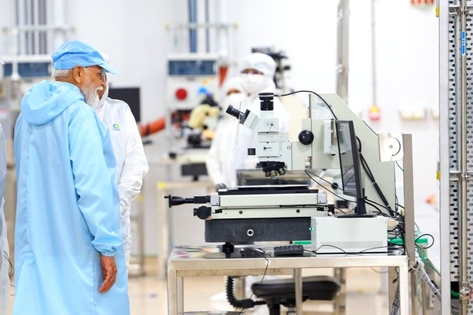
What Sanand does today is the 'back end' of chipmaking: assembly, test, marking and packaging, known in the trade as ATMP or OSAT. It takes finished silicon wafers, dices them, bonds them, encases them and checks that they work.
It is not the 'front end', the fabrication plant or 'fab' where raw wafers are etched with circuitry, the capital-hungry, technologically forbidding heart of the industry. Packaging is the shallow end. It is the part of the business Malaysia and Vietnam have done competently for decades without ever becoming Taiwan.
But dismissing Sanand on those grounds would be a mistake.
Assembly is exactly where a newcomer should begin. It costs a fraction of a leading-edge fab, it is far quicker to build, it sits close to India's existing electronics-manufacturing base, and, most importantly, it forces an entire workforce and supplier network to learn the industry's unforgiving disciplines: cleanroom protocol, yield management, tolerances measured in billionths of a metre. You do not hand a country the keys to an eleven-billion-dollar fab and hope. You have to build the muscle first.
And thankfully, the muscle is being built at speed.
Micron's facility — a $2.75-billion investment, the very first project approved under the India Semiconductor Mission — went from groundbreaking in September 2023 to inaugurated production by February 2026, packaging memory chips in one of the world's largest single-floor test-and-assembly cleanrooms.
Kaynes Semicon followed within weeks, and by October 2025 had already shipped India's first commercially packaged multi-chip module, seventeen separate dies in a single power unit, to a customer in California.
CG Semi, the plant Modi opened last Sunday (4 July), is a Rs 7,600-crore joint venture that draws Japan's Renesas and Thailand's Stars Microelectronics in as technology partners, with a ramp targeted toward five billion chips a year.
You have three plants, three distinct business models, all reaching commercial production inside five months.