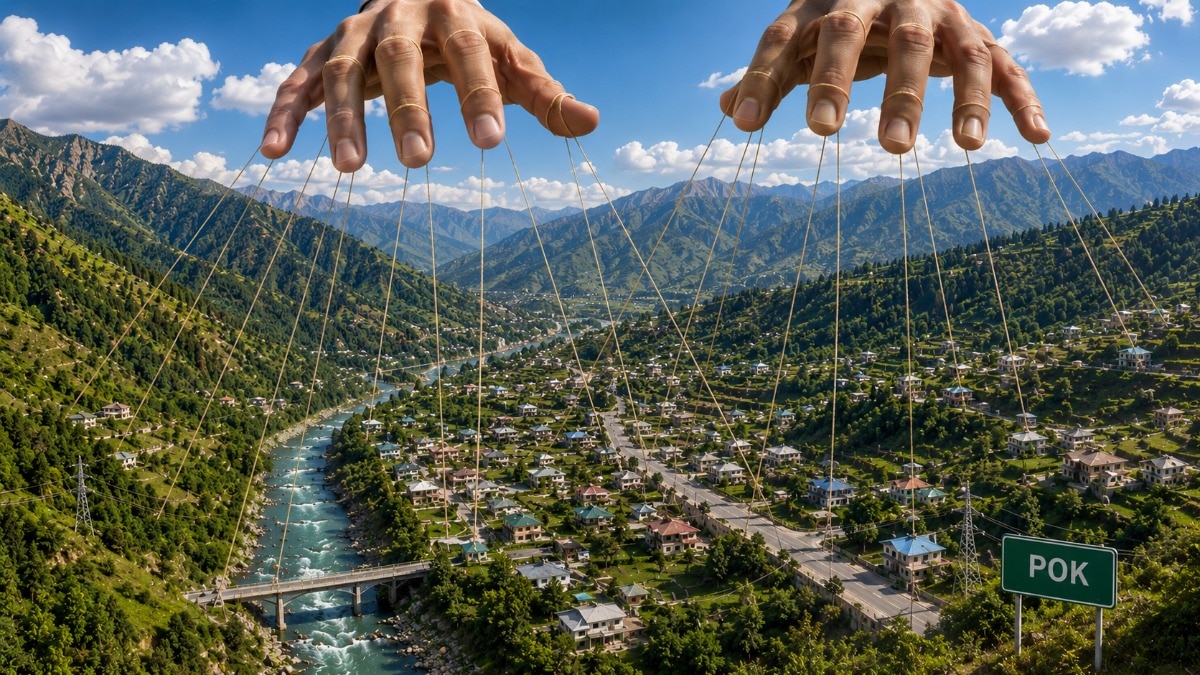
Read Full StoryThe term doesn't just refer to the linguistic dominance of Pakistani Punjabis in POK, along with Gilgit-Baltistan, roughly six times the size of POK by area, which Pakistan had illegally annexed in 1948.
The domination of Punjabis, although not restricted only to the POK, is not new to the illegally-annexed region.
While Pakistani census data does not capture the long-term language shift in POK, scholars have documented it for decades.
Researchers and activists trace the turning point to 1974, when Pakistan abolished State Subject Rules that had historically restricted land ownership and settlement by outsiders in POK.
There is substantial evidence that political authority over the POK, including Gilgit-Baltistan, has remained concentrated in institutions located outside the region — Islamabad and Rawalpindi.
For decades, Pakistan has described the illegally-occupied territory as "Azad" Jammu and Kashmir. Yet, far from being governed by local Kashmiris and other ethnic groups, the region has been shaped by political, administrative and demographic decisions taken hundreds of kilometres away in Pakistan's Punjabi power centres of Islamabad and Rawalpindi.
Several strategic experts and activists have commented on the well-planned project, which they summed up in one word. "Punjabisation".
Read Full Story
The term doesn't just refer to the linguistic dominance of Pakistani Punjabis in POK, along with Gilgit-Baltistan, roughly six times the size of POK by area, which Pakistan had illegally annexed in 1948. Apart from the linguistic dominance (as it's with other provinces), activists, political groups and rights campaigners in POK, say, there had been a broader process through which Pakistan's Punjabi-dominated military establishment, bureaucracy and political elite came to dominate the affairs of POK, and Gilgit-Baltistan. While the Punjabi domination and infiltration isn't restricted to these territories, every other Pakistani province and administrative unit has faced Punjabisation. Even culturally-rich Sindh and Balochistan.
Unlike Balochistan or Punjab, POK isn't Pakistan's territory. It is illegally captured, and demographic change there matters to the locals and to India.
Nationalist groups in the POK that are not aligned with the elite military establishment, say that decisions about governance, resources, demographics and even cultural identity are made outside the region. Local institutions are reduced to being administrative extensions of the Pakistani establishment. Scholars and activists have attributed it to "state-sponsored Islamisation policies and migration patterns",
The phenomenon, Punjabisation, has sprung back into the spotlight after the Pakistani military establishment carried out a deadly crackdown on protesters in POK, killing dozens. It was the second such large-scale protests in POK since September 2025.
Over the last few years, protests led by the civil society body, Joint Awami Action Committee (JAAC), have challenged Islamabad's authority in POK. Alongside basic demands related to inflation, electricity and governance, protesters called for greater autonomy and the abolition of Assembly seats reserved for refugees settled outside the region in Pakistan. The JAAC has argued that outsiders, primarily from Punjab, continue to wield disproportionate influence in POK.
As the Pakistani security forces launched a crackdown in POK last week, Indian Army veteran, Lt General KJS Dhillon (Retd) said, "Kashmiris [in the illegally-occupied region] shared the same language, way of life, and cultural ethos" as in Jammu and Kashmir's Valley.
"However, in POK, Punjabi-Pakistani Muslims seek to suppress the local Kashmiri population. They aim to impose a Punjabi-style dominance not only in POK but also in Gilgit-Baltistan. The Joint Awami Action Committee has been raising its voice for their rights... for quite some time the Punjabi-dominated government of Pakistan banned the group and even declared it a terrorist organisation...," Lt General KJS Dhillon (Retd) told news agency ANI.
The domination of Punjabis, although not restricted only to the POK, is not new to the illegally-annexed region. In 2020, a rights activist of Pakistani origin, Arif Aajakia, said during a television discussion that "Azad Kashmir has already undergone a process of Punjabisation. The Kashmiri language was no longer widely spoken there; Punjabi has become the dominant language". Similar sentiments have been voiced by diaspora activists and nationalist groups for years. So, how did POK get Punjabised?
WHO LIVES IN POK? IS KASHMIRI THE MOST COMMON LANGUAGE IN POK?
Any discussion of Punjabisation (with respect to Pakistan) must begin with a historical reality that's often overlooked. Not all of POK was and is ethnically and linguistically Kashmiri.
The territory illegally annexed and now administered by Pakistan consists of two broad distinct regions. They are, "Azad Jammu and Kashmir" and Gilgit-Baltistan. Together they cover more than 78,000 square kilometres and contain a mix of ethnic, linguistic and religious communities.
According to Indian think tank IDSA's 2011 Pakistan Occupied Kashmir report, major ethnic groups in POK include Gujjars, Jats, Rajputs, Sudhans, Awans, Mughals and Pashtuns, while languages spoken include Punjabi, Hindko, Pahari, Kashmiri, Balti and Shina.
advertisement
In fact, much of Mirpur, Bhimber and Kotli regions in southern POK historically belonged to the broader cultural belt stretching into undivided Punjab's northern Potohar region (Rawalpindi, Jhelum, Chakwal and Attock districts). In this region closer to the Jhelum-Indus Plains, Pahari-Pothwari dialects are spoken more than Kashmiri. Thus, the idea that all of POK is uniformly Kashmiri-speaking is inaccurate. But only on the basis of language and ethnicity. But it's an accurate assessment that the region also saw Punjabi-speaking settlers settle there over the decades.
Gilgit-Baltistan in the north is even more diverse, with communities speaking Shina, Balti, Burushaski, Wakhi, Khowar and several other local languages. It also had a considerable Shia population, which has been suppressed over the decades. An American map of India's Jammu and Kashmir, showing areas under illegal control of Pakistan and China, along with major geographic features including the Pir Panjal Range and the Kashmir Valley. (Image: US Central Intelligence Agency, adapted via Wikimedia Commons)
"And today, in POK, the generation that speaks the Kashmiri language is dying. In schools there, Mandarin is being taught, which is a Chinese language. In Gilgit-Baltistan, Mandarin is being taught. And all the Pakistani forces which are in control there keep relation with all the Pakistani-Punjabi Muslims. Whereas, Kashmiri is dying, minorities are dying," Lt General KJS Dhillon (Retd) told news agency ANI.
While Pakistani census data does not capture the long-term language shift in POK, scholars have documented it for decades. In his book Kashmir and Its People (2004), former Indian bureaucrat MK Kaw cited Pakistani linguist Tariq Rahman as observing that "most of them [Kashmiris] are gradually shifting to other languages, such as the local Pahari and Mirpuri, which are dialects of Punjabi".
advertisement
APART FROM LANGUAGE, HOW WAS PUNJABISATION OF POK DONE?
Punjabisation of the POK is, in its character and intent, a political phenomenon carried out to create the geopolitical goal of strategic depth. The Pakistani establishment kept POK outside the formal constitutional structure in the name of a future plebiscite, even as it tied the region's politics, bureaucracy and identity to the Punjabi-dominated state apparatus. That would also help if and when the plebiscite takes place, which Islamabad has sought in the UN since independence. All these have had their impact on the economy, demography, culture and local identity.
advertisement
The roots of this complaint from POK stretch back to 1949 and the Karachi Agreement. Signed between Pakistan, the "Azad Kashmir government" and the Muslim Conference, the agreement transferred control of defence, foreign affairs, negotiations related to Kashmir and the administration of Gilgit-Baltistan to the federal government of Pakistan. Notably, Gilgit-Baltistan itself had no representative at the negotiations, according to an ORF report by Bhashyam Kasturi, former Director of the National Security Council Secretariat.
Over subsequent decades, Pakistan repeatedly altered POK's constitutional arrangements through executive orders. Local consultation was never a norm. According to an IDSA report of 2011, changes in "AJK's political structure" were introduced through executive decrees issued by Islamabad and "were not based on any recommendations or representations made by any representative body of the people".
Now the most powerful institution in POK remains the AJK Council, historically headed by Pakistan's prime minister. Even elected governments in Muzaffarabad have found themselves subordinate to decisions taken in Islamabad by the Council headed by the prime minister. The same IDSA report noted that successive Pakistani governments, civilian and military alike, treated AJK administrations with "absolute contempt" and sought to install governments of their choice.
Concerns over the outsider's settlement have also surfaced in local news reports in POK.
A report published in the Gilgit-Baltistan-based weekly Iwan-e-Sadaqat in November 2009 claimed that "more than 25,000 illegal immigrants from mainland Pakistan had purchased land in the AJK and were settling primarily in Muzaffarabad and Rawalakot". The report further alleged that "some among them were involved in drug trafficking, weapons smuggling and other criminal activities".
Former Indian diplomat Rajiv Dogra said that the "problem started in POK right from 1947".
"Unlike us [India], where we, our leaders, said that refugees from Pakistan would not be settled in Jammu and Kashmir, Pakistan ensured that Punjabis coming out of mainly Indian Punjab were not allowed to settle in Punjab in large numbers, but taken in large numbers to the POK to be settled there so that they could change the demographic complexion. And the result is that today more than 50% of the people are Punjabis. They are the ones who are thriving," former diplomat Rajiv Dogra told India Today TV.
"They are the ones who run all the large businesses. They are the ones who are getting all the large military contracts. The local population is starved financially. Can you imagine a population of 4 million people that has only 5,000 income taxpayers?
SO, WHO HOLDS POWER IN POK?
A recurring grievance among rights and nationalist groups like the JAAC in POK is the dominance of officials from Pakistan's Punjab province within the military, civil administration and security apparatus in the region.
While chief ministers and prime ministers in the AJK are "locally elected", crucial levers of power have traditionally remained under federal control. The military maintains a significant presence, while key bureaucratic positions are often filled by officers belonging to Pakistan's federal services. Critics argue that this creates a structure where local politicians administer but do not really govern. POK has a PM, a President, and a flag. But that's a marketing gimmick.
The situation is even worse in Gilgit-Baltistan and the complaints are even stronger.
For decades after 1947, Gilgit-Baltistan was ruled directly from Islamabad through the Ministry of Kashmir Affairs. Residents had no representation in Pakistan's Parliament, no constitutional status and no meaningful say in decisions affecting their future. A 2020 paper by the European Foundation for South Asian Studies (EFSAS) observed that Gilgit-Baltistan remained subject to the wishes of the political-military elite in Islamabad and is excluded from vital decision-making processes. Gilgit-Baltistan (L) lies in the rugged trans-Himalayan region, where the Karakoram, Himalaya, and Hindu Kush ranges meet. The region is home to Mount K2, the world's second-highest peak, and connects Pakistan's illegally-occupied Indian region with China through the Karakoram Highway under the CPEC via the Khunjerab Pass (C). The people of Gilgit-Baltistan comprise diverse ethnic groups, including Shina, Balti, Burusho, Wakhi, and Khowar communities, with a mix of Shia, Sunni, and Ismaili Muslim traditions. (Images: Unsplash/Jessica Anderson/Rizwan Saeed)
WHY DO DEMOGRAPHICS MATTER IN POK's PUNJABISATION?
The demographic dimension of the Punjabisation debate is most pronounced in Gilgit-Baltistan, an integral part of India's Jammu and Kashmir, now under Pakistan's illegal control. After Pakistan illegally ceded the 5,180-sq-km Shaksgam Valley, part of the erstwhile princely state of Jammu and Kashmir, to China in 1963, it could develop a land crossing point and deepen its strategic ties with Beijing. It was through Gilgit-Baltistan that the China-Pakistan Economic Corridor's (CPEC) Karakarum Highway rolled into Pakistan. New Delhi had protested as it passes through territory that is India's.
Researchers and activists trace the turning point to 1974, when Pakistan abolished State Subject Rules that had historically restricted land ownership and settlement by outsiders in POK.
The move opened the door to large-scale migration from mainland Pakistan, particularly from Punjab and adjoining Khyber Pakhtunkhwa and the erstwhile Federally Administered Tribal Areas (FATA).
Researchers studying Gilgit-Baltistan have documented concerns over demographic engineering and the gradual erosion of indigenous cultural identities in POK. The 2020 EFSAS paper noted that Gilgit-Baltistan's social fabric has been transformed by state-driven policies and described the process as a form of "internal colonisation".
The region has also witnessed profound sectarian change. Historically dominated by Shia and Ismaili communities, Gilgit-Baltistan has seen the growth of Sunni populations and recurring sectarian violence since the 1980s. Scholars and activists have attributed part of this shift to "state-sponsored Islamisation policies and migration patterns", according to the EFSAS study.
A 2010 report by Freedom House, a US non-profit, said the "appropriation of land in the Northern Areas by non-Kashmiri migrants from elsewhere in Pakistan, with the tacit encouragement of the federal government and army" had led to "dwindling economic opportunities for the local population". The report also warned of rising sectarian tensions between the region's Shia majority and "a growing number of Sunnis".
PUNJABISATION OF POK A FACT OR A CLAIM?
The human displacement caused by infrastructure projects such as the Mangla Dam (between 1961 and 1967), the continued absence of full constitutional rights for the people of POK, and Islamabad's control over political apparatus have made local interests subordinate to priorities of the federal government. The recent JAAC protests show that these grievances are potent and remain intact among the population of POK. In fact, one of the 38 demands of JAAC includes abolition of seats for Kashmiris living outside POK. It has become a bone of contention. The establishment doesn't want its control to erode.
Local groups have repeatedly questioned why major decisions affecting the region continue to be taken by institutions outside POK and why electoral arrangements allow representation for people living outside the region. The JAAC, making these rude demands to the Asim Munir-led apparatus, was banned as they wanted the outsiders out, months before the so-called "AJK Assembly polls".
While it's simplistic to claim that POK was once entirely Kashmiri-speaking and has now become wholly Punjabi. Large parts of today's POK historically spoke Pahari, Hindko and Punjabi-related dialects long before Partition. But Punjabisation doesn't pertain to just language.
There is substantial evidence that political authority over the POK, including Gilgit-Baltistan, has remained concentrated in institutions located outside the region — Islamabad and Rawalpindi. Constitutional arrangements, direct federal control, demographic changes and the high-handedness of Pakistan's military establishment have made sure that the local voices of the POK remain secondary.
Whether one calls it Punjabisation, centralisation or colonisation, the underlying reality remains the same. The people of Pakistan-occupied Kashmir exercise limited control over their own political present and future.
- Ends