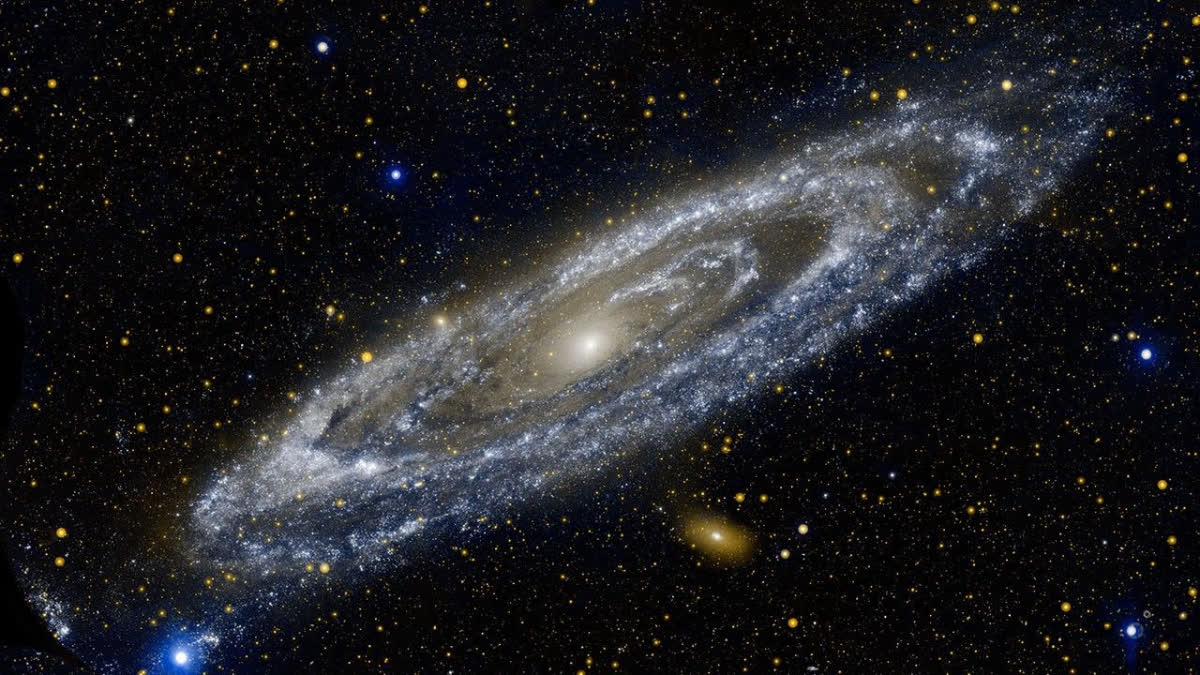
ETV Bharat / technologyHubble Data Reveals Sharp Slowdown In Star Formation Across Andromeda GalaxyHot stars burn brightly in this image from NASA's Galaxy Evolution Explorer, showing the ultraviolet side of the Andromeda galaxy, or M31.
As a result, areas that have experienced recent star formation (1) tend to have a larger fraction of blue stars, while areas with less recent star formation (2) typically have a redder population.
Hyderabad: Star formation in the nearby Andromeda galaxy (or M31) appears to be on the decline.
However, the history of star formation in Andromeda near M32 showed greater signs of decreased star formation compared with other regions.
Fig 1: Andromeda Galaxy in the night sky | Fig 2: Generated version of the Andromeda Galaxy and its companion galaxies M32 and M110.
ETV Bharat / technology
Hubble Data Reveals Sharp Slowdown In Star Formation Across Andromeda Galaxy
Hot stars burn brightly in this image from NASA's Galaxy Evolution Explorer, showing the ultraviolet side of the Andromeda galaxy, or M31. ( Credit: NASA )
The new study, published in The Astrophysical Journal , calculated that 500 million years ago, Andromeda formed stars at a rate of about one solar mass per year. However, the rate dropped to about half that by 40 million years ago. The current rate has plummeted even further, to about one-fifth solar mass per year.
Massive stars are bluer and short-lived, while less massive stars are redder and longer-lived. As a result, areas that have experienced recent star formation (1) tend to have a larger fraction of blue stars, while areas with less recent star formation (2) typically have a redder population. (Image: NASA, ESA, Benjamin Williams (UWashington), Zhuo Chen (UWashington), L. Clifton Johnson (Northwestern); Image Processing: Joseph DePasquale (STScI))
The rate of star formation is measured in terms of the mass or amount of gas and dust converted into stars every year. Previous research showed the Andromeda galaxy experienced a dramatic burst of star formation about 2 billion years ago, expected to be the result of a past interaction or merger with another galaxy. Since that time, the star formation has been steadily declining.
Hyderabad: Star formation in the nearby Andromeda galaxy (or M31) appears to be on the decline. A new study using data from NASA's Hubble Space Telescope measured about 200 million individual stars across the galaxy and concluded that the rate of star formation has undergone a 500-million-year decline, with an even steeper drop in the last 40 million years.
Since much of Andromeda's recent star formation has occurred in a star-forming ring located about 32,000 light-years from the galaxy's centre, much of the decline is also driven by a decrease in activity in that region.
The study suggests that the reason for a declining star formation rate is not reduced material but is more likely a natural winding down from its previous, more active state.
Astronomers also suspected if decrease in activity in Andromeda is influenced by its proximity to satellite galaxy M32 (Messier 32), which is only at a distance of 16,000 light years. Even though probing the potential interactions between M32 and Andromeda's disk was one of the major motivations behind this study, the survey data could not help draw conclusive evidence. However, the history of star formation in Andromeda near M32 showed greater signs of decreased star formation compared with other regions.
Fig 1: Andromeda Galaxy in the night sky | Fig 2: Generated version of the Andromeda Galaxy and its companion galaxies M32 and M110. (Credit: Stellarium Web)
The team now plans to continue analysing the Hubble data and combine it with data from ground-based observatories to gain additional insights into the history of Andromeda.
The Andromeda galaxy is located about 2.5 million light-years from Earth. It is comparable in size to our Milky Way and close enough to be seen with the unaided eye from areas with dark skies. It offers an opportunity to examine its stellar populations in detail and help astronomers better understand the past of galaxies like our own.