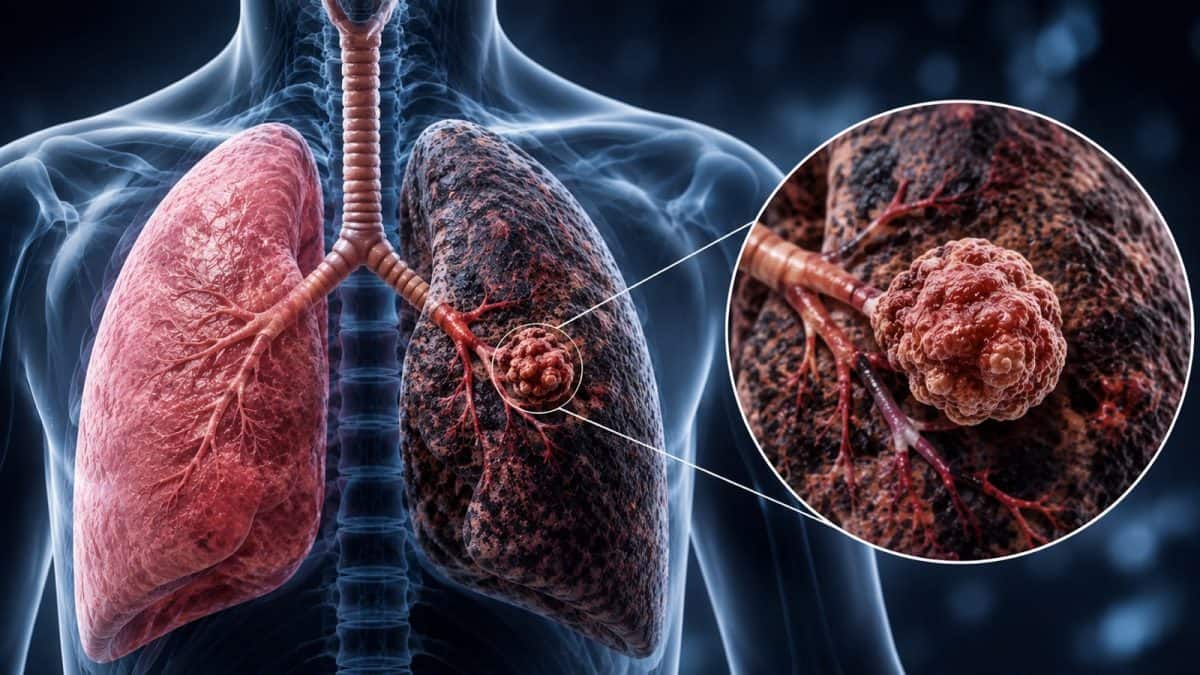
Lung cancer is no longer limited to smokers, with Indian studies showing a growing share of non-smokers among patients due to various reasonsFor years, lung cancer has been strongly associated with smoking.
“We are seeing a significant proportion of patients who have never smoked, and that cannot be ignored.”The growing number of non-smokers with lung cancerHospital-based studies in India suggest that a substantial share of lung cancer patients are non-smokers.
“It is not a national prevalence estimate, but in certain hospital cohorts, around 40 to 50 per cent of lung cancer patients are non-smokers.
Advertisement“In never-smokers, lung cancer is frequently adenocarcinoma and may carry distinct molecular alterations,” explains Dr Pahuja.
“I have never smoked should never be interpreted as I cannot get lung cancer,” Dr Pahuja concludes.
Lung cancer is no longer limited to smokers, with Indian studies showing a growing share of non-smokers among patients due to various reasons
For years, lung cancer has been strongly associated with smoking.
However, this perception is increasingly incomplete, especially in the Indian context.
“The idea that lung cancer is essentially a smoker’s disease is becoming outdated,” says Dr Sourabh Pahuja, Senior Consultant, Pulmonary Medicine, Amrita Hospital, Faridabad. “We are seeing a significant proportion of patients who have never smoked, and that cannot be ignored.”
The growing number of non-smokers with lung cancer
Hospital-based studies in India suggest that a substantial share of lung cancer patients are non-smokers.
“The commonly cited figure of 50 per cent needs context,” explains Dr Pahuja. “It is not a national prevalence estimate, but in certain hospital cohorts, around 40 to 50 per cent of lung cancer patients are non-smokers. That is far too large a proportion to dismiss as an exception.”
Advertisement
This shift highlights the need to look beyond tobacco as the sole cause.
Air pollution: a major but overlooked risk
One of the biggest contributors is the air people breathe every day.
“Fine particulate matter, especially PM2.5, penetrates deep into the lungs and triggers chronic inflammation, oxidative stress and cellular damage,” says Dr Pahuja. “Over time, this can increase the risk of cancer.”
Outdoor air pollution has already been classified as a Group 1 carcinogen by the International Agency for Research on Cancer.
More from Lifestyle More from Lifestyle
“In India, long-term exposure comes from traffic emissions, industrial pollutants, construction dust and seasonal smog,” he adds. “This exposure accumulates over decades.”
Indoor air and occupational hazards
The risk is not limited to outdoor environments. Indoor exposures also play a critical role.
“Biomass fuels, poorly ventilated kitchens and second-hand tobacco smoke are important risk factors,” says Dr Pahuja. “In addition, occupational exposure to asbestos, silica and diesel exhaust significantly increases risk.”
He points to Indian research that reinforces this link.
“Case-control studies among never-smokers have shown strong associations with high-risk occupations, poorly ventilated biomass fuel use and even family history,” he notes.
The role of biology and genetics
Lung cancer in non-smokers often behaves differently at a biological level.
Advertisement
“In never-smokers, lung cancer is frequently adenocarcinoma and may carry distinct molecular alterations,” explains Dr Pahuja. “For example, EGFR mutations are significantly more common in non-smokers, in some studies up to three times higher than in smokers.”
This has direct implications for treatment.
“Lung cancer is no longer treated as a single disease,” he says. “Its molecular profile helps determine targeted therapies and outcomes.”
The danger of delayed diagnosis
Perhaps the most concerning issue is how lung cancer is perceived among non-smokers.
“The biggest danger is that people do not consider themselves at risk,” says Dr Pahuja. “A lifelong non-smoker with symptoms like persistent cough, unexplained weight loss, blood in sputum, chest pain or recurrent infections may not seek timely medical attention.”
This delay can lead to diagnosis at more advanced stages.
What needs to change
While smoking remains the leading preventable cause, experts stress the importance of expanding awareness.
“Smoking is still the largest risk factor, but it is not the only one,” Dr Pahuja emphasises. “We need to broaden the conversation to include air pollution, indoor exposures, occupational risks and genetic susceptibility.”
Advertisement
He adds that early detection is key.
“Awareness of symptoms and timely evaluation can make a significant difference in outcomes,” he says.
The bottom line
Lung cancer is no longer a disease confined to smokers.
“I have never smoked should never be interpreted as I cannot get lung cancer,” Dr Pahuja concludes. “Recognising the broader risk factors and seeking early diagnosis is essential, particularly in a country like India where environmental exposures are high.”
The shift in understanding calls for a more inclusive approach to prevention, awareness and care.