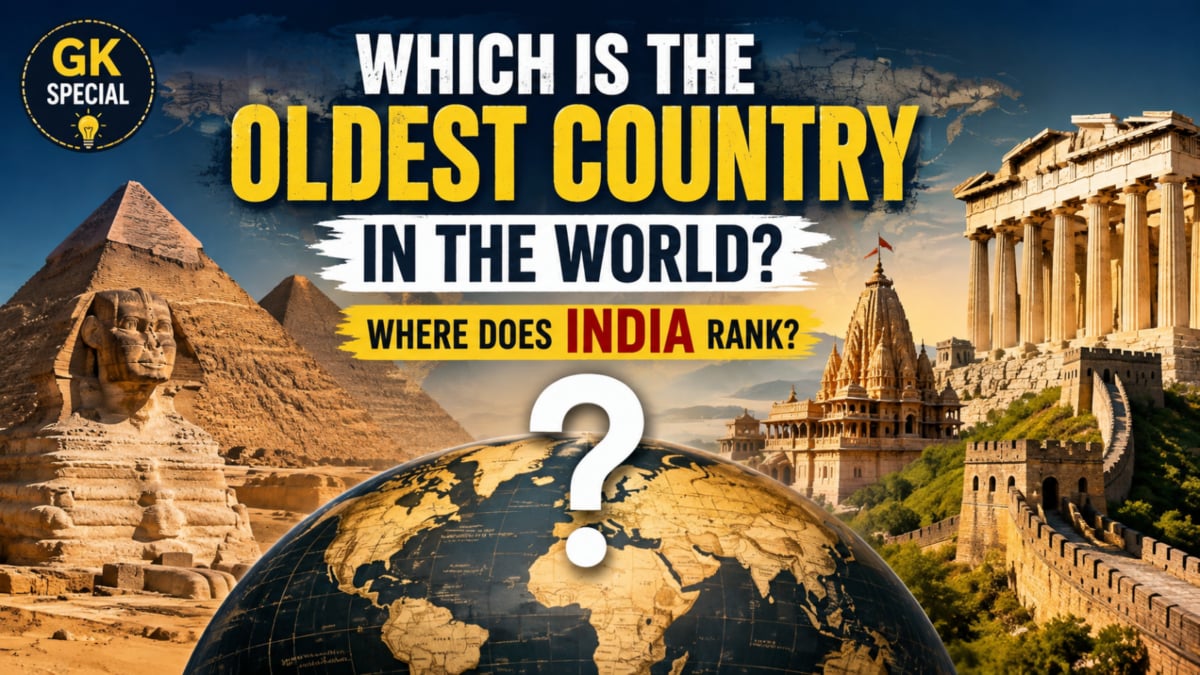
Last Updated: August 16, 2026, 13:55 IST1 / 11 While many people consider India to be among the world’s oldest civilisations, determining the “oldest country” is not straightforward.
It depends on whether age is measured by the emergence of an ancient civilisation, the formation of an early state or kingdom, or the continuity of a country as a political entity.
Ancient India made significant contributions to mathematics, science, medicine, philosophy and literature, while many of its cultural and spiritual traditions continue to influence the country today.
6 / 11 Ethiopia (Around 980 BC): Ethiopia has one of Africa’s oldest and most distinctive historical traditions.
ADVERTISEMENT7 / 11 Greece (Around 800 BC): Ancient Greece played a major role in shaping Western civilisation.
Last Updated: August 16, 2026, 13:55 IST
1 / 11 While many people consider India to be among the world’s oldest civilisations, determining the “oldest country” is not straightforward. It depends on whether age is measured by the emergence of an ancient civilisation, the formation of an early state or kingdom, or the continuity of a country as a political entity. Here are some countries with exceptionally ancient historical roots: (Image-AI)
2 / 11 Egypt (Around 3100 BC): Ancient Egypt, which developed along the Nile River, is regarded as one of the world’s earliest civilisations. Its pyramids, temples and pharaonic monuments continue to reflect the sophistication of this ancient society. Historians generally associate the political unification of Upper and Lower Egypt with King Narmer around 3100 BC, marking the beginning of Egypt’s Early Dynastic Period.
ADVERTISEMENT
3 / 11 India (Around 3300 BC): India’s ancient history can be traced to the Indus Valley Civilisation, which emerged around the third millennium BC and developed into one of the world’s earliest urban civilisations. Indian civilisation subsequently evolved through the Vedic period and numerous kingdoms and empires. Ancient India made significant contributions to mathematics, science, medicine, philosophy and literature, while many of its cultural and spiritual traditions continue to influence the country today.
4 / 11 China (Around 2070 BC): China has one of the world’s longest recorded civilisational histories. Traditional Chinese historical accounts connect its earliest dynasty with the Xia Dynasty, conventionally dated to around 2070 BC, although historians continue to debate aspects of its early history. Over the centuries, successive dynasties shaped Chinese society, culture and technology. China is also associated with major historical innovations, including papermaking, printing, gunpowder and the compass.
ADVERTISEMENT
5 / 11 Georgia (Around 1500 BC): Georgia, located in the Caucasus region, has roots extending deep into antiquity. Its early history is associated with ancient kingdoms such as Colchis and Iberia. Despite coming under the influence of various empires over the centuries, the region retained a distinctive cultural identity and developed traditions that continue to form an important part of modern Georgian heritage.
6 / 11 Ethiopia (Around 980 BC): Ethiopia has one of Africa’s oldest and most distinctive historical traditions. Its history includes ancient kingdoms, unique languages, cultural practices and a long-standing religious heritage. The country also maintained a significant degree of independence during the era of European colonial expansion, although Italy occupied Ethiopia from 1936 to 1941.
ADVERTISEMENT
7 / 11 Greece (Around 800 BC): Ancient Greece played a major role in shaping Western civilisation. Its contributions to philosophy, science, art, literature and political thought continue to influence the modern world. City-states such as Athens and Sparta became prominent centres of ancient Greek civilisation. The Greek philosophical tradition, particularly the work of thinkers such as Socrates, Plato and Aristotle, remains influential even today.
8 / 11 Iran (around 550 BC): Modern-day Iran is historically associated with ancient Persia. In the 6th century BC, Persia emerged as a powerful empire after Cyrus the Great founded the Achaemenid Empire. The Persian Empire exerted influence over a vast region, including much of West Asia.
ADVERTISEMENT
9 / 11 Japan (Traditionally 660 BC): According to traditional Japanese chronology, Emperor Jimmu is believed to have ascended the throne in 660 BC. However, this date is generally regarded as part of Japan’s traditional founding narrative rather than a historically established event. Japan has nevertheless developed a remarkably long cultural tradition, combining ancient customs and practices with modern technology and innovation.
10 / 11 Armenia (Traditionally 2492 BC): Armenia has an ancient historical and cultural heritage, with traditional accounts tracing the origins of the Armenian people to Hayk. The region has been home to several ancient kingdoms and played an important role in the history of the Caucasus. Armenia is also notable for adopting Christianity as its state religion around AD 301, making it one of the earliest countries to officially embrace Christianity.
ADVERTISEMENT