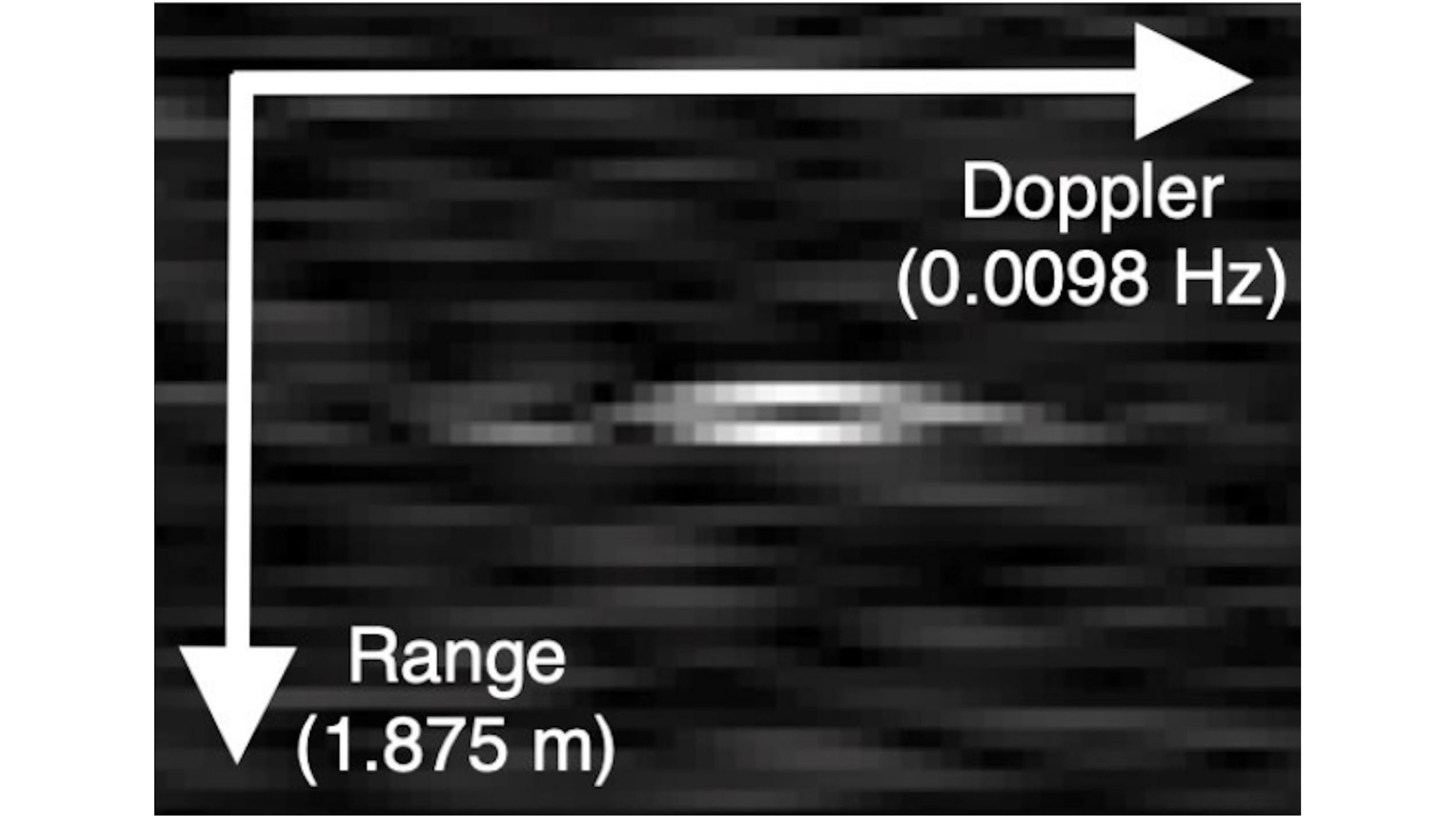
Click for next articleThe pixels in this image represent the Orion spacecraft during NASA’s Artemis 2 moon mission.
A giant radio telescope in West Virginia tracked Artemis 2 's Orion spacecraft around the moon for five days, gathering precise observations on its movements from over 200,000 miles away during the historic mission.
The observations came from the U.S. National Science Foundation Green Bank Telescope (NSF GBT).
The observatory released a pixelated image that the telescope captured of Orion while it was over 213,000 miles (343,000 km) from Earth .
The spike in this data, produced by the NSF GBT, represents the Artemis 2 Orion spacecraft.
Click for next article
The pixels in this image represent the Orion spacecraft during NASA’s Artemis 2 moon mission. The vertical (range) axis indicates distance to the spacecraft, with distance increasing downward in the image. The horizontal (Doppler) axis indicates a frequency shift from the expected return signal. This image of the Orion capsule was created while the spacecraft was over 213,000 miles (343,000 km) from Earth.
Here's a unique view of NASA's Artemis 2 moon mission.
A giant radio telescope in West Virginia tracked Artemis 2 's Orion spacecraft around the moon for five days, gathering precise observations on its movements from over 200,000 miles away during the historic mission.
The observations came from the U.S. National Science Foundation Green Bank Telescope (NSF GBT).
Reaching 485 feet (148 meters) up into the sky and weighing 17 million (7.7 million kilograms) pounds, with a dish that covers about 2.3 acres (0.9 hectares), the massive steerable telescope is the largest moving structure on land.
"With the GBT, we were able to track the movement of the spacecraft within 0.2 millimeters per second of what NASA calculated in its projections," Anthony Remijan, the observatory site director, said in a May 6 statement .
"It's like having a speedometer in your car that can track your speed within 0.0004 decimal places per hour," he continued.
The observatory released a pixelated image that the telescope captured of Orion while it was over 213,000 miles (343,000 km) from Earth . The vertical axis shows distance to the capsule, which the Artemis 2 crew named " Integrity ," with the distance increasing downward.
Signup to our newsletter Follow us on Google
"There are four people in those pixels," Will Armentrout, an NSF GBO scientist, said while presenting to colleagues at the NSF GBO.
The spike in this data, produced by the NSF GBT, represents the Artemis 2 Orion spacecraft. (Image credit: NSF/AUI/NSF NRAO)
The NSF National Radio Astronomy Observatory said that these observations show how the radio telescope can help on future space missions, both for NASA and for commercial aerospace companies.
"It's exciting when projects like this put our NSF facilities in national headlines," Linnea Avallone, NSF chief officer for research facilities, said in the same statement. "Being able to offer inter-agency support to our colleagues at NASA makes the most of all our capabilities."