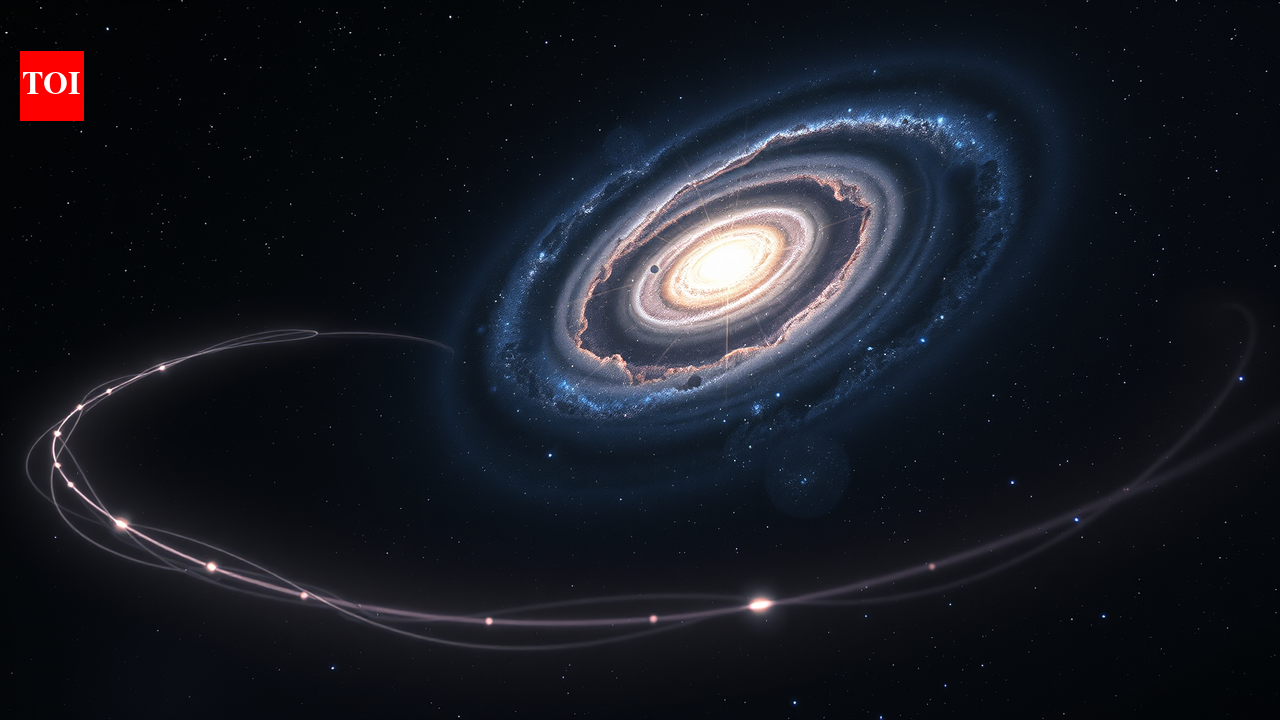
In 2021, the IceCube Neutrino Observatory buried deep in the Antarctic ice detected a high-energy neutrino known as IC 210922A.
Neutrinos are often called ghost particles because they carry no charge, have almost no mass and pass through planets and people without leaving a trace.
None of these were found, and even after multiple observatories scanned the region, the sky stayed unusually quiet.
This combination of brilliance and invisibility earned it the nickname Shadow Blaster.
Shadow Blaster broke that pattern completely.
Ghost particles and why they are so hard to trace
The hunt for the source of IC 210922A
Discovery of the dusty starburst galaxy Shadow Blaster
Gravitational lensing reveals the galaxy's hidden core
Star formation instead of a black hole as the energy source
What this discovery means for neutrino astronomy
Confirming the connection will take more evidence
A tiny particle that barely interacts with anything in the universe has helped scientists solve one of astronomy's long-standing mysteries. In 2021, the IceCube Neutrino Observatory buried deep in the Antarctic ice detected a high-energy neutrino known as IC 210922A. Neutrinos are often called ghost particles because they carry no charge, have almost no mass and pass through planets and people without leaving a trace. Pinpointing where they come from has always been extremely difficult, but a new study has finally traced this particular ghost back to a dust-hidden, star-forming galaxy nicknamed Shadow Blaster, located roughly 11 billion light-years away, offering the first strong evidence linking an individual starburst galaxy to a cosmic neutrino event.Neutrinos are among the most abundant particles with mass in the universe, yet they remain incredibly elusive. They are produced through processes like exploding stars, nuclear reactions inside the sun and the decay of heavier particles, but because they barely interact with matter, trillions of them pass through the human body every second without being noticed. This same quality that makes them fascinating also makes them nearly impossible to track back to a single source, since detectors like IceCube can only narrow a neutrino's origin down to a region of sky far larger than any individual galaxy.When IceCube recorded the high-energy neutrino event in 2021, astronomers immediately began searching the surrounding sky in the direction of the constellation Eridanus for an obvious explanation, such as a gamma ray burst, an exploding star or a black hole tearing apart a star. None of these were found, and even after multiple observatories scanned the region, the sky stayed unusually quiet. The research team, led by Yuji Urata of MITOS Science, eventually shifted their search toward longer wavelengths, the kind better suited to spotting galaxies hidden behind thick clouds of cosmic dust.A few days after the original alert, the team pointed the James Clerk Maxwell Telescope and the Submillimeter Array toward the flagged region and discovered an extremely bright galaxy called JCMT0402−0424. The galaxy showed an infrared luminosity nearly 2.7 trillion times that of the Sun, yet remained almost invisible to optical telescopes because of how densely it was wrapped in dust. This combination of brilliance and invisibility earned it the nickname Shadow Blaster. Full details of the discovery, along with the team's complete methodology, were later published in the peer-reviewed study available through Nature Astronomy Shadow Blaster turned out to sit almost directly behind a massive foreground elliptical galaxy, which acted as a natural gravitational lens. This lensing effect bent and magnified light from the more distant galaxy, splitting it into four distorted images and allowing astronomers to study a region that would otherwise have been too faint and too far away to resolve. Using the Gemini North telescope, researchers first measured the distance and mass of the foreground lensing galaxy, information that was essential for correctly modelling how much the lens magnified the signal. Follow-up observations using the Atacama Large Millimetre Array then revealed Shadow Blaster's core, a remarkably compact region only about 1,500 light years wide yet packed with gas and dust and forming stars at an intense pace.Most previously identified neutrino-producing galaxies have been powered by supermassive black holes launching energetic jets. Shadow Blaster broke that pattern completely. The observations showed no signs of an active black hole at its centre, suggesting instead that its dense, rapid star formation alone could be generating the cosmic rays responsible for producing high-energy neutrinos. Researchers believe that when stars form this quickly inside such a compact, gas-rich environment, the resulting collisions between particles can act like a natural accelerator, an idea long predicted by theoretical models but never directly observed in an individual galaxy until now.Scientists have only ever linked a handful of nearby galaxies to high-energy neutrinos, and these known sources fall far short of explaining the total flux of neutrinos detected on Earth, a puzzle astronomers call the diffuse neutrino background. If confirmed, Shadow Blaster would be the first dusty, star-forming galaxy ever directly tied to an individual neutrino event, and researchers estimate that galaxies like it could account for up to roughly 20 percent of that unexplained background. The team has been careful to describe Shadow Blaster as a strong candidate rather than a fully confirmed source, since a single spatial coincidence, however compelling, cannot alone prove a direct physical link.Researchers say confirming Shadow Blaster as the definitive source of IC 210922A will require either additional high-energy neutrinos arriving from the same direction in the years ahead or a more detailed theoretical model capable of predicting the exact energy of the original neutrino event based on the galaxy's known properties. Either way, this discovery opens an entirely new chapter in the search for the origins of the universe's ghost particles, suggesting that some of the most energetic neutrinos reaching Earth may be born not in the dramatic glow of a black hole jet, but quietly inside galaxies busy building stars in the hidden corners of the early universe.