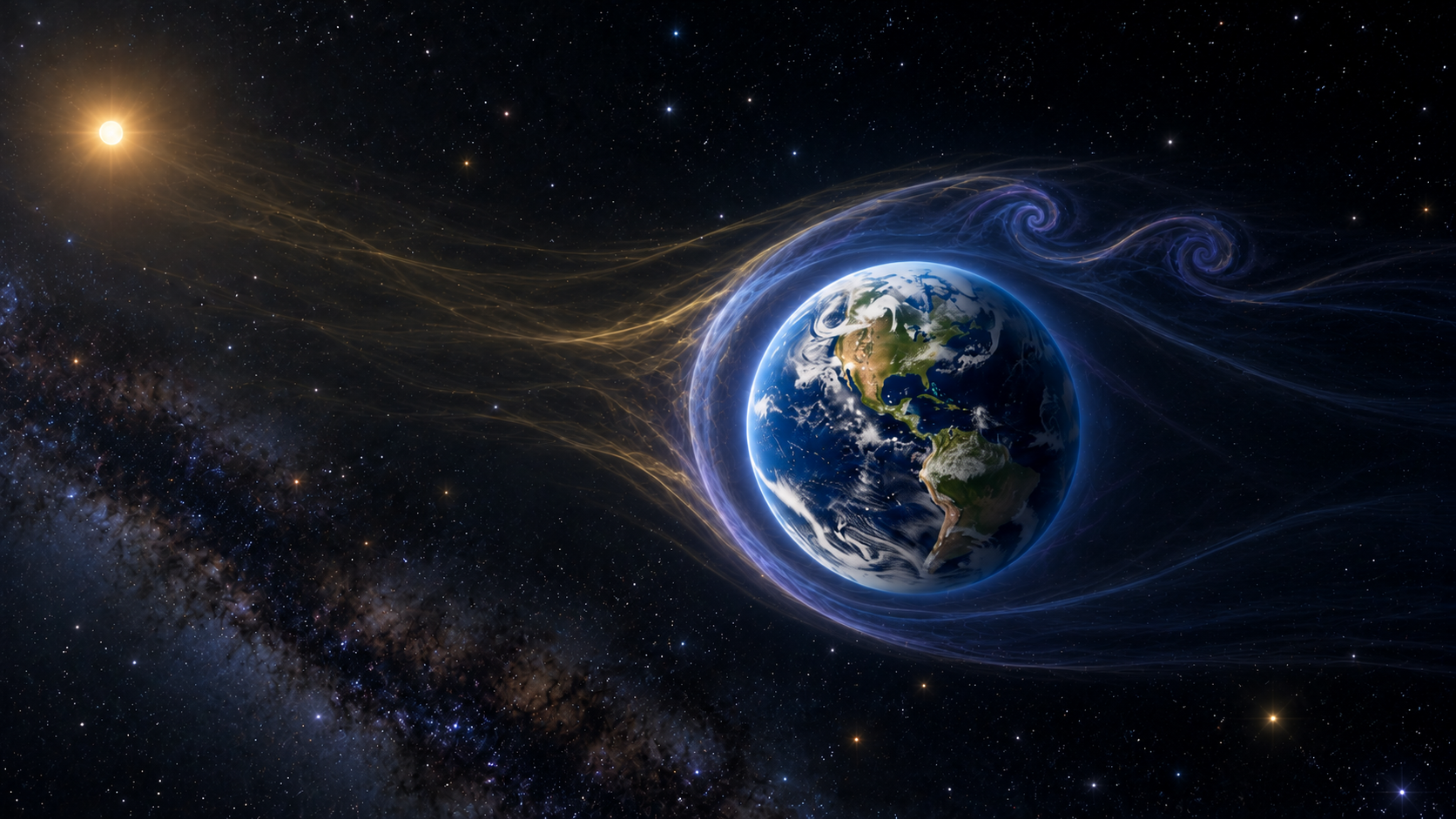
It also shows why the response of Earth’s magnetic environment depends on geometry, rather than solar wind strength alone.
In the simulated image of the Earth's magnetic field, the solar wind comes from the right in the image and Kelvin-Helmholtz waves are visible at the top.
(CREDIT: Lauri Holappa / University of Oulu)A boundary that moves and exchanges materialThe magnetosphere is the region dominated by Earth’s magnetic field.
Draped magnetic fields can hold waves backAs solar wind plasma encounters the magnetosphere, its magnetic field bends around the obstacle.
The original story "Earth’s tilted magnetic field changes where space waves form" is published in The Brighter Side of News.
Simulations explain how magnetic-field draping and reconnection shape uneven waves at Earth’s magnetic shield. (CREDIT: The Brighter Side of News)
Simulations show how magnetic-field draping and reconnection can favor boundary waves on one side of Earth’s magnetosphere.
Under the tested winter conditions, reversing the solar wind’s sideways magnetic-field component moved the waves from dawn to dusk.
The results explain a possible mechanism behind observed asymmetries, but do not demonstrate improved storm forecasts or isolate the waves’ effects on electrical currents.
Giant waves at the edge of Earth’s magnetic shield can grow strongly on one flank while barely appearing on another. Computer simulations now show how the solar wind’s magnetic field and the shape of the boundary can produce that uneven pattern.
The University of Oulu-led study, published in Geophysical Research Letters, examines Kelvin–Helmholtz waves. These arise where streams of plasma move at different speeds along the magnetosphere’s outer boundary.
The findings connect wave growth to magnetic-field draping and magnetic reconnection, a process that changes how field lines connect. Together, those effects can encourage waves in one region while suppressing them elsewhere.
The work offers a physical explanation for asymmetries previously seen in observations. It also shows why the response of Earth’s magnetic environment depends on geometry, rather than solar wind strength alone.
In the simulated image of the Earth's magnetic field, the solar wind comes from the right in the image and Kelvin-Helmholtz waves are visible at the top. The color indicates the density of the plasma. (CREDIT: Lauri Holappa / University of Oulu)
A boundary that moves and exchanges material
The magnetosphere is the region dominated by Earth’s magnetic field. Its outer boundary, called the magnetopause, separates that region from the surrounding magnetosheath, where solar wind plasma has passed through a shock. Plasma is a gas containing charged particles. As it flows past the magnetopause, differences in speed across the boundary can cause ripples to grow.
These ripples resemble the curling waves sometimes visible in clouds. Both involve Kelvin–Helmholtz instability, although magnetic forces add an important complication in space. When the instability develops far enough, waves can roll into vortices. Related processes, including reconnection and diffusion, can then help transport solar wind material into the magnetosphere. That exchange contributes to space weather, the changing conditions that can affect satellites, communications and electrical infrastructure. However, a boundary wave does not automatically produce a damaging storm.
Academy Research Fellow Lauri Holappa began investigating the pattern after noticing unusual simulation images during a NASA visit in 2020. He later recognized the waves and connected their different behavior on opposite sides. “Asymmetries in the wave motion at the edge of the magnetic field have been observed before, but now we were able to show how they arise,” Holappa said.
Two simulated worlds with one crucial difference
The team used the Lyon–Fedder–Mobarry global model at NASA Goddard’s Community Coordinated Modeling Center. It represents plasma and magnetic-field behavior across the magnetosphere rather than tracking individual particles. Two four-hour simulations used idealized solar wind conditions. Both set the wind speed at 500 kilometers per second and the proton density at five particles per cubic centimeter.
Kelvin–Helmholtz waves can also be seen in clouds. (CREDIT: Famartin, CC BY-SA 4.0 via Wikimedia Commons)
Earth’s magnetic dipole had a fixed tilt of minus 35 degrees, representing northern winter and southern summer. The interplanetary magnetic field’s north–south component pointed southward, allowing substantial magnetic reconnection. The key difference was the sideways magnetic-field component, known as By. One run used plus five nanoteslas; the other used minus five nanoteslas.
Changing that sign changed where the waves appeared. Positive By favored the dawn flank in the northern hemisphere. Negative By favored the dusk flank there instead. Neither simulation showed comparable visible waves on the southern, summer-side boundary in the examined slices. This is a finding under the tested conditions, rather than a rule that winter always hosts the strongest activity.
The simulated waves had wavelengths of roughly five Earth radii, about 32,000 kilometers. Their estimated propagation speed was around 170 kilometers per second. That describes movement along the boundary, not a wave sweeping across Earth’s surface.
Draped magnetic fields can hold waves back
As solar wind plasma encounters the magnetosphere, its magnetic field bends around the obstacle. This draping is uneven when the incoming field has a sideways component and Earth’s dipole is tilted. The orientation matters because bending a magnetic field creates a restoring force called magnetic tension. Field components aligned with a growing wave can resist its development.
In the positive-By simulation, the draped field supplied stronger stabilizing tension on the northern dusk flank. The northern dawn flank experienced less resistance, allowing waves to grow more easily. Reversing By shifted the favored side. The pattern therefore emerged from how the fields met and wrapped around the magnetosphere, rather than from a permanent weakness at dawn or dusk.
Kelvin-Helmholtz waves are also seen in river currents. Countercurrents meet the main current, creating eddies and Kelvin-Helmholtz waves. A similar encounter of opposing currents occurs at the edge of the magnetosphere. (CREDIT: Katariina Nykyri)
The researchers also assessed wave growth using theoretical calculations based on local plasma properties. Those calculations agreed with the simulations’ preference for northern dawn-side waves under positive By. Density differences did not contribute significantly to the asymmetry at the sampled locations. Differences in magnetic tension and velocity shear were more important.
Reconnection reshapes the flow as well
Magnetic tension was only part of the explanation. Reconnection also changed the direction of plasma flow and the thickness of the boundary layer. For positive By, the simulated reconnection line curved from southern dawn toward northern dusk. Its geometry helped create stronger velocity shear on the northern dawn side.
The northern dusk boundary also had a broader transition between different flow speeds. Kelvin–Helmholtz instability generally grows more slowly when that shear layer is thicker. That broader layer reinforced the stabilizing effect of magnetic tension. On the opposite flank, a thinner layer and stronger shear favored wave growth.
These mechanisms may be linked, because reconnection can also influence magnetic-field draping. The study therefore treats the uneven wave pattern as the result of interacting processes. The comparison with water flowing past a breakwater offers a useful starting point. Yet space adds magnetic forces and reconnection, making its boundary behavior more complicated than ordinary water waves.
A mechanism to test, rather than a finished forecast
The simulations also produced uneven distributions of electrical currents flowing along magnetic field lines. Their pattern agreed in important respects with earlier empirical studies. However, the analysis did not isolate how much of that current pattern came from Kelvin–Helmholtz waves. Velocity shear, pressure gradients and reconnection-driven circulation could also contribute.
Snapshots of the magnetospheric plasma density from the two LFM runs. (CREDIT: Lauri Holappa et al, Geophysical Research Letters 2026)
The authors say higher-resolution simulations and detailed mapping between vortices and currents are needed to establish causality. They also call for simultaneous spacecraft measurements across dawn and dusk regions in both hemispheres. The model used steady inputs and did not include the usual Parker-spiral configuration of the interplanetary field. Real solar wind conditions change over time, adding further tests for the proposed explanation.
The result is a clearer account of where boundary waves can grow under specific magnetic conditions. Incorporating and testing that mechanism could improve space weather models, but this study did not measure a gain in forecasting accuracy. Testing the mechanism across changing conditions is therefore an important next step.
Dig deeper into waves at Earth’s magnetic boundary
These studies explore seasonal wave activity, plasma transport and the processes operating across the magnetopause.
Seasonal and diurnal variations of Kelvin-Helmholtz Instability at terrestrial magnetopause: Examines how Earth’s magnetic dipole orientation influences observed wave occurrence. (Nature Communications, 2023)
Kelvin-Helmholtz Stability Analysis as a Function of Dipole Tilt and Solar Wind Property: Analyzes how tilt and solar wind conditions affect boundary stability. (Journal of Geophysical Research: Space Physics, 2026)
Comparison of Kelvin–Helmholtz waves observed simultaneously at the dawn and dusk flanks of the Earth’s magnetopause: Compares spacecraft observations of waves on opposite flanks. (Planetary and Space Science, 2025)
Multi-scale processes of the Kelvin-Helmholtz instability at Earth’s magnetopause: Reviews interactions among wave growth, turbulence, reconnection and plasma transport. (Frontiers in Astronomy and Space Sciences, 2024)
Transport of solar wind into Earth’s magnetosphere through rolled-up Kelvin–Helmholtz vortices: Presents foundational observational evidence linking vortices with solar wind plasma entry. (Nature, 2004)
Research findings are available online in the journal Geophysical Research Letters.
The original story "Earth’s tilted magnetic field changes where space waves form" is published in The Brighter Side of News.
Related Stories