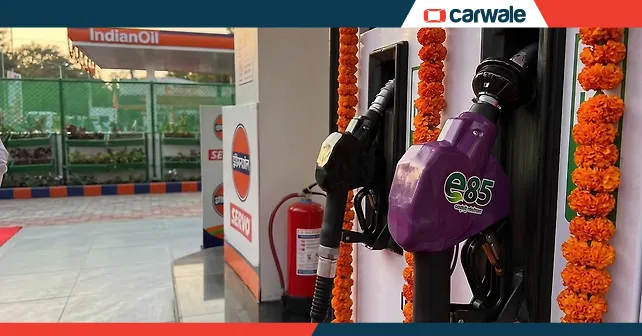
E85 fuel launched in Delhi at Rs.
82.12 per litreContains up to 85 per cent ethanol and 15 per cent petrolIndia's ethanol-blending programme has taken another step forward with the introduction of E85 fuel in Delhi.
82.12 per litre, the new fuel is significantly cheaper than petrol, which currently costs around Rs.
While the E20 fuel currently available across the country contains up to 20 per cent ethanol, E85 contains as much as 85 per cent ethanol blended with 15 per cent petrol.
As a result, the vast majority of petrol-powered cars currently sold in India cannot use E85 fuel.
E85 fuel launched in Delhi at Rs. 82.12 per litre
Contains up to 85 per cent ethanol and 15 per cent petrol
India's ethanol-blending programme has taken another step forward with the introduction of E85 fuel in Delhi. Priced at Rs. 82.12 per litre, the new fuel is significantly cheaper than petrol, which currently costs around Rs. 110 per litre in Mumbai. At first glance, that difference of nearly Rs. 28 per litre appears substantial enough to attract motorists. However, the arrival of E85 raises two important questions: can your car use it, and will it actually reduce your fuel bills?
For starters, E85 is not simply another version of petrol. While the E20 fuel currently available across the country contains up to 20 per cent ethanol, E85 contains as much as 85 per cent ethanol blended with 15 per cent petrol. This higher ethanol concentration requires specially designed engines and fuel systems that can handle the unique properties of ethanol.
As a result, the vast majority of petrol-powered cars currently sold in India cannot use E85 fuel. Even though many manufacturers have upgraded their vehicles to support E20 petrol, that does not automatically make them compatible with E85. Running E85 in a conventional petrol vehicle could potentially lead to performance issues and long-term mechanical damage.
To use E85, a vehicle needs to be flex-fuel compatible. Such vehicles can automatically adjust engine parameters to run on varying ethanol blends ranging from regular petrol to E85. Over the past few years, several manufacturers have showcased flex-fuel prototypes in India. Among the most notable examples is the Maruti Suzuki Wagon R Flex Fuel, which was specifically developed to operate on higher ethanol blends.
Then comes the question of savings. At Rs. 82.12 per litre, E85 is around 20 per cent cheaper than petrol in Delhi. On paper, this should translate into lower running costs. However, the reality is slightly more complicated.
Ethanol contains less energy than petrol. As a result, vehicles running on E85 generally consume more fuel to travel the same distance. In international markets such as Brazil and the United States, flex-fuel vehicles operating on E85 often experience a fuel efficiency drop of anywhere between 20 and 30 per cent compared to petrol.
To understand this better, consider a hypothetical example. If a petrol-powered car returns 15kmpl on regular petrol costing Rs. 102.12 per litre, the running cost works out to roughly Rs. 6.81 per kilometre. If the same vehicle running on E85 experiences a 25 per cent drop in efficiency, fuel economy would reduce to around 11.25kmpl. At Rs. 82.12 per litre, the running cost would be approximately Rs. 7.30 per kilometre.
Interestingly, despite the lower fuel price, the running cost in this example is actually higher due to the drop in fuel efficiency. This highlights why motorists should look beyond the per-litre price when evaluating the potential benefits of E85.
This highlights the larger purpose of E85. The fuel is not solely about reducing running costs for consumers. Instead, it forms part of India's broader strategy to reduce crude oil imports, support domestic ethanol production, and lower tailpipe emissions. Ethanol is primarily produced from agricultural feedstocks, making it a domestically sourced alternative to imported fossil fuels.
For consumers, however, the journey towards E85 adoption is only just beginning. While the fuel has now arrived, flex-fuel vehicles remain a rarity, and availability is currently limited to select locations. Until compatible products become more widespread, E85 will largely remain a technology showcase rather than a mainstream alternative to petrol.