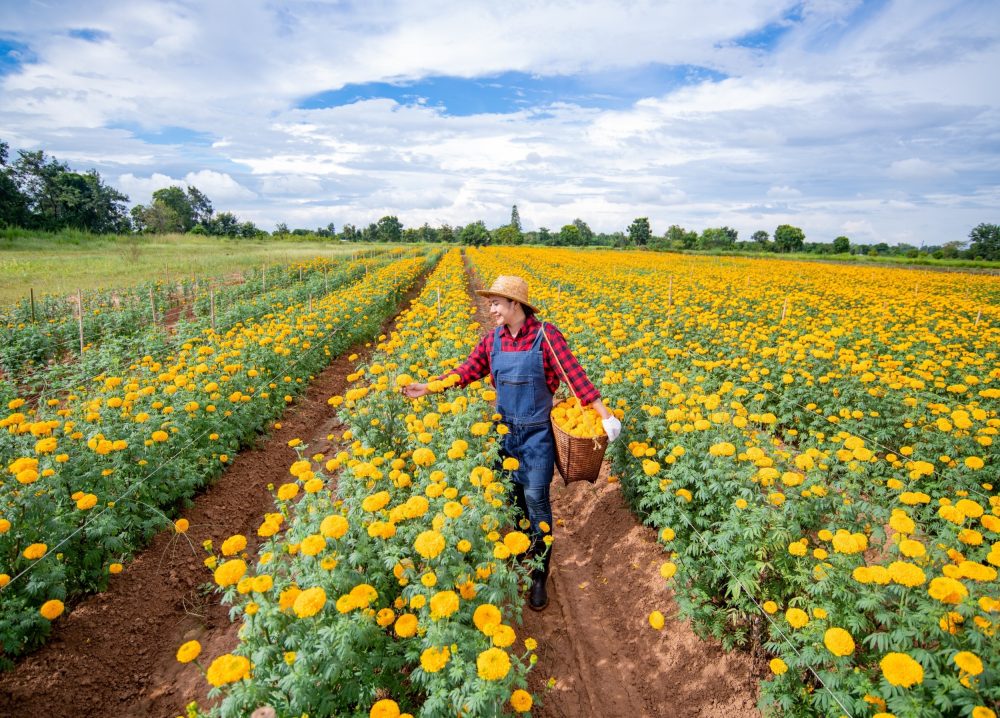
Marigold protein rivals quinoaMarigold petals are not just pretty filler.
The team did not treat marigold protein as one thing.
Marigold protein could add depth to a dish rather than only bulk.
We must look around and uncover it.”The researchers say the next step is testing how marigold protein behaves in real products and on industrial lines.
Turning discarded blooms into food, after all, could cut waste and open a fresh protein source at the same time.
Marigolds turn up in gardens, festival garlands, and wedding decorations. Hardly anyone pictures them as food.
That habit might be worth rethinking. A team at the University of Georgia took a hard look at the common marigold and found real value packed into its petals.
Wasted flowers hold value
Floral waste is a bigger problem than most people realize.
In India, close to 40 percent of the marigolds grown each year are thrown out, and the floral trade in the United States piles up its own mountains of discards.
All that waste is what got the researchers curious.
Study co-author Anand Mohan is an associate professor at the College of Agricultural and Environmental Sciences (CAES).
“Billions of dollars of flowers are thrown away each year,” said Mohan. “Can you imagine if we were able to take those flowers and use them for food instead?”
He admitted it is easier said than done. Work like this, he added, is the first real step toward making it happen.
Marigold protein rivals quinoa
Marigold petals are not just pretty filler. On a dry-weight basis, they hold almost 10 percent protein.
That lands them in the same neighborhood as familiar plant sources like quinoa, oats, and wheat. For a flower most people overlook, that is a serious amount.
The team did not treat marigold protein as one thing. They separated it into four types, each one loosened by a different liquid during extraction.
Albumin made up the biggest share at roughly 65 percent. It also proved to be the most useful of the bunch, leading the pack on water holding, oil holding, and emulsifying.
Heat tolerance of marigold protein
One result stood out for anyone who bakes or cooks. Marigold albumin stayed stable up to around 221 degrees Fahrenheit, the point where its structure finally started to give way.
That is tougher than the protein in chickpea and pea. Heat tolerance like that matters in breads, snacks, and anything pushed through high-temperature processing.
Several marigold proteins were good at emulsifying. That is the property that keeps oil and water blended instead of splitting apart in foods like salad dressing.
Albumin again came out on top, holding more oil and water than the other fractions.
Inside it sat plenty of small, low-weight protein pieces. These move quickly to the line between oil and water and hold the mixture together.
Flavor, antioxidants, and minerals
The petals also offer something for flavor. Albumin, glutelin, and globulin were rich in glutamic and aspartic acid.
Those are the amino acids behind savory, umami taste. Marigold protein could add depth to a dish rather than only bulk.
There was more than protein hiding in the flowers. Albumin and glutelin showed the strongest antioxidant activity, which helps slow the way fats spoil in food.
The petals also carry fiber and a healthy dose of minerals. Calcium, potassium, and iron all turned up in good amounts.
Rethinking what flowers can do
“What excites me most about this research is that it challenges how we think about flowers,” said Fidele Benimana, first author of the study.
“Most people see marigolds as ornamental plants, but they also contain proteins with unique functional properties that could be useful in food formulation.”
The findings suggest that edible flowers could become useful food ingredients because they provide nutrition along with texture, stability, and other properties needed in today’s food products.
Not every marigold is safe
One word of caution before anyone raids the garden. Not every marigold belongs on a plate.
The safe ones are pot marigold, also called Calendula, and the true marigolds in the Tagetes group.
This study worked with Calendula officinalis, the common marigold. Its proteins came from the petals, since the stems and leaves taste bitter.
Looking beyond the bloom
“I don’t know if the marigold is a super flower. But to me, I feel like maybe all these beautiful flowers are super flowers. You’d be surprised by how little we actually know about the flowers growing in our yards,” said Mohan.
“Mother Nature still holds a lot of truth that we don’t know yet. We must look around and uncover it.”
The researchers say the next step is testing how marigold protein behaves in real products and on industrial lines.
Turning discarded blooms into food, after all, could cut waste and open a fresh protein source at the same time.
The study is published in the journal ACS Food Science & Technology.
—–
Like what you read? Subscribe to our newsletter for engaging articles, exclusive content, and the latest updates.
Check us out on EarthSnap, a free app brought to you by Eric Ralls and Earth.com.
—–