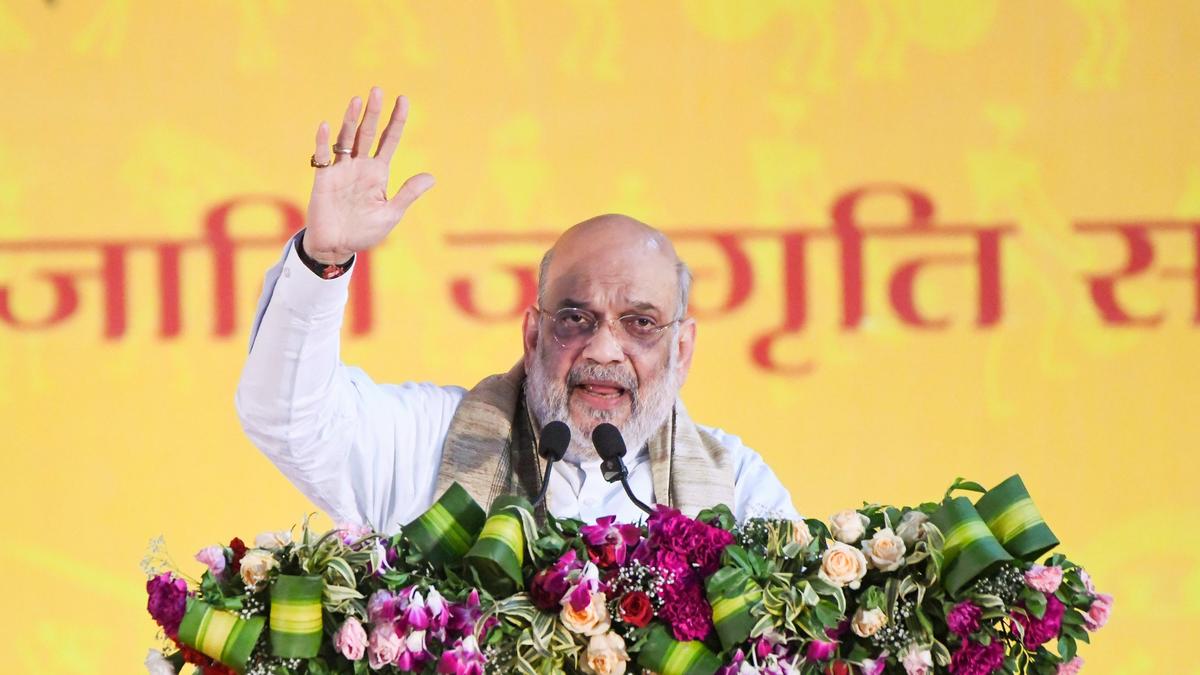
The Union government on Tuesday (May 26, 2026) constituted a “High-Level Committee to study the demographic changes arising from illegal immigration and other abnormal reasons”, Home Minister Amit Shah said.
The committee will also recommend an appropriate institutional mechanism for “population stabilisation,” according to the terms of reference.
“This committee will conduct a comprehensive assessment of the demographic changes occurring across India due to illegal immigration and other abnormal reasons.
It will analyse patterns of abnormal population changes at the level of religious and social communities and will present a well-planned and time-bound solution to address the issue,” the Minister said.
The committee may also recommend any other measures it deems appropriate to address challenges arising from demographic changes, the Ministry said.
The Union government on Tuesday (May 26, 2026) constituted a “High-Level Committee to study the demographic changes arising from illegal immigration and other abnormal reasons”, Home Minister Amit Shah said.
The committee will also recommend an appropriate institutional mechanism for “population stabilisation,” according to the terms of reference.
The panel has been directed to submit its report within a year, and if necessary, its tenure could be extended by up to six months, the Ministry of Home Affairs (MHA) said.
The committee will be headed by retired Supreme Court Judge Prakash Prabhakar Navlekar (83) and will also comprise the Census Commissioner, retired IAS officer Durga Shanker Mishra, retired IPS officer Balaji Srivastava (Retired IPS) and Dr. Shamika Ravi, who is part of the PM’s Economic Advisory Council. The Joint Secretary (Foreigners-I) in the MHA will be the Member Secretary of the Committee.
Justice Navlekar also served as Lokayukta of Madhya Pradesh. Mr. Mishra retired as Chief Secretary of Uttar Pradesh on June 30, 2024, and Mr. Srivastava, former Director General of the Bureau of Police Research and Development, retired in March 2024.
The last population census was conducted in the country in 2011, and the next Census exercise is scheduled for 2027.
The latest Sample Registration System (SRS) report for 2024 shows that India’s birth rate fell from 21 in 2014 to 18.3 in 2024. According to the National Family Health Survey-V, published in 2022, the country’s Total Fertility Rate (TFR)—an average number of children per woman—dropped to 2, lower than the replacement level of 2.1. The SRS covered a population of 89.81 lakh.
In a post on X, Mr. Shah said, “Illegal infiltration and other reasons leading to unnatural demographic change are a very big challenge for the present and future of any nation. To deal with this challenge, Prime Minister Shri Narendra Modi had announced the ‘High-Level Committee on Demographic Change’ on 15 August 2025. I am delighted to inform that the government has constituted this Committee.”
A serious problem
He stated that demographic change is a serious problem linked not only to sovereignty but also to national security, law and order, major changes in social structure, and the protection of tribal societies. “This committee will conduct a comprehensive assessment of the demographic changes occurring across India due to illegal immigration and other abnormal reasons. It will analyse patterns of abnormal population changes at the level of religious and social communities and will present a well-planned and time-bound solution to address the issue,” the Minister said.
The MHA said that the committee will scientifically assess the demographic changes occurring in various parts of the country due to illegal immigration and other abnormal reasons, analyse their causes, and recommend appropriate policy, legislative, and administrative measures. The proposed structure and Terms of Reference of the Committee are to comprehensively deliberate upon the challenges arising from demographic changes to study the possible causes such as cross-border activities (including illegal immigration), economic opportunities, and other socio-environmental factors, the Ministry said.
The committee will also identify factors, including illegal immigration, abnormal settlement patterns, and orchestrated migration, and analyse structural population changes at the level of religious or social communities, particularly where they deviate from broader trends. The committee has also been tasked with recommending a streamlined and permanent operational mechanism for the legal, fair, and time-bound identification, detention, and deportation of illegal immigrants residing in the country.
Additionally, it will recommend an appropriate institutional mechanism to strengthen border management, population stabilisation, and identification systems for the continuous monitoring of such trends and propose a comprehensive policy framework to enhance coordination between the Central and State Governments on matters related to illegal immigration and the resulting demographic imbalances.
The committee may also recommend any other measures it deems appropriate to address challenges arising from demographic changes, the Ministry said.
On October 10, 2025, Mr. Shah had said at an event that, according to the 2011 Census, the decadal growth of the Muslim population in Assam was 29%, which, he claimed, was “not possible without infiltration”. He had also said that in West Bengal, the decadal growth of the Muslim population had crossed 40%, and reached 70% in some districts.