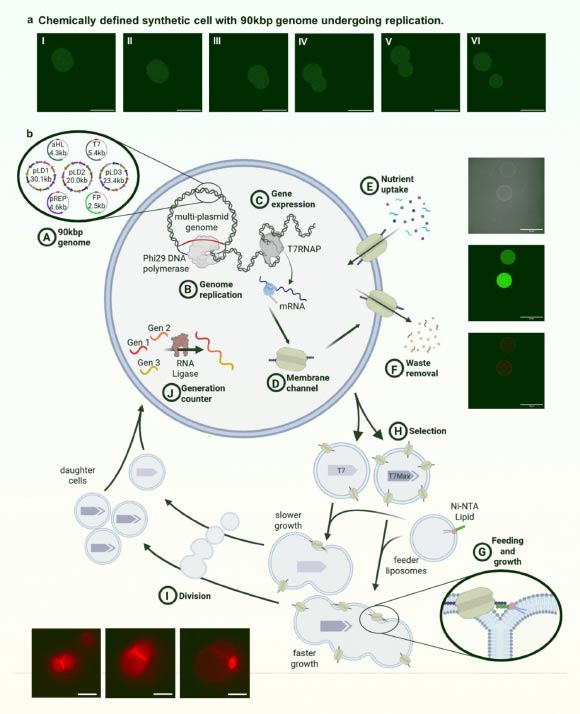
The genome was designed to encode everything the cell would need to feed itself, replicate its DNA, grow and divide.
To feed, the synthetic cells fuse with smaller ‘feeder’ liposomes that supply lipids, enzymes and small molecules.
Over repeated rounds of feeding, the cells replicated their DNA using an enzyme borrowed from a bacterial virus, and were mechanically split into ‘daughter’ cells.
They showed that this genetically encoded division, too, could be linked to the feeding advantage, with faster-growing cells producing more daughter cells.
A Chemically Defined Synthetic Cell Capable Of Growth and Replication.
Biologists at the University of Minnesota say they have built a synthetic cell — made entirely from non-living chemical components — that can complete a full life cycle: taking in nutrients, growing, copying its genetic material, dividing into daughter cells and passing along beneficial mutations to the next generation. Called SpudCell, their project marks a major breakthrough in biological engineering.
“DNA is the programming for all living organisms,” said corresponding author Dr. Katarzyna Adamala and her colleagues.
“A human genome is roughly 3 billion pairs in size. Biologists had speculated that the genome for a living cell could be as small as 113,000 pairs, but SpudCell’s genome is even smaller, at 90,000 pairs.”
Unlike natural cells, which inherit billions of years of evolutionary machinery, the team’s synthetic cells were assembled from scratch out of chemically defined parts: fatty membranes shaped into liposomes, a stripped-down protein-making system, and a 90,000-base-pair genome spread across seven or eight plasmids.
The genome was designed to encode everything the cell would need to feed itself, replicate its DNA, grow and divide.
To feed, the synthetic cells fuse with smaller ‘feeder’ liposomes that supply lipids, enzymes and small molecules.
The fusion is triggered by a modified bacterial pore protein, made by the cell itself, that displays a chemical tag on its outer surface. That tag latches onto a matching tag on the feeder liposomes, merging the two and delivering fresh raw material — a process the researchers compare to a predator drawing in prey that is deliberately kept in surplus.
Over repeated rounds of feeding, the cells replicated their DNA using an enzyme borrowed from a bacterial virus, and were mechanically split into ‘daughter’ cells.
Tracking a chemical marker built into each round of feeder liposomes, the team followed a single lineage of cells through five generations, and found that roughly 30% of the surviving daughter cells still carried a complete copy of the seven-part genome, despite having no cellular skeleton or dedicated system for sorting DNA to offspring, mechanisms every natural cell relies on.
The scientists then tested whether Darwinian selection could take hold in this stripped-down system.
They engineered a version of the feeding protein with a stronger genetic promoter, causing cells carrying it to fuse with feeder liposomes more efficiently.
When cells with the stronger and weaker versions were mixed and allowed to compete for five generations, the faster-growing cells gradually made up a larger share of the population, rising from an even split to as much as 61% in one experiment.
When feeder liposomes were made scarce, mimicking limited resources, the advantage of the faster-growing cells grew even more pronounced, with fast growers eventually outnumbering slow growers by better than two to one.
“This is likely the most exciting project I’ve ever worked on,” Dr. Adamala said.
“We’ve replicated in chemistry what only used to be possible in biology: the complete set of behaviors of a cell.”
“It proves that the most fundamental functions of life, like growth and replication, do not need a mysterious magical spark.”
Finally, the authors engineered a division mechanism that does not depend on any cellular skeleton, instead relying on proteins crowding together on the cell’s surface to pinch the membrane apart.
They showed that this genetically encoded division, too, could be linked to the feeding advantage, with faster-growing cells producing more daughter cells.
“This work is just the beginning,” Dr. Adamala said.
“We are showing it’s possible to engineer the basic functions of the cell.”
“To fully realize the promise of this technology — to make it robust and practical — we need combined international effort.”
A paper on the findings was posted July 2 as a preprint on bioRxiv.org.
_____
Nathaniel J. Gaut et al. 2026. A Chemically Defined Synthetic Cell Capable Of Growth and Replication. bioRxiv, doi: 10.64898/2026.07.01.735724