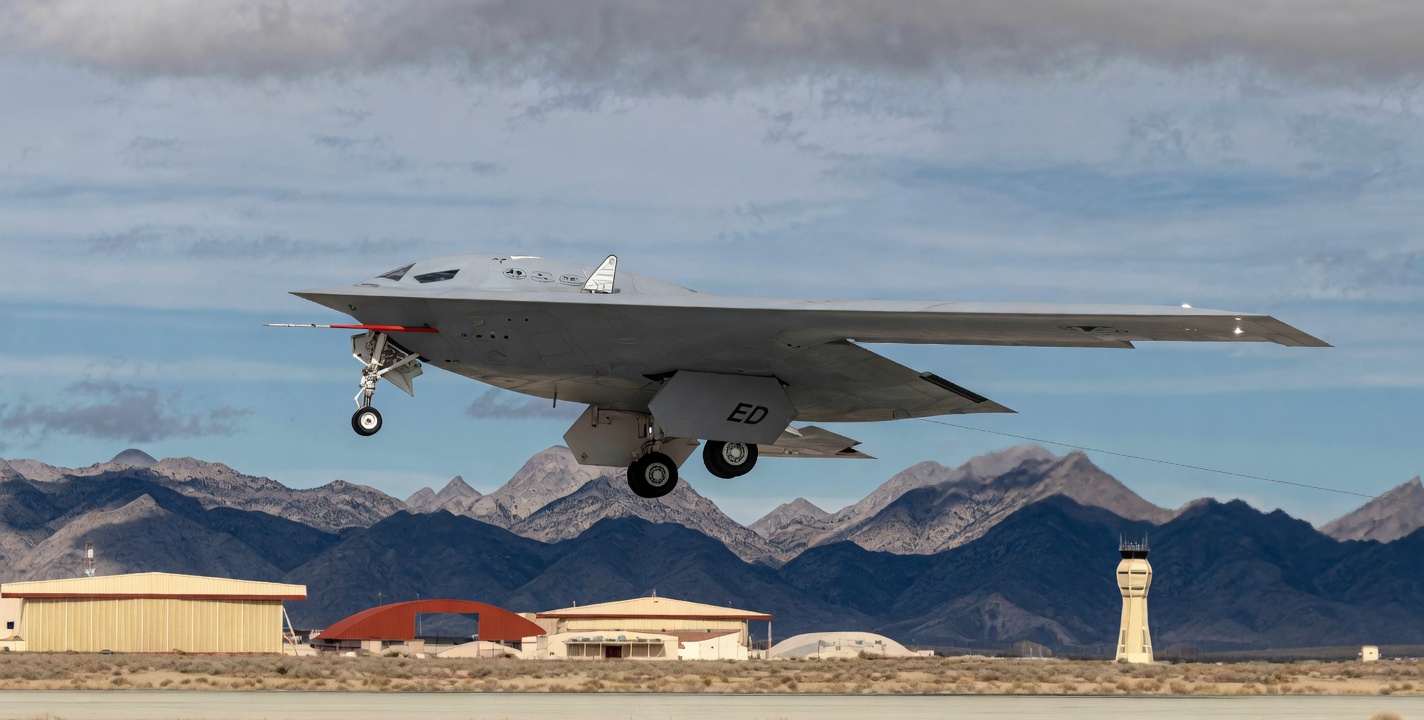
In a big breakthrough for the B-21 Raider program, an operational test pilot flew alongside a developmental test pilot, sharing the cockpit for the first time, bringing the next-generation stealth bomber another step closer to induction.
So far, only the 420th Flight Test Squadron pilots, in charge of developmental flight testing with the first two airframes, had flown the B-21.
“We put an operational test member in the pilot seat with an Air Force Test Pilot School graduate in the other,” Col. Matt Guasco, AFOTEC Det.
The DT/OT integration within the B-21 Raider program marks the fastest integration of operational testers into developmental testing for a major acquisition.
The B-21 is ComingThe B-21 bomber is a sixth-generation stealth aircraft designed to conduct deep-penetrating nuclear and conventional strikes in heavily defended airspace.
In a big breakthrough for the B-21 Raider program, an operational test pilot flew alongside a developmental test pilot, sharing the cockpit for the first time, bringing the next-generation stealth bomber another step closer to induction.
“Another milestone for the B-21! Putting operational and developmental test pilots in the same cockpit today accelerates the delivery of lethality tomorrow. We are rapidly fielding and getting after test faster than ever,” General Kenneth Wilsbach, the Chief of Staff of the United States Air Force (USAF), said in a post on X.
The first flight was conducted at Edwards Air Force Base, California, and the operational pilot was assigned to the Air Force Operational Test and Evaluation Center’s Detachment 5 at Edwards AFB, the USAF said in an official statement, without disclosing the flight date.
So far, only the 420th Flight Test Squadron pilots, in charge of developmental flight testing with the first two airframes, had flown the B-21.
“We put an operational test member in the pilot seat with an Air Force Test Pilot School graduate in the other,” Col. Matt Guasco, AFOTEC Det. 5 commander, stated. “In the history of modern testing, we’ve never done that so early in a program.”
The developmental testing (DT) is conducted to ensure that an aircraft meets its technical specifications and flies safely, whereas operational testing (OT) is conducted separately and at a later stage to determine whether the platform is combat-effective, appropriate, and survivable in the hands of the warfighter.
Moving directly into a mixed DT/OT phase closes the gap between ensuring a plane is operational and ensuring it is combat-ready.
“Bringing operational testers onto the team at this early point in the program now means we can evaluate the bomber’s true combat utility, not just its flying characteristics,” said Lt. Col. Matthew Gray, 420th Flight Test Squadron commander and Raider CTF director.
In general, operational pilots bring real-world combat perspectives, such as tactics, mission effectiveness, crew workload, survivability in contested environments, etc, while the design and software are still evolving. Their involvement in the testing would help the USAF to fix issues before the aircraft is “locked in,” avoiding costly retrofits later.
Succinctly put, this approach shortens the overall timeline from testing to initial operational capability (IOC), potentially allowing the aircraft to deploy sooner if needed.
The DT/OT integration within the B-21 Raider program marks the fastest integration of operational testers into developmental testing for a major acquisition. It reflects the USAF’s push to field the Raider more quickly to address strategic needs, such as the looming threat of a conflict in the West Pacific, and sustained tensions in West Asia.
“Integrating operational and developmental test in the B-21 exemplifies the acquisition culture we’re instilling throughout the force,” said Gen. Dale White, the Pentagon’s direct reporting portfolio manager for critical weapon systems. “It’s a smarter and faster mindset that leverages modern production and test tools with the proper sense of urgency, an urgency that challenges old processes and moves us to a more agile acquisition system.”
“In the case of the Raider,” White said, “it means we’re now that much closer to placing asymmetric lethality into the hands of the warfighter.”
Earlier, during an all-call with the Raider CTF team, General White had said that there are three capabilities—the B-21 Raider, the F-47 sixth-generation fighter, and the Sentinel Intercontinental ballistic missile (ICBM)—that the US would turn to in its “darkest hour.”
Notably, the project has moved at a breakneck pace, going from the official public unveiling in December 2022 to the maiden flight in November 2023, and onto the integration of the development and operational test pilots in June 2026.
This milestone, achieved by the Raider program, according to officials, underscores the urgency of fielding the B-21, which is expected to replace the B-2 and B-1B bombers over the long term. The USAF and Northrop officials have stated that the sixth-generation bomber is “close” to entering service and is expected to reach Ellsworth AFB in South Dakota, one of the three bases selected for basing Raider, in 2027.
In addition to expediting testing to shorten induction time, there are growing calls to expand the planned fleet of B-21 Raiders. The USAF currently plans to buy about 100 B-21 next-generation bombers, but top officials, such as the Indo-Pacific Commander, Admiral Samuel Paparo, said he would favor a fleet of at least 200 B-21 bombers, not just for nuclear deterrence, but also for penetrating strike capabilities.
Meanwhile, a report by the Mitchell Institute for Aerospace Studies titled “Strategic Attack: Maintaining the Air Force’s Capacity to Deny Enemy Sanctuaries,” said the USAF’s current plans to purchase “at least” 100 B-21s are commensurate with one-time operations into hostile airspace, such as Operation Midnight Hammer [launched to destroy Iran’s nuclear facilities in June 2025], but insufficient to maintain pressure in a larger conflict because they are “a raid force, not a campaign force.”
On its part, Northrop Grumman is making attempts to expand the production of the B-21 Raider, as notified by Kathy Warden, Northrop’s chief executive, during a May 28 discussion at the Bernstein Strategic Decisions Conference. The manufacturer hopes that steady production growth will prompt the USAF to increase acquisition and final fleet sizes.
The B-21 is Coming
The B-21 bomber is a sixth-generation stealth aircraft designed to conduct deep-penetrating nuclear and conventional strikes in heavily defended airspace. It is anticipated to replace the B-2 Spirit bombers, which have recently proven their mettle during the Iran War 2026 and during Operation Midnight Hammer, launched in June 2025.
Two test B-21 bombers are currently in testing. The first aircraft arrived at Edwards AFB for flight testing after its first flight in 2023, while the second was welcomed only in 2025. The testing has progressed well into more advanced phases, including aerial refueling demonstrated earlier this year, mission systems evaluation, and weapons integration.
Officials have stated that the program is believed to be exceeding expectations as test aircraft are achieving high “code one” rates, which is the rate at which the aircraft is ready to fly again with minimal issues. In fact, a major 180-day test cycle was reportedly completed in just 73 days, as revealed in May 2026.
The bomber is currently in Low Rate Initial Production (LRIP), which involves building a small number of aircraft to test the production process and refine it before full-rate production begins. The USAF and Northrop agreed on a $4.5 billion deal in February this year, to increase production capacity by 25%, in a bid to accelerate deliveries while maintaining cost and performance discipline.
Details about the B-21 have been withheld, but we know it will feature significantly more advanced stealth technology than its predecessors, including narrower, recessed air intakes that reduce the radar cross-section and a smoother radar-absorbent coating.
In addition to its advanced broadband low-observable characteristics, the B-21 is expected to have a very long unrefueled range, thanks to advanced engines and a highly efficient airframe designed for high-altitude flight. This will reduce the need for airborne tanker support for refueling during operations, although the bomber has already been very well integrated with a KC-135 refueller, as demonstrated in April 2026.
The B-21 will be much more than just a strategic bomber with its wide range of networking, combat management, electronic warfare, and intelligence, surveillance, and reconnaissance (ISR) capabilities.
Notably, the B-21 is a next-generation aircraft with much-improved targeting radar arrays, state-of-the-art avionics, and sensors.
Furthermore, Northrop claims that the Raider’s ability to penetrate airspace deemed impenetrable distinguishes it from existing USAF bombers.
“As adversaries continue to invest in and develop advanced weapons, the B-21 Raider will provide the United States with a strategic asset capable of penetrating enemy air defences and reaching targets anywhere in the world — something approximately 90 percent of the nation’s current bomber fleet is incapable of doing,” the manufacturer stated earlier.
The B-21 will eventually replace the B-2, the backbone of the US strategic operations. However, unlike the B-2, which featured a boxy, sugar-scoop exhaust, the B-21 exhibits a narrow, 2-D exhaust embedded in the jet’s tail.
Experts have already noted that the B-21’s 2-D exhaust system appears to reduce infrared signatures, and its design prioritizes ultra-low observability against cutting-edge air defenses.
Consequently, it has exceptional deep-penetration capability and is a very stealthy aircraft.
The B-21 is expected to be a huge aircraft, yet still much smaller than the iconic bomber it is meant to replace, as previously explained by the EurAsian Times. It has a wingspan of about 140 feet, which is far less than the B-2’s 172-foot wingspan. In addition, the B-21 is expected to carry only 9,100 kg of payload, compared to 18,000 kg for the B-2. However, it is important to keep in mind that these B-21 characteristics are just estimates.
The sixth-generation open systems architecture of the B-21 will facilitate the integration of new technology and software. “The B-21 is being designed with open systems architecture to reduce integration risk and enable competition for future modernization efforts to allow the aircraft to evolve as the threat environment changes,” states the USAF.
The bomber is expected to be a cornerstone of USAF operations in a potential conflict with China, which is virtually never off the table despite a thaw in ties.
The B-21 has been particularly designed for high-threat scenarios, such as in the Indo-Pacific. It has the capability to penetrate advanced integrated air defense systems—a key capability in any potential hostilities with China, which has meticulously established a potent Anti-Access/Area-Denial network along its coastline.
The Mitchell Institute report surmised that the B-21 bomber and the F-47 fighters could work in tandem to breach enemy airspace and fight “from the inside out,”—dealing devastating blows against military bases and other vital infrastructure deep inside China.
The latest milestone just brings the USAF another step closer to achieving this capability and becoming the first nation in the world to field a sixth-generation stealth bomber.