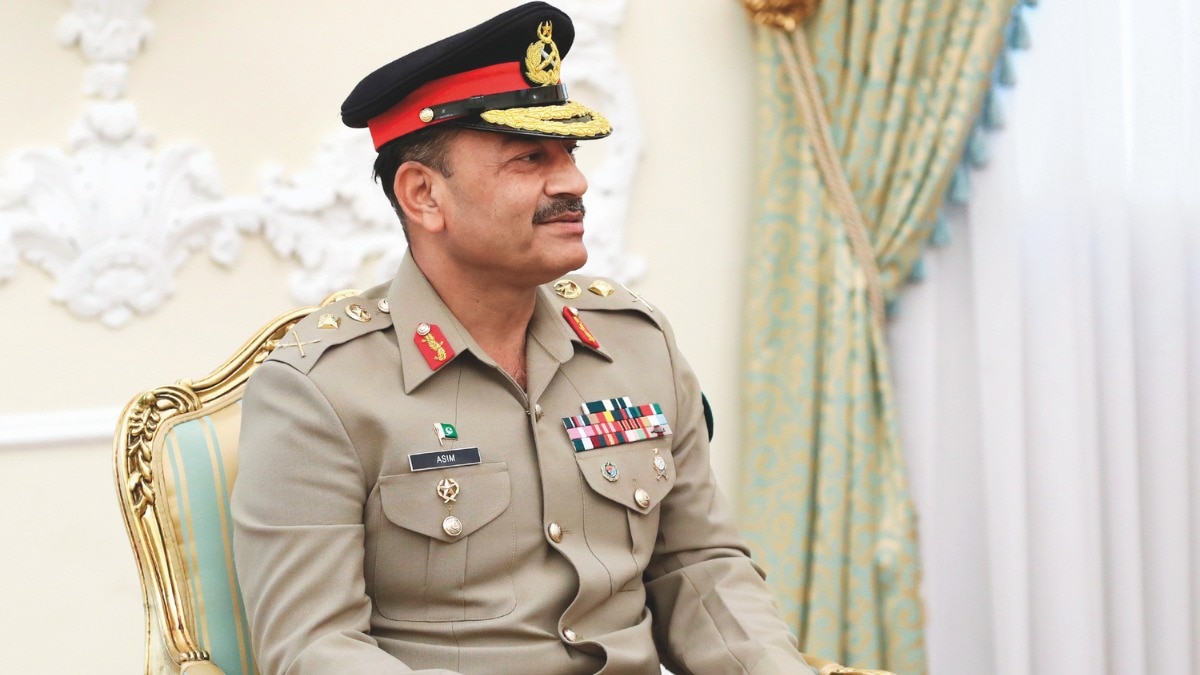
Read Full StoryMunir, appointed Pakistan’s first CDF in December 2025, now sits at the centre of Pakistan’s military command architecture.
Military analysts claim these provisions give the CDF substantial influence over the military hierarchy, command appointments and succession planning.
The law comes at a time when Munir’s influence has expanded beyond Pakistan’s military establishment.
He is now Pakistan’s army chief, CDF, senior military advisor to the prime minister and a central figure in the country’s strategic command architecture.
Security experts in New Delhi believe India should focus on whether Pakistan’s defence forces headquarters becomes a real operational nerve centre or remains mostly a legal rebranding of existing control.
Pakistan has formally moved towards a highly centralised military command structure, placing its army, navy and air force under a framework dominated by Field Marshal Syed Asim Munir, who serves simultaneously as chief of army staff and chief of defence forces (CDF).
The country’s National Assembly and Senate approved the Defence Forces of Pakistan Act, 2026, along with amendments to the National Command Authority Act, 2010, on August 20. The move synced with constitutional changes introduced in 2025 that had created the post of CDF and abolished that of chairman, joint chiefs of staff committee.
Read Full Story
Munir, appointed Pakistan’s first CDF in December 2025, now sits at the centre of Pakistan’s military command architecture. The new law gives him an authority that extends beyond the traditional role of a service chief. He is designated as the principal military advisor to the prime minister on national security, defence and matters concerning the armed forces, while also exercising operational command and control over the military.
The Defence Forces of Pakistan Act establishes a defence forces headquarters as the nerve centre of Pakistan’s armed forces and places it under the command and authority of the CDF. This gives Munir a permanent institutional mechanism through which he can coordinate the army, navy and air force as well as joint, strategic and multidomain operations.
The legislation assigns the CDF responsibility for strengthening tri-service integration, operational cohesion and coordination across land, air, maritime, cyber and strategic domains. In effect, Pakistan is seeking to move away from a system in which the three services largely function through separate command structures and towards a single framework led by the army chief.
For India, the most significant aspect is the concentration of military authority in one office. Munir can advise his prime minister on national security policy and also oversee the execution of military decisions across the armed forces. The combination of political influence and operational command gives the CDF both an advisory and executive role during peacetime and crisis situations.
Munir’s powers extend to military personnel. The Act allows the CDF to retire, release or discharge personnel, accept or reject resignations, retain individuals in service and relax retirement-age or service requirements within the limits of the law. He may also exercise additional powers or perform further functions assigned by the federal government.
Military analysts claim these provisions give the CDF substantial influence over the military hierarchy, command appointments and succession planning. Although the law retains formal constitutional and legal limitations, its practical effect is to place considerable control over the structure and functioning of Pakistan’s armed forces in Munir’s hands.
advertisement
The Act gives itself overriding authority wherever it conflicts with earlier legislation. Its provisions, along with rules, regulations, instructions, notifications and orders issued under it, will prevail over inconsistent provisions in other laws. The legislation specifically states that the Pakistan Army Act, 1952; Pakistan Air Force Act, 1953; Pakistan Navy Ordinance, 1961; Cantonments Act, 1924; and other laws governing armed forces personnel cannot be interpreted in a manner that undermines the new command framework.
As per the Act, the federal government has been empowered to frame rules and regulations for implementing the Act while the CDF can issue instructions and orders to give effect to the legislation. The president can also intervene to remove administrative or legal difficulties that arise during implementation. These provisions provide the executive and the CDF with considerable flexibility to shape the functioning of the new system.
The law has immediate effect but is deemed to have been in force from November 13, 2025. Rules, notifications, orders, instructions and actions taken before its formal enactment will remain valid if they are consistent with the Act. The retrospective provision is intended to protect decisions taken during the transition to the CDF-led structure and indicates that Pakistan has been operationalising the new command arrangement for several months.
advertisement
The reforms also have implications for Pakistan’s strategic and nuclear command architecture. The constitutional changes that preceded the Act created the post of commander of the National Strategic Command and removed the chairman, joint chiefs of staff committee from the command structure. Although the Defence Forces Act focuses mainly on the CDF and the Defence Forces Headquarters, these changes, taken together, point towards a system in which the army chief occupies a much more central position within Pakistan’s wider defence and strategic hierarchy.
Observers feel that this does not necessarily mean that every nuclear decision will be taken directly by the CDF since Pakistan’s formal political and institutional procedures remain relevant. However, the removal of the chairman, joint chiefs of staff committee and the creation of new strategic command arrangements reduce the importance of the earlier joint-services structure and increase the relative weight of the army-led system.
Pakistan has presented the legislation as a response to lessons drawn from recent military confrontations and multidomain operations. Its statement of objectives and reasons refers to integrated tri-service operations, real-time situational awareness, network-centric warfare and coordination across land, sea and cyber domains.
advertisement
For India, the more important issue is the institutional lesson Islamabad says it has drawn from recent military experience: future conflicts will require faster information-sharing, closer coordination between the services, real-time awareness across multiple domains and a unified chain of command.
The reforms appear to have been shaped in part by Pakistan’s experience during and after India’s Operation Sindoor in May 2025, when Pakistan suffered heavy military setbacks. Following the conflict, Munir promoted himself to the rank of field marshal. The new legislation now provides the officer holding that rank with a legal framework to direct and coordinate Pakistan’s military establishment across conventional, strategic and multidomain operations.
The centralised system could allow Pakistan to respond more quickly during a crisis by reducing delays between the army, navy and air force. It may help Islamabad coordinate air defence, missile forces, maritime assets, cyber operations and ground formations through a single military chain of command. This could become particularly relevant in any future confrontation with India involving simultaneous activity along the western land front, in the airspace and across the Arabian Sea.
At the same time, the law does not provide Pakistan with new weapons, better intelligence or enhanced military technology. Legal integration does not automatically produce genuine operational jointness. The effectiveness of the new structure will depend on Pakistan’s communications networks, intelligence-sharing mechanisms, joint training, logistics and the willingness of the three services to operate under a command system led by the army chief.
advertisement
Military analysts pointed out that the concentration of authority could also create vulnerabilities. A system built around one officer may accelerate decision-making, but it can weaken institutional checks, reduce internal debate and make the wider command structure heavily dependent on the judgement of the CDF. The legislation therefore gives Munir sweeping powers, but it also places the success or failure of Pakistan’s new military model largely around his office.
The law comes at a time when Munir’s influence has expanded beyond Pakistan’s military establishment. His relationship with US president Donald Trump grew unusually close after the 2025 India-Pakistan conflict, including a private lunch at the White House and public expressions of mutual praise. Munir has used that channel during the US-Iran conflict, engaging with both sides and helping Pakistan position itself as an intermediary in efforts to secure a fragile ceasefire.
These developments have increased Munir’s political and diplomatic visibility while the new legislation has expanded his domestic military authority. He is now Pakistan’s army chief, CDF, senior military advisor to the prime minister and a central figure in the country’s strategic command architecture.
For India, the immediate takeaway is that Pakistan is no longer merely discussing military jointness; it is attempting to institutionalise it through law under the authority of the army chief. The central question for New Delhi will be how effectively Pakistan can combine its land, air, maritime, cyber and strategic capabilities under Munir’s command—and whether this centralised system makes the country’s military response faster, more coherent and potentially more unpredictable along India’s western frontier.
The broader implication is that Pakistan’s civilian institutions are becoming even less relevant in core security decisions. India should therefore expect fewer effective civilian brakes on military behaviour during a dispute. That does not automatically make Pakistan more stable. A tightly centralised system can appear disciplined while still being brittle under pressure, especially if institutional competition is pushed underground rather than resolved.
Security experts in New Delhi believe India should focus on whether Pakistan’s defence forces headquarters becomes a real operational nerve centre or remains mostly a legal rebranding of existing control. It should also watch officer reshuffles, joint command exercises, nuclear command procedures, and how quickly Pakistan issues crisis statements after border incidents. The key Indian security adjustment is to treat Pakistan as a more centralised, more personalised military state. That means stronger emphasis on rapid intelligence, escalation control, air and maritime readiness, and close reading of command behaviour rather than assuming that normal civilian constraints still apply.
Subscribe to India Today Magazine
- Ends