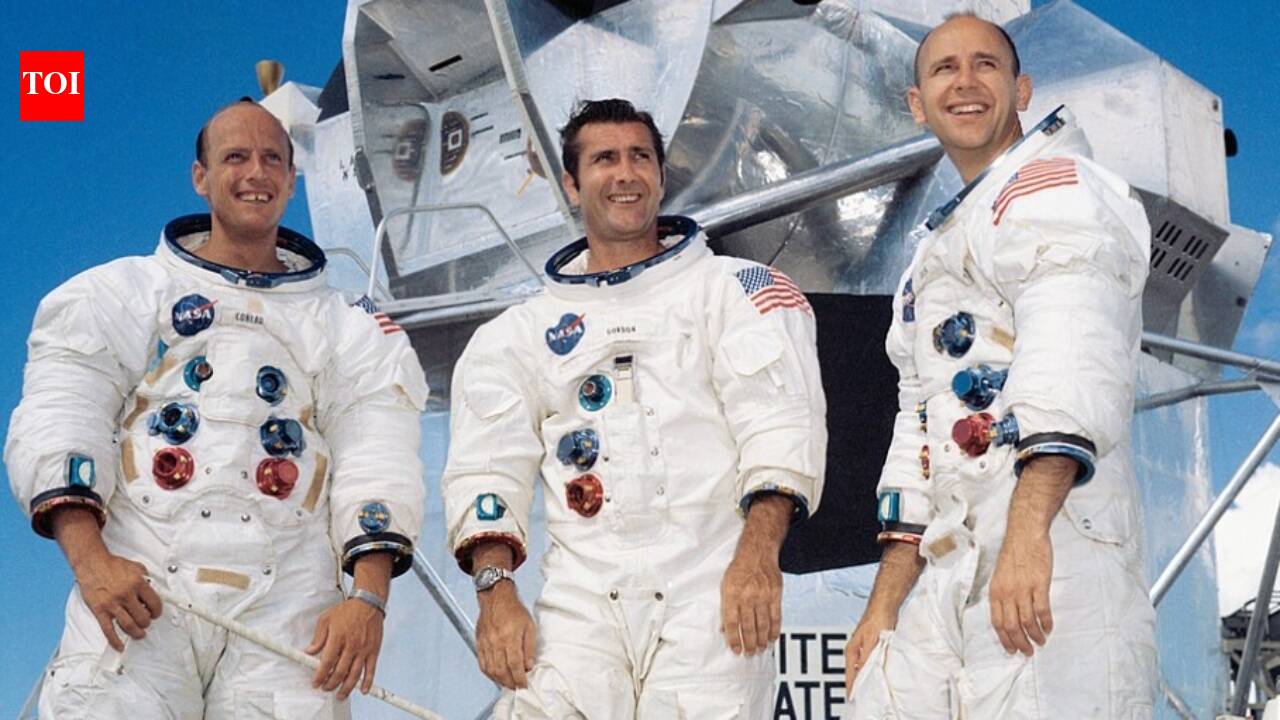
Portrait of the prime crew of the Apollo 12 lunar landing mission.
From left to right, they are Commander Charles "Pete" Conrad Jr, Command Module pilot Richard F. Gordon Jr, and Lunar Module pilot Alan L. Bean.
Credits - Wikimedia CommonsHow the dust took over the lunar moduleWhy Gordon made them strip before letting them aboardCommander Pete Conrad studies the Surveyor 3 spacecraft, which had landed two years previously, and the Apollo Lunar Module.
Conrad and Bean had returned from the lunar surface coated in fine grey dust that Gordon compared to a black cloud drifting through the lunar module.
Lunar dust remains a serious engineering challenge for Artemis and other planned missions that aim to support astronauts on the Moon for longer periods.
Portrait of the prime crew of the Apollo 12 lunar landing mission. From left to right, they are Commander Charles "Pete" Conrad Jr, Command Module pilot Richard F. Gordon Jr, and Lunar Module pilot Alan L. Bean. Credits - Wikimedia Commons
How the dust took over the lunar module
Why Gordon made them strip before letting them aboard
Commander Pete Conrad studies the Surveyor 3 spacecraft, which had landed two years previously, and the Apollo Lunar Module. Credits - Wikipedia Commons
How the dust kept causing problems long after splashdown
After Apollo 12’s two moonwalks in 1969, command-module pilot Richard Gordon initially refused to let crewmates Charles “Pete” Conrad and Alan Bean enter the clean spacecraft until they removed their dust-covered spacesuits. Conrad and Bean had returned from the lunar surface coated in fine grey dust that Gordon compared to a black cloud drifting through the lunar module. Conrad and Bean had just completed two moonwalks totalling nearly eight hours on the Ocean of Storms, and the fine grey powder that clung to their suits proved impossible to brush away.The trouble began the moment Conrad and Bean climbed back into their lunar module Intrepid after their EVAs. As NASA's own history office recounts , the lunar dust that had settled on the floor of the module floated throughout the cabin once the astronauts were weightless again, prompting them to keep their suits and helmets on to avoid breathing in the abrasive material. A NASA mission report from the time noted that the astronauts found a fairly large amount of dust and grains of lunar material carried inside no matter how carefully they tried to clean themselves before entering, describing the texture as similar to powdered graphite and noting a distinct, pungent odour once helmets came off. Engineers later catalogued the problem and found that The astronauts carried dust into the lunar module on their boots, gloves, suits and tools, while engine exhaust and movement around the landing site disturbed additional material.Once the ascent stage lifted off, the dust already inside the cabin became suspended in the weightless environment and spread through the spacecraft. By the time the two moonwalkers prepared to rejoin Gordon in lunar orbit, the dust had already created the contamination problem they would carry into the command module.When Intrepid finally docked with Yankee Clipper, Gordon opened the hatch expecting his crewmates back. Instead, he later recalled peering inside and seeing a haze of dust and saying they were not getting in and dirtying up his clean spacecraft. Conrad later described the scene in the post-flight debriefing: he and Bean removed their dust-covered suits, transferred the suits to Gordon for stowage, and then floated into the command module wearing only their headsets and later a change of clothes. Removing the suits kept most of the loose lunar dust out of Yankee Clipper, although the astronauts themselves still carried dust on their skin and in their hair.In Gordon’s telling, the transfer involved the moon rocks first, followed by the spacesuits and then the astronauts’ remaining clothing before he allowed them into Yankee Clipper.The exchange has since become one of the more memorable anecdotes of the Apollo programme, partly because it captures the unglamorous side of lunar exploration that rarely made it into official transcripts. Gordon never walked on the Moon himself, despite orbiting it twice, and spent the mission keeping the command module in order while Conrad and Bean dealt with the mess from their moonwalks. Their long Navy service and earlier Gemini flight together meant they later recalled the confrontation with humour rather than irritation.Even after the stripping ritual, the dust proved impossible to fully contain. Fine particles floated free inside Yankee Clipper for the rest of the journey home. Those particles irritated the crew’s eyes and lungs and clogged air filters that had to be cleaned repeatedly. NASA's technical review of lunar dust across the Apollo missions found that the material lodged so deeply into the astronauts' skin that crews who stripped off their clothes on the way back to Earth discovered they were still covered in it, with the dust proving impossible to remove completely from beneath their fingernails. Other Apollo moonwalkers reported similar experiences in the years that followed, with some noting that traces of embedded dust took months to fully grow out. Once Apollo 12 splashed down in the Pacific Ocean on 24 November 1969, Conrad, Gordon and Bean were placed into a mobile quarantine facility as a precaution against any unknown lunar organisms, a protocol NASA maintained for its early Moon landings before eventually discontinuing it.The dust problem was not fully solved during the Apollo era, and later missions experimented with brushes, vacuum devices and revised suit designs to limit how much material made it back into the spacecraft. None of these fixes were entirely effective. Lunar dust remains a serious engineering challenge for Artemis and other planned missions that aim to support astronauts on the Moon for longer periods.