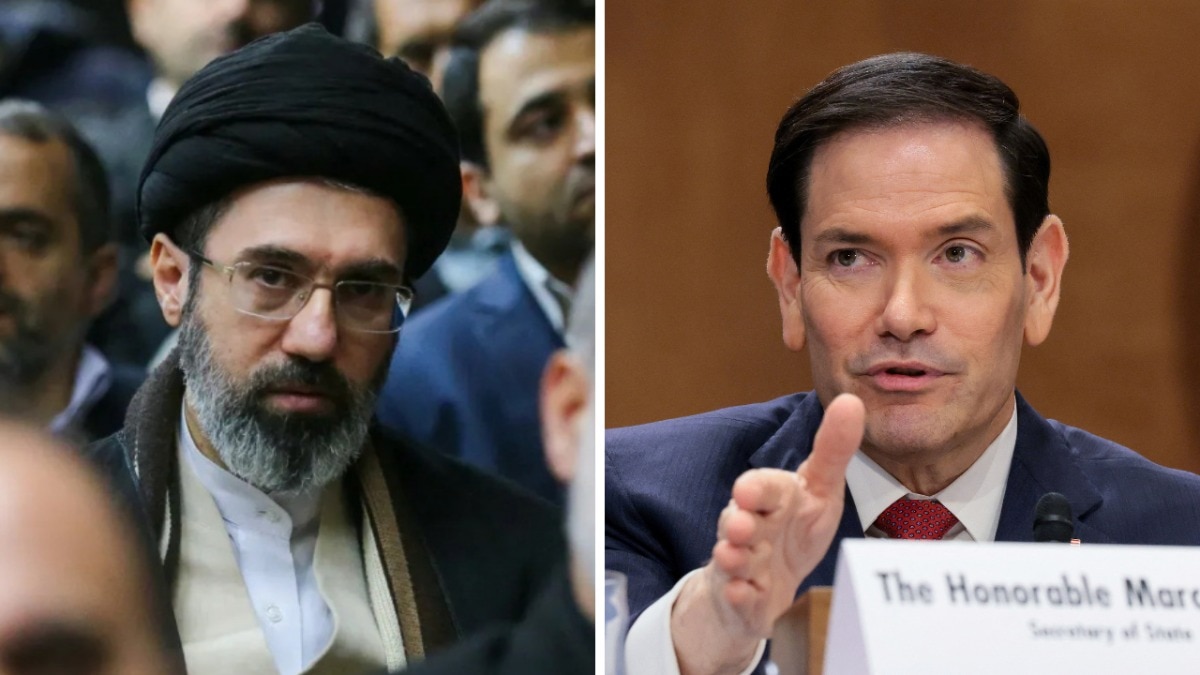
Testifying before US Congress, Secretary of State Marco Rubio said Mojtaba Khamenei appears to be increasingly engaged in governing Iran as negotiations between the two countries enter a critical phase.
Mojtaba Khamenei has not appeared publicly since taking over as Iran's supreme leader following the death of his father.
Apart from written statements carried by Iranian state media, little has been known about his condition or day-to-day role in governing the country.
QUESTIONS REMAIN OVER IRAN TALKSThe US and Iran continued to send mixed signals about the state of negotiations on Tuesday.
Instead, he clarified that any sanctions relief would be directly linked to Iran's nuclear activities.
The fate of the Iranian regime has been one of the biggest unanswered questions since the US-Israeli strikes killed former Supreme Leader Ayatollah Ali Khamenei. Now, the Trump administration says there are signs that his successor remains actively involved in Iran's decision-making. Testifying before US Congress, Secretary of State Marco Rubio said Mojtaba Khamenei appears to be increasingly engaged in governing Iran as negotiations between the two countries enter a critical phase.
Read Full Story
Rubio made the remarks during a Congressional hearing, where lawmakers pressed the Trump administration for answers on its Iran strategy, the future of nuclear negotiations and the conflict that has impacted the Middle East since the US-Israel war erupted earlier this year. Senators from both parties sought clarity on whether diplomacy still has a path forward and how Washington plans to navigate the increasingly volatile region.
"I think there are indications out there that he is increasingly engaging at some level, although all of his communications have been in writing and through intermediaries," Rubio told senators.
Mojtaba Khamenei has not appeared publicly since taking over as Iran's supreme leader following the death of his father. Apart from written statements carried by Iranian state media, little has been known about his condition or day-to-day role in governing the country.
Iranian officials have admitted that Khamenei was wounded in the US-Israeli strikes that killed his father, but have insisted the injuries were not serious. In May, an Iranian official told news agency Reuters that he had been only lightly injured and remained active in state affairs.
QUESTIONS REMAIN OVER IRAN TALKS
The US and Iran continued to send mixed signals about the state of negotiations on Tuesday. US President Donald Trump insisted that communication channels between the two countries are still open despite reports claiming talks had stalled.
In a post on Truth Social, Trump rejected claims that contacts between Washington and Tehran had been suspended.
"Fake News Reports that the Islamic Republic of Iran, and the USA, stopped speaking a few days ago are false and erroneous. The conversations between us have been going on continuously, including four days ago, three days ago, two days ago, one day ago, and today," Trump wrote.
He acknowledged that there were no guarantee negotiations would succeed but maintained that diplomacy remained active.
"Where they lead, one never knows, but as I told Iran, 'It's time, one way or another, for you to make a deal. You've been doing this for 47 years, and it cannot be allowed to go on any longer!'"
advertisement
However, Iran-linked media have painted a different picture. Reports from state media claim Iranian officials are still reviewing the latest American proposal and have not communicated directly with US negotiators for several days.
According to Reuters, distrust continues to run deep in Tehran, with Iranian officials accusing Washington of failing to honour key parts of the ceasefire reached in April. That lingering scepticism has complicated efforts to revive negotiations, even as both sides continue to signal an interest in keeping diplomacy alive.
HORMUZ REMAINS KEY STICKING POINT
The latest round of diplomacy is focused on two issues that could shape the future of the region: Iran's nuclear programme and the reopening of the Strait of Hormuz. Rubio told lawmakers that Iran may now be willing to discuss aspects of its nuclear programme that it had refused to consider only weeks ago.
"US talks with Iran may include aspects of their nuclear programme that just a month ago, just a year ago, they were refusing to even mention," he said.
However, he warned against assuming a breakthrough was imminent.
"That is not a guarantee it will ultimately lead to a deal that's acceptable," Rubio cautioned. The US Secretary of State said reopening the Strait of Hormuz and addressing Iran's stockpile of highly enriched uranium remain main objectives for Washington.
advertisement
RUBIO RULES OUT SANCTIONS RELIEF FOR HORMUZ REOPENING
One of the clearest messages from Rubio's testimony concerned sanctions.
He rejected the fact that Washington was prepared to ease economic restrictions in exchange for Iran reopening the Strait of Hormuz.
"That's not been discussed. That's not been offered," Rubio said. Instead, he clarified that any sanctions relief would be directly linked to Iran's nuclear activities.
"Right now, everything that's been discussed with them is that any sanctions relief is condition-based, which means it has to be in return for the reason why those sanctions were put in place in the first place, which is their nuclear programme," he said.
"Iran is being sanctioned because they've highly enriched uranium. Iran is being sanctioned because of their nuclear activities. If they agree to give up those things, there will be sanctions relief associated with their commitment and compliance with those agreements."
It was Rubio's first appearance before Congress since the Iran conflict began.
- Ends
With inputs from agencies