Paper: Synthesis of mineral-organic hybrid materials under dynamic prebiotic conditions.
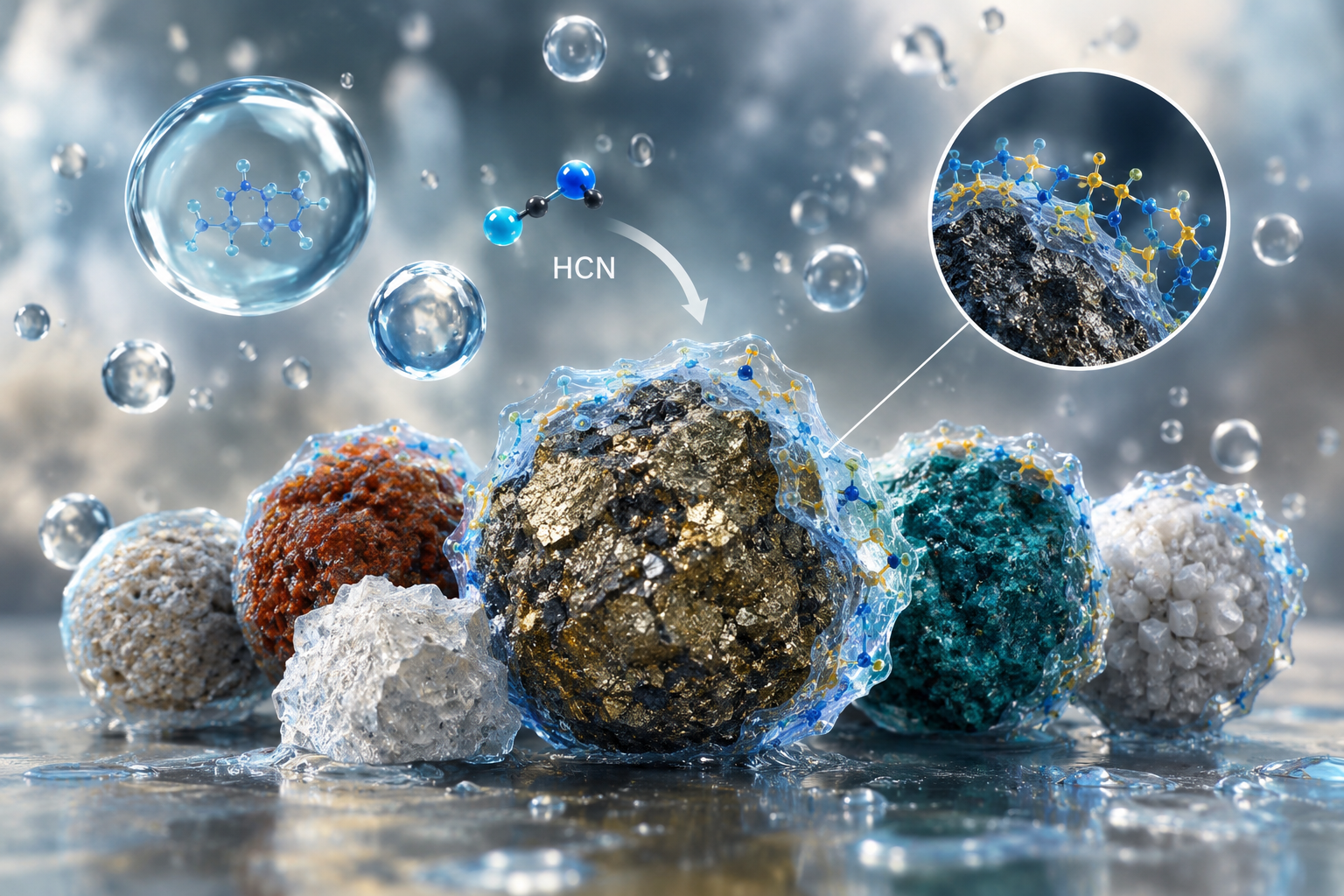
The findings show how cyanide chemistry interacting with mineral surfaces can yield complex, surface-bound hybrid materials, offering new insights into prebiotic chemical evolution and potential functional materials.
Dynamics of Aerosol Interfaces in Cyanide PolymerizationHydrogen cyanide is a key chemical precursor for the synthesis of nitrogen-rich organic materials and biologically relevant molecules.
It employs a high cyanide concentration (1 M) as an initial approach to exploring the potential prebiotic synthesis of hybrid materials."
It employs a high cyanide concentration (1 M) as an initial approach to exploring the potential prebiotic synthesis of hybrid materials.
Dynamic aerosol experiments reveal a two-way chemical relationship in which mineral surfaces shape cyanide-derived organic networks while the emerging coatings can preserve or transform the minerals beneath them.
Paper: Synthesis of mineral-organic hybrid materials under dynamic prebiotic conditions. AI-generated conceptual image created using ChatGPT/OpenAI
A recent study published in the journal Communications Chemistry explored how dynamic alkaline aqueous aerosols drive the formation of mineral-organic hybrid materials through cyanide chemistry. By simulating unbuffered droplet-air microreactors over multiple reaction cycles, researchers demonstrated that mineral surfaces strongly influence the assembly and cross-linking of nitrogen-rich polymeric coatings, rather than serving as passive supports.
The findings show how cyanide chemistry interacting with mineral surfaces can yield complex, surface-bound hybrid materials, offering new insights into prebiotic chemical evolution and potential functional materials.
Dynamics of Aerosol Interfaces in Cyanide Polymerization
Hydrogen cyanide is a key chemical precursor for the synthesis of nitrogen-rich organic materials and biologically relevant molecules. Under alkaline conditions, it oligomerizes to reactive intermediates such as aminomalononitrile and diaminomaleonitrile. These intermediates undergo condensation and cross-linking to produce soluble molecular species and adhesive surface-bound films. Related HCN-derived materials have previously shown semiconducting properties and protective activity against oxidation.
Conducting these reactions within alkaline aerosol microdroplets alters their chemistry compared to bulk solutions. The large water-air interfacial area enhances interactions between dissolved cyanide species and suspended mineral particles, thereby enabling extensive surface functionalization and the assembly of organic networks under dynamic laboratory conditions. However, the combined role of aerosol interfaces and mineral substrates in controlling the formation and stability of these hybrid materials has remained poorly understood.
3), maghemite (γ-Fe 2 O 3 ), magnesium sulfate (MgSO 4 ), apatite [Ca 5 (PO 4 ) 3 (F, Cl, OH)], pyrite (FeS 2 ), and silica (SiO 2 ). The minerals shown represent the primary phases expected in each environment; other minerals may occur as secondary products depending on local conditions. In addition, alkaline lakes and seasonal evaporation-rehydration cycles would allow the concentration HCN from the atmosphere 19 or from hydrothermal systems 58. Moreover, aqueous aerosols could be formed easily from these lake surfaces alongside physical mechanisms like wind or shock waves 52 since relies solely on the interaction between liquid water and air at their interface. In any case, it is important to point out that this study is framed as a laboratory simulation inspired by early Earth chemistry rather than a reconstruct of these environments here illustrated. It employs a high cyanide concentration (1 M) as an initial approach to exploring the potential prebiotic synthesis of hybrid materials." title="" src="https://www.azom.com/images/news/ImageForNews_65711_17870963387473139.jpg" width="891px" height="420px" />
Conceptual model showing the spatial distribution of environments and mineral phases relevant to prebiotic chemistry. Key geochemical systems include a hydrothermal system (left), a serpentinite system (center), and an alkaline lake environment (right). Each system is associated with specific mineral assemblages, including calcium carbonate (CaCO 3 ), maghemite (γ-Fe 2 O 3 ), magnesium sulfate (MgSO 4 ), apatite [Ca 5 (PO 4 ) 3 (F, Cl, OH)], pyrite (FeS 2 ), and silica (SiO 2 ). The minerals shown represent the primary phases expected in each environment; other minerals may occur as secondary products depending on local conditions. In addition, alkaline lakes and seasonal evaporation-rehydration cycles would allow the concentration HCN from the atmosphere 19 or from hydrothermal systems 58. Moreover, aqueous aerosols could be formed easily from these lake surfaces alongside physical mechanisms like wind or shock waves 52 since relies solely on the interaction between liquid water and air at their interface. In any case, it is important to point out that this study is framed as a laboratory simulation inspired by early Earth chemistry rather than a reconstruct of these environments here illustrated. It employs a high cyanide concentration (1 M) as an initial approach to exploring the potential prebiotic synthesis of hybrid materials.
Framework for Mineral-Organic Hybrid Formation
To investigate the formation of mineral-organic hybrid materials, researchers selected six inorganic substrates: silica nanoparticles, synthetic maghemite nanoparticles, commercial pyrite powder, calcium carbonate, blue apatite microparticles, and anhydrous magnesium sulfate. Each reaction contained 30 mg of mineral dispersed in 5 mL of an unbuffered, equimolar 1.0 M sodium cyanide-ammonium chloride solution under a degassed nitrogen atmosphere.
Using an ultrasonic aerosol generator, the mixtures were continuously cycled as fine aerosol mists inside sealed reactors for 4 or 21 days without pH control. The resulting solid hybrids were recovered by centrifugation at 13,000 rpm for 15 minutes, washed four times with deionized water, and freeze-dried until constant weight was achieved. All synthesis experiments were performed in triplicate.
The hybrid materials were characterized using a range of analytical techniques. Powder X-ray diffraction and Fourier-transform infrared spectroscopy identified crystal phases and functional groups, while transmission electron microscopy and energy-dispersive X-ray spectroscopy resolved nanoscale morphology, coating interfaces, and elemental distributions. Thermal stability and organic content were evaluated by thermogravimetric analysis, derivative thermogravimetry, and differential scanning calorimetry from room temperature to 1000 °C under inert argon and oxidative air atmospheres. Furthermore, principal component analysis ( PCA ) and multivariate statistical modeling were used to identify structural trends across different mineral substrates and reaction times.
The authors emphasized that the 1 M cyanide concentration does not represent typical early Earth surface waters, but instead models localized environments where cyanide could have become highly concentrated. The different particle sizes and surface areas of the mineral substrates also limit direct comparisons of coating formation and retention.
Substrate-Driven Synthesis and Structural Changes
Microscopic analyses confirmed that cyanide-derived organic matter formed surface-bound coatings that acted as binders between mineral particles, producing stable hybrid composites without detectable unattached organic debris. In the pyrite system, the coating also protected the mineral against oxidative alteration. On maghemite nanoparticles, the amorphous carbonaceous coating measured between 0.5 and 6 nanometers in thickness. Elemental mapping demonstrated persistent carbon and nitrogen signals across all substrates, consistent with the formation of nitrogen-rich polymer networks.
Thermogravimetric analysis provided semi-quantitative estimates, meaning approximate rather than absolute measurements, indicating that organic matter contributed approximately 12-21% of the total mass in silica, calcite, maghemite, and apatite composites. The 4-day magnesium sulfate system contained approximately 40% organic matter, while the 21-day material was estimated at 15- 30%. Prolonged aerosol cycling promoted chemical and structural evolution of the organic phases, producing substrate-dependent changes in their thermal decomposition profiles. Magnesium sulfate transformed into magnesium hydroxide (brucite) after 4 days and into a magnesium silicate-organic system after 21 days. The researchers attributed the silicate formation to high-pH attack on the borosilicate reaction vessel, which released dissolved silica that subsequently reacted with the magnesium-containing phase.
Spectroscopic analyses identified three regions corresponding to amine and alkyl groups (~3300 cm-1), conjugated nitrile bonds (2275-2000 cm-1), and conjugated imine, vinylene, and carbonyl groups (~1650 cm-1). PCA and multivariate analyses supported the conclusion that mineral surface chemistry and reaction time jointly influence polymer cross-linking, thermal behavior, and chemical structure. Categorical PCA of the nitrile spectral region explained 85% and 91% of the variance in the 4-day and 21-day datasets, respectively, reinforcing evidence that mineral type and reaction time shape the resulting organic chemistry. Among the most striking interfacial effects, sulfate-associated signals disappeared from the pyrite hybrids, while the cyanide-derived coating preserved crystalline pyrite against oxidative alteration for at least 18 months.
Applications for Multifunctional Coatings
Together, these structural, thermal, and protective properties suggest possible uses beyond prebiotic chemistry. The spontaneous formation of these mineral-organic hybrids demonstrates a prebiotic chemistry-inspired route for generating potentially multifunctional materials under dynamic aqueous aerosol conditions. The nitrogen-rich polymer coatings exhibit adhesion and particle-binding behavior, while long-term protection against oxidation was demonstrated specifically for pyrite. Related HCN-derived materials have previously been investigated as semiconductors and catalysts, but the present study did not directly test semiconductor, catalytic, or broader corrosion-control performance.
Beyond material science and engineering, these findings also have significant implications for planetary science. Organic nanocoatings can alter the thermal and spectroscopic properties of mineral surfaces, complicating the interpretation of potential biosignatures in planetary samples. The researchers therefore caution that thermal measurements should be combined with spectroscopic, microscopic, and other analytical approaches when assessing materials from Mars or other planetary environments.
Future Directions in Sustainable Material Synthesis
In summary, this study demonstrates that mineral surfaces are active participants in organic self-assembly rather than inert supports or simple catalytic templates. Through dynamic interactions at aerosol interfaces, inorganic minerals influence macromolecular growth, while evolving polymers simultaneously stabilize and transform some of the underlying mineral phases, thereby enabling the formation of complex hybrid materials under simulated prebiotic conditions.
Future work should focus on testing aerosol-cyanide chemistry under a broader range of potentially prebiotic atmospheric conditions and directly evaluating the functional properties of the resulting coatings. The findings establish important context for planetary exploration by showing that abiotic mineral-organic interactions can significantly modify thermal decomposition and spectroscopic signatures, potentially complicating efforts to distinguish purely geological materials from those influenced by biological or other organic processes.
Disclaimer: The views expressed here are those of the author expressed in their private capacity and do not necessarily represent the views of AZoM.com Limited T/A AZoNetwork the owner and operator of this website. This disclaimer forms part of the Terms and conditions of use of this website.