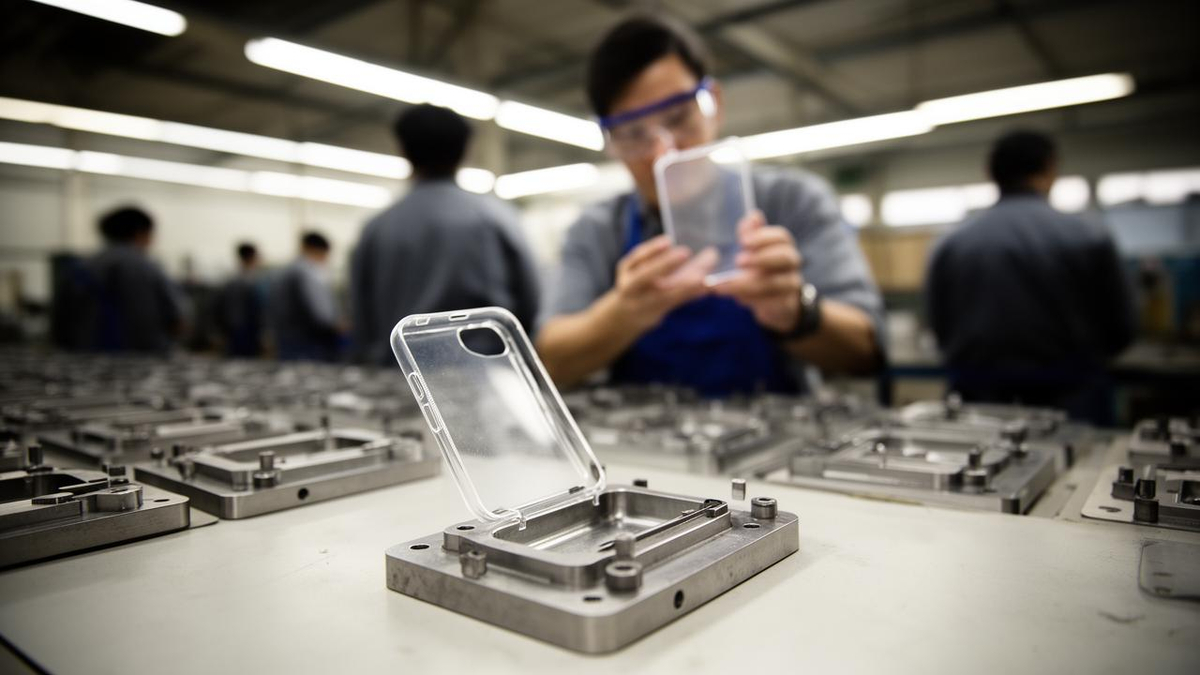
With roughly a month remaining before Apple's first foldable iPhone and the iPhone 18 lineup officially debut, the accessory "early-bird" battle on e-commerce platforms has already begun.
Multiple sellers have listed foldable phone cases under keywords like "iPhone Fold" and "iPhone Ultra," while cases and tempered glass screen protectors for the unreleased iPhone 18 series have also appeared simultaneously.
Some listings are already sorted by model, material, and style, indicating that the accessory supply chain has a remarkably firm grasp of the new devices' specifications.
Yet a phone case's journey from mold-making and sampling to inventory stocking involves the entire supply chain.
Waiting until Apple's official announcement to begin development means the prime traffic window has already passed.
With roughly a month remaining before Apple's first foldable iPhone and the iPhone 18 lineup officially debut, the accessory "early-bird" battle on e-commerce platforms has already begun. Multiple sellers have listed foldable phone cases under keywords like "iPhone Fold" and "iPhone Ultra," while cases and tempered glass screen protectors for the unreleased iPhone 18 series have also appeared simultaneously. Some listings are already sorted by model, material, and style, indicating that the accessory supply chain has a remarkably firm grasp of the new devices' specifications.
According to a report by National Business Daily, when reporters posed as customers to inquire about pricing, most merchants declined to reveal their data sources, insisting only that "the factory guarantees the data and builds molds accordingly" and that products are "confirmed to fit," with replacements promised if molds are revised later. Yet a phone case's journey from mold-making and sampling to inventory stocking involves the entire supply chain. Mass-producing before an official announcement is, at its core, a high-stakes wager.
Why Are Accessory Makers Willing to Jump the Gun?
Industry insiders who have long worked with Apple ecosystem accessories note that third-party manufacturers conventionally begin preparations three months in advance, targeting the "buy a phone, must buy a case" window immediately following a launch. Waiting until Apple's official announcement to begin development means the prime traffic window has already passed. Information sources extend beyond official channels: supply chain leakage during mass production, dummy unit circulation, render leaks, and industry tip-offs are all sufficient for established manufacturers to begin mold-making based on dimensions, camera positioning, and button layouts.
This year introduced an unusual variable. Tata Electronics, Apple's key contract manufacturer in India, suffered a ransomware attack in June, with over 200,000 files totaling 630GB of confidential data leaking onto the dark web. The trove included motherboard schematics, chip parameters, component procurement floor prices, and real-device test videos—described by observers as the most severe leak in Apple's history. S. Krishnan, Secretary of India's Ministry of Electronics and Information Technology, confirmed in early July that the incident is under investigation. This has given accessory makers access to "public intelligence" far more substantial than in previous years.
However, the risks have risen in tandem. Slab-style iPhones have iterated for years, giving case manufacturers deep accumulated experience. Foldable screens involve hinges, body thickness, folding mechanisms, and display form factors—any change in a critical dimension could invalidate earlier mold work entirely. The gamble on foldable models is far greater than on Pro devices.