Across the Ranji and Duleep trophies, 1,245 runs came from just 15 innings at an extraordinary average of 103.75.
Gautam Gambhir, another left-handed opener attempting to break into the Indian side, finished the season with 877.
A month later, both he and Gambhir were called into India's squad for the fourth Test against Australia in Mumbai.
Gambhir made his Test debut at the Wankhede and eventually became one of India's most important openers.
Gambhir, Jadhav, Dinesh Karthik and Shib Shankar Paul were brought into the squad for the final Test in Mumbai.
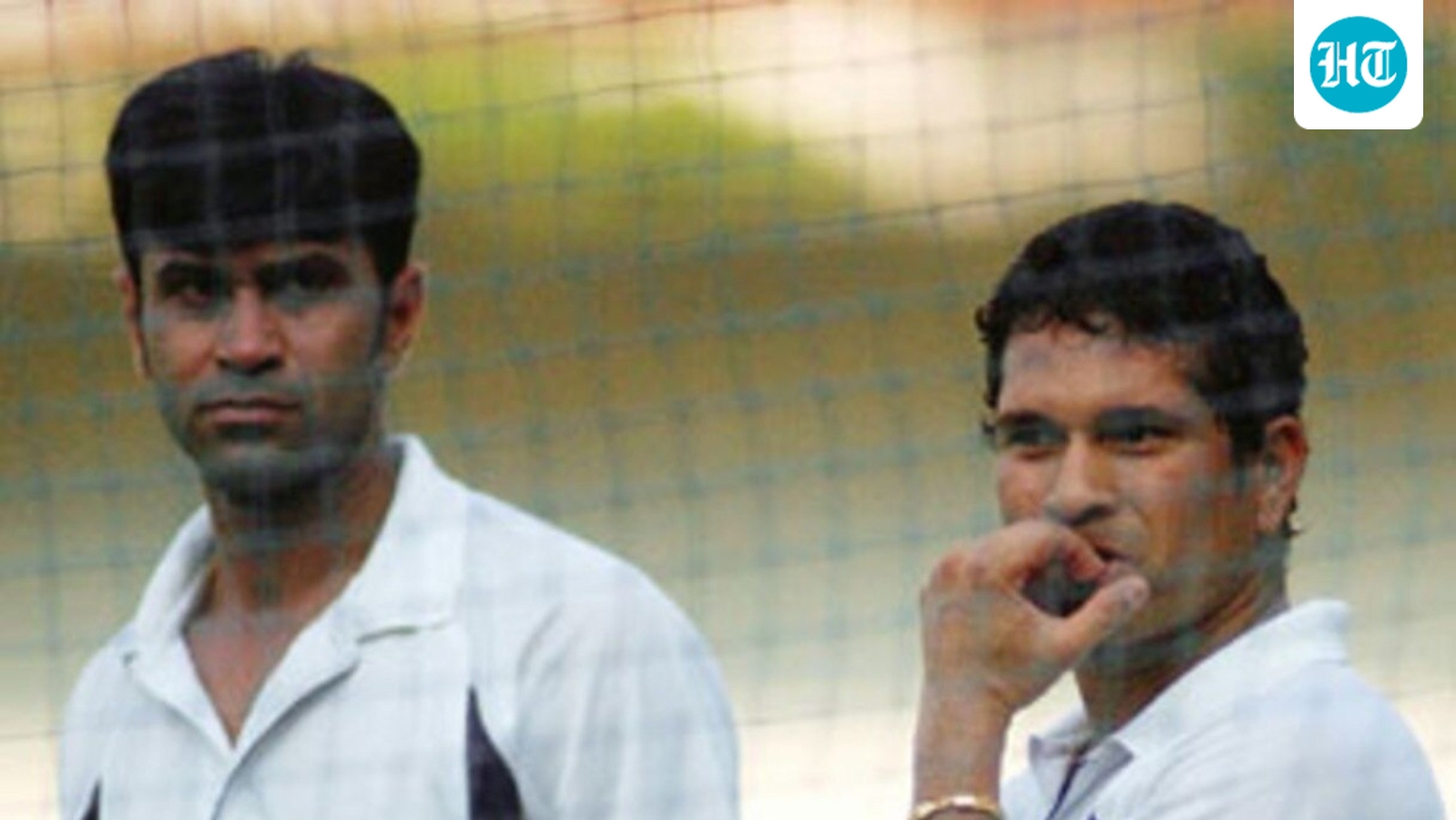
The 2003-04 Indian domestic season produced plenty of contenders for the national side, but one left-handed opener separated himself from almost everybody else. Across the Ranji and Duleep trophies, 1,245 runs came from just 15 innings at an extraordinary average of 103.75. There were five centuries, three of them double hundreds, while the next-highest aggregate belonged to Hrishikesh Kanitkar with 935. Gautam Gambhir, another left-handed opener attempting to break into the Indian side, finished the season with 877. Dheeraj Jhadav with Sachin Tendulkar. (X Images)
The numbers travelled with him to Africa a few months later. On an India A tour of Kenya that would become famous for accelerating MS Dhoni's rise towards international cricket, the Maharashtra opener scored 257 runs in the triangular one-day tournament and saved his most important innings for the final against Pakistan A. Gambhir fell for 12 and Dhoni for 15, but an 89 off 112 balls anchored the chase and earned him the Player of the Match award. Once the one-day tournament was over, he went further still, carrying his bat for 260 not out against Kenya in a three-day match as India A piled up 492.
There was another audition almost immediately after returning home. Playing for India A against the senior Indian side before Australia's 2004 Test tour, the opener made 113 against a bowling attack containing Anil Kumble, Harbhajan Singh, Zaheer Khan and Irfan Pathan. A month later, both he and Gambhir were called into India's squad for the fourth Test against Australia in Mumbai. India had an opening vacancy after dropping Aakash Chopra, but only one of the two would be given the cap.
The man who missed out was Dheeraj Jadhav, a domestic run-machine who would spend the next decade compiling the sort of numbers that usually demand at least one chance at the highest level. Gambhir made his Test debut at the Wankhede and eventually became one of India's most important openers. Jadhav remained on the sidelines, and even another India call-up less than a year later — this time as Sachin Tendulkar's replacement for a Test series — would not be enough to produce an international debut.
From 'stonewaller' to India's leading run-getter Jadhav's explosion in 2003-04 was not simply the natural progression of a player who had always dominated domestic cricket. He had made his first-class debut for Maharashtra in 1999-00 and acquired a reputation for patience rather than aggressive accumulation. Jadhav himself later acknowledged that he had been known as a "stonewaller" before consciously changing his mental approach during the off-season. He worked on driving the spinners and, crucially, on taking singles more regularly, so that occupying the crease translated into a greater volume of runs.
The transformation was dramatic. Jadhav became the only player to cross 1,000 runs across the Ranji and Duleep competitions in 2003-04, with his 1,245 coming at an average above 100. Of his three double hundreds, he considered the 251 against Madhya Pradesh in the Ranji Plate final his finest. That innings came against an attack containing Narendra Hirwani, who finished as the joint-highest wicket-taker of the season, and helped cap the campaign that pushed Jadhav firmly into India A contention.
Kenya offered the next level of examination. Much of that 2004 tour is remembered through the prism of Dhoni, whose explosive performances made an enormous impression before his India debut later that year. Gambhir was also prolific, but Jadhav ensured the tour was hardly a two-man show. The final against Pakistan A was particularly significant because of the quality of the opposition and the situation in which his runs arrived.
Pakistan A had Misbah-ul-Haq carrying his bat for 89 and also fielded players such as Kamran Akmal and Faisal Iqbal. Chasing 210, India A lost Gambhir at 24 and Dhoni at 44. Jadhav then put together the innings around which the chase was built, making 89 with seven fours and a six before falling with victory virtually secured. India A won by six wickets under the Duckworth-Lewis method, and Jadhav walked away with the final's individual award.
The 260 not out that followed was another kind of innings altogether. Jadhav faced 386 balls and remained unbeaten from the beginning of India A's innings until the declaration, with Dhoni making 78 and Ambati Rayudu 50 around him. The score stood for more than 12 years as the highest first-class innings by an Indian carrying his bat before Samit Gohel went past it with 359 not out in the 2016-17 Ranji Trophy.
By September 2004, the evidence was becoming difficult for the selectors to ignore. Jadhav's 113 for India A against the senior side came as Kumble, Harbhajan, Zaheer and Pathan prepared for the Test series against Australia. Gambhir made a duck in the same innings, while Jadhav and Mohammad Kaif, who scored an unbeaten 103, gave the senior attack a prolonged workout. Kumble eventually dismissed Jadhav after 221 balls.
The immediate Test call still did not arrive, but India's disastrous defeat in Nagpur changed the picture. Australia won by 342 runs to clinch their first series triumph in India in 35 years, after which the selectors dropped Chopra, Yuvraj Singh, Parthiv Patel and Ajit Agarkar. Gambhir, Jadhav, Dinesh Karthik and Shib Shankar Paul were brought into the squad for the final Test in Mumbai. With Chopra gone, India needed a new partner for Virender Sehwag, and the choice came down heavily in Gambhir's favour.