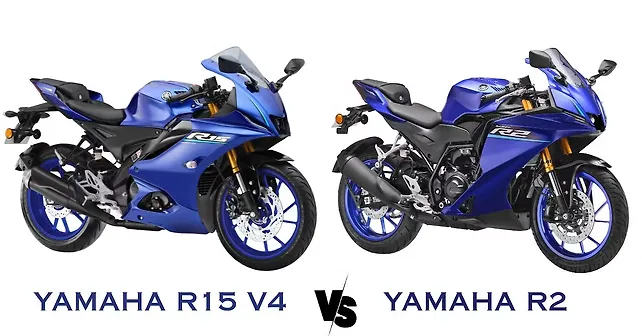
The hero of the masses R15 V4 starts at around Rs.
The R2 takes a fundamentally different route, not simply a larger R15 engine.
Electronics show how much the segment has moved forward since the R15 V4 arrived.
If you are a first-time performance motorcycle buyer, the R15 V4 still makes a lot of sense.
At the lower end, however, the R15 V4 remains almost untouchable within Yamaha’s own range.
R2 makes 26bhp from an all-new 204cc engine, against R15 V4’s 18bhp 155cc single
R2 has three riding modes, five-inch TFT, bi-directional quickshifter on higher variants
R15 V4 costs considerably less, weighs eight kilograms less
The arrival of the Yamaha YZF-R2 finally gives Indian riders a natural step above the R15 V4. R2 takes the same broad supersport idea but moves into another level of performance, equipment, and, inevitably, price.
The hero of the masses R15 V4 starts at around Rs. 1.75 lakh, while the R15M Carbon Fibre at just over Rs. 2.01 lakh average ex-showroom. The newly launched R2 starts at Rs. 2,30,500, remember all mentioned prices here are ex-showroom Delhi. The version with the quickshifter costs Rs. 2,39,500, while the R2M is priced at Rs. 2,53,000. For someone looking at a basic R15, the extra spend required for an R2 is substantial. However, a customer already considering a top R15M is only around Rs. 29,000 away from the base R2. Hmmm…
Performance Create that Clear Step Up
R15’s trusted 155cc liquid-cooled single produces 18bhp at 10,000rpm and 14.2Nm at 7,500rpm. Its six-speed gearbox and assist and slipper clutch are standard fit. This small engine likes revs, while VVA helps widen the usable performance band instead of concentrating everything near the redline.
The R2 takes a fundamentally different route, not simply a larger R15 engine. This newly developed 204cc liquid-cooled single brings a higher 26bhp at 10,000rpm and 19.1Nm. Its uses a finger-follower valvetrain with Diamond-Like Carbon coating to reduce friction and reciprocating mass. The larger engine instead uses its additional capacity, new head design and different valve architecture to produce more performance.
So, the R2 has roughly 44% more peak power than the R15’s official 18bhp figure and about 35% more torque. Also its 149kg kerb weight is only eight kilograms higher than the R15’s 141kg. This would mean that power-to-weight improvement should be easy to feel during acceleration.
We ourselves have long praised the R15 for its communicative handling and high-revving engine, describing it as equally useful as an everyday motorcycle and a beginner’s track tool. Our road test of the production R2 is still needed before making the same judgement about the new bike.
Chassis and Electronics Put More Distance Between Them
The differences continue underneath the bodywork. The R15 uses Yamaha’s Deltabox frame, 37mm upside-down front forks and a linked-type monocross rear suspension. It has 170mm ground clearance, an 815mm seat height and an 11-litre fuel tank.
R2 uses an all-new high-tensile steel tube diamond frame which itself weighs just 14kg, while its geometry takes inspiration from the YZF-R6. Its ground clearance remains at 170mm. R2’s seat is actually five millimetres lower at 810mm despite being the bigger motorcycle. Fuel capacity increases to 12 litres.
The R2 also uses 37mm USD front forks and linked monocross rear suspension, but the R2M goes further with adjustable front suspension, rear shock, clutch lever, and brake lever. Yamaha has also fitted a radially mounted front brake calliper to the R2 for better feel. Both motorcycles come with dual-channel ABS.
Electronics show how much the segment has moved forward since the R15 V4 arrived. The R15 already has an unusually good equipment list for its capacity. It gets traction control, dual-channel ABS, Bluetooth connectivity, Track and Street display modes, and an assist and slipper clutch. The R15M gets a colour TFT, while a quickshifter is standard on selected higher versions. That quickshifter works on upshifts.
The R2 raises the level noticeably. All variants get a five-inch colour TFT, traction control, Yamaha Ride Control, an assist and slipper clutch, and Street, Sport, and Rain riding modes. The middle variant introduces a bi-directional quickshifter, allowing clutchless upshifts and downshifts. The R2M keeps the quickshifter and adds its adjustable hardware, premium trim, and Smart Key system.
There is also a difference in how both motorcycles deliver their identity. The R15 is still a focused small supersport. Its compact dimensions, low weight, narrow tyres, committed riding position, and proven chassis allow younger riders to learn cornering without having to manage intimidating performance.
The R2 offers more headroom. The engine should demand fewer compromises while overtaking or maintaining higher highway speeds, and the extra electronics provide greater adjustment as the rider’s ability improves. In that sense, it is closer to being a motorcycle someone can grow into rather than quickly grow out of.
Which Yamaha Should You Pick?
If you are a first-time performance motorcycle buyer, the R15 V4 still makes a lot of sense. It is cheaper to buy, consumes less fuel, weighs less and has been on Indian roads long enough for its strengths and weaknesses to be well understood. Our testing too has consistently highlighted its sharp handling, good build quality, refined engine and ability to work as both a road motorcycle and an entry-level track machine.
There are compromises. The riding posture is committed, particularly for riders spending long hours in traffic, and its 155cc engine needs revs when quick acceleration is required. Someone regularly carrying a pillion or travelling long highway distances may also find its supersport priorities tiring.
The R2 is aimed at the rider who has moved beyond those limitations. An existing R15 or MT-15 owner is probably its most obvious customer. So is someone considering a KTM RC 200, but wanting Yamaha’s interpretation of a lightweight supersport. With 26bhp, a 149kg kerb weight, three riding modes, full TFT instrumentation and a proper bi-directional quickshifter on higher versions, there is considerably more motorcycle here.
But which variant? The base R2 arguably makes the most interesting case. At Rs. 2.30 lakh, it already gets the new engine, TFT, riding modes, traction control, USD forks and the same basic chassis as the expensive R2M. Buyers can then decide whether another Rs. 9,000 for the quickshifter is worthwhile. The Rs. 2.53 lakh R2M is more specialised with its adjustable suspension and premium details appealing to riders who want to exploit the chassis more seriously.
The tougher decision is between a top R15M and the base R2. Once the R15 crosses Rs. 2 lakh, saving roughly another Rs. 30,000 becomes harder to justify if outright performance is the priority. The R2 provides substantially more power and torque without becoming dramatically heavier or taller.
At the lower end, however, the R15 V4 remains almost untouchable within Yamaha’s own range. You are paying around Rs. 1.75 lakh for that supersport appearance, VVA engine, excellent chassis, traction control, USD forks and dual-channel ABS without stretching into the Rs. 2.30 lakh.