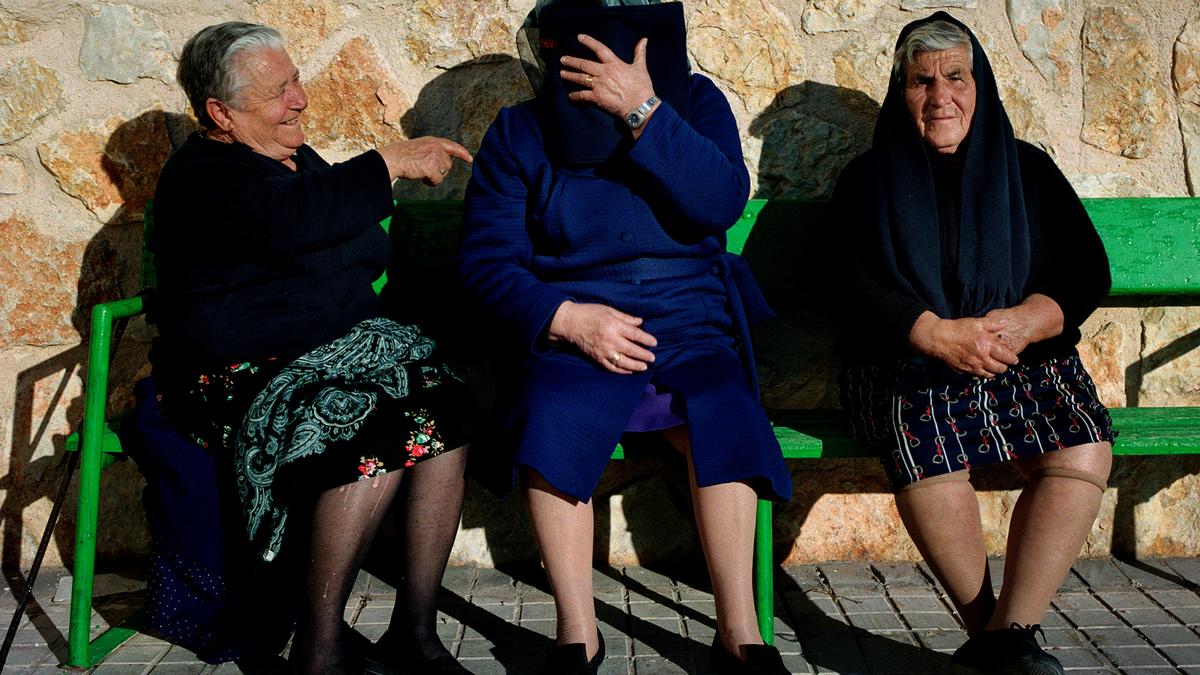
So how did women’s laughter, especially in Europe, come to be treated with such deep suspicion?
Women’s emotional expressions in general, and their laughter in particular, have often been policed more closely than men’s.
The fact that women’s laughter continues to be more heavily scrutinised today suggests that traces of this medieval vision still remain.
Undoubtedly, such stories about the risks of laughter deprived women of laughter not only in public, but also in their own homes.
Perhaps that is why, throughout history, laughter in general, and women’s laughter in particular, has unsettled so many people.
My grandmother, Tina, was born in the 1930s in a small village in northern Portugal. She had a difficult life. Widowed young, she was forced to raise 13 children on her own. She wore black until almost the end of her life. In my childhood memories, her face had only two expressions: ‘sad’ and ‘stern’. The first was constant; the second appeared whenever she scolded us.
I grew up without ever seeing her laugh. As a child, I assumed this was natural. Silence and emotional restraint seemed woven into her character. Only later did I begin to understand that this was not merely a trait of my grandmother’s, but the result of wider beliefs and social expectations that, for generations, deprived many women of the freedom to express something that had belonged to them since birth: their laughter.
I have often returned to those childhood memories of her lack of laughter. They stayed with me so deeply that, years later, they became the starting point for my PhD research into how laughter is shaped by culture and media.
When I was living and studying in London, I remember having many conversations with friends (and friends of friends) about their own memories of non-laughing grandmothers. I found echoes of my own story in accounts from Saudi Arabia, Japan and many other countries around the world: stories of grandmothers who were permanently serious, or of other women whose laughter was absent, inappropriate or out of place.
Of the many accounts I have gathered, one stands out. A Spanish friend told me that her grandmother began to laugh only after developing dementia. ‘I preferred that version of her,’ she confessed. ‘She stopped being rigid; she began to laugh and became more light-hearted.’
We may think of laughter as one of the simplest human impulses – spontaneous, joyful, harmless. So how did women’s laughter, especially in Europe, come to be treated with such deep suspicion?
Over the years, I have heard many explanations. Some have argued that prohibitions on laughter were a Latin or Catholic inheritance – and one that did not affect only women. There is some truth in that. For a long time, social norms spread by the Church suggested that positive emotional responses, like laughter, expressed a temporary enjoyment of worldly things and, therefore, a visible threat to moral purity. In the eyes of the medieval Church, as Umberto Eco suggests in his novel The Name of the Rose (1980), laughter could be seen as a kind of daytime orgasm or ejaculation, the waking counterpart to the nocturnal emissions (ie, wet dreams) that doctrine excused as involuntary, and a shameful public display of earthly pleasure, uncontrolled by spiritual discipline.
But that reading is reductive. Women’s emotional expressions in general, and their laughter in particular, have often been policed more closely than men’s.
To understand this history, it is worth looking at some of the pillars that shaped the Western feminine emotional ideal. Athenagoras of Athens, who lived around 115 to 190 CE, argued that a man should approach a woman in the same way a farmer approaches the land: not for pleasure, but only to sow his seed. In his view, woman was merely ‘ground’ – something that does not desire, does not feel, does not choose, and exists only to reproduce. We are speaking here of the feminine ideal in intimate life, but the same ideas applied socially. At one point, the Archbishop of Constantinople John Chrysostom, who lived around 347 to 407 CE, observed that women barely dared to laugh in the presence of their husbands. He even expressed discomfort at seeing them do so during his sermons. It is therefore unsurprising that later manuals, such as Le Ménagier de Paris (c1393) and The Ladies’ Book of Etiquette, and Manual of Politeness (1860), promoted a feminine ideal in which laughing freely and openly could not, ultimately, exist within society.
Stories about the risks deprived women of laughter not only in public, but also in their own homes
When we look at the Western tradition of writers and thinkers – especially those who were influenced by Plato – we frequently find laughter associated with a loss of control and distance from reason and sacred things. In a world organised through hierarchies, where man owed reverence to God and woman to man, female laughter was seen as a threat to that order. The fact that women’s laughter continues to be more heavily scrutinised today suggests that traces of this medieval vision still remain.
Maggie Hennefeld, professor of cultural studies and comparative literature at the University of Minnesota, notes that between the mid-19th and early 20th centuries, accounts circulated claiming that hundreds of women had died from laughter. She writes:
For example, in 1893, Bertha Pruett was entertaining guests at her home in Philadelphia, one of whom, a young man, was ‘a noted wit. One of his remarks threw Miss Pruett into a violent fit of laughter, which lasted some minutes, when it suddenly changed to a cry of pain, and she fell to the floor. Blood gushed from her nose and mouth and medical assistance was summoned, but before anything could be done … she was dead’ … Stories such as these, evidently, revealed women’s laughter to be fatal.
It is easy to imagine the impact of such painful stories. Undoubtedly, such stories about the risks of laughter deprived women of laughter not only in public, but also in their own homes. Many must have lived in fear of laughing, since – according to those narratives – the consequences could be fatal. Some women, according to certain accounts, died simply for laughing at jokes about mothers-in-law.
You may like Who do you think you are? There are two answers Joanna Lawson Save Emotions were felt differently in the past Sam Haselby Save How needing others became a source of shame for Americans Susan J Matt Save
In the study ‘Gender and the Evaluation of Humor at Work’ (2019), Jonathan B Evans and colleagues found that, in the workplace, making others laugh tends to increase men’s status while diminishing that of women. As for laughter itself, something similar occurs in public life. In contemporary political contexts, figures such as Hillary Clinton and Kamala Harris have been repeatedly scrutinised for their laughter, in a way that is rarely applied to their male counterparts. Few people today would openly tell women not to laugh or make others laugh. Yet both actions still seem to disturb a masculinised atmosphere whose pressure may not always be immediately obvious but is still felt in certain places and by certain people.
Why might this happen? In Laughter (1900), Henri Bergson suggests that laughter marks the breaking of social rigidity and exposes the artificiality of social norms. We might therefore understand laughter as the sound of that rigidity giving way, like glass breaking. The person who laughs at the way things are is able to momentarily step outside the established order and, from that position, reveal how constructed it really is: a peasant laughing at a king, a worker laughing at a boss, a woman laughing at a world that expects her to be silent. In such moments, human nature asserts itself over social constructions, and whatever hierarchies were in place are briefly suspended. Perhaps that is why, throughout history, laughter in general, and women’s laughter in particular, has unsettled so many people. Laughter is, after all, the sound of social rigidity cracking under the pressure of human nature.
Though laughter has historically been seen as dangerous and unsettling, it has firmly established itself in the modern world. This change has been generated, in part, by the rise of new forms of media.
In the early 20th century, cinema emerged as a powerful tool for weakening older fears around laughter and unleashing its liberating force. Women attending movies during that period could see, with their own eyes, people like them laughing on screen. They watched them laugh without any negative consequence befalling them and, more importantly, without succumbing to a laughter-induced death. In this way, the laughter present in cinema was important for many women who, symbolically at least, did not yet know what laughter really was. And comedy films brought a new and uplifting message of hope, power and prominence to laughter, the opposite of what had often been heard until then. This was true for both women and men, but especially for women, whose laughter had been more restricted. The arrival of comedies on television only accelerated this process.
Morning talk shows filled with small acts of silliness played a crucial role in my grandmother’s transformation
Think of the laughter running through the US TV comedy I Love Lucy in the 1950s, the Mexican comedy El Chavo del Ocho in the 1970s, or the British comedy Keeping Up Appearances in the 1990s. Think also of the many daytime talk shows that proliferated across television screens around the world in the late 20th century, where laughter and tears are as common as words. What elite culture has often dismissed as frivolous media content – easy laughter, excessive emotionality – has played an important role in the democratisation of emotions in general, and laughter in particular, in the past century. For millions of people, the arrival of cinema, radio, television and, more recently, social media has served as a source of emotional literacy in both personal and social life.
As for my grandmother, her beliefs deprived her for practically her entire life not only of comfortable access to the social world but, above all, of a genuine connection to her own emotional world. Only later in life did she truly begin to laugh. What helped was her favourite television programmes – morning talk shows filled with recipes, domestic advice, laughter and small acts of silliness – which played a crucial role in that transformation. Through the easy laughter she consumed, she slowly learned to laugh without fear or embarrassment.
That daily exposure helped free her from the constraints of a certain cultural and religious pressure she never knew how to name, but which had kept her enclosed within herself, distant from her own body and her own nature.
I cannot say exactly when I first saw her laugh openly. But I remember her last laugh. It was in hospital, when I asked whether the hotel service was good enough for her requirements. It was not a good joke, I know, but it was enough to make her laugh. And laugh she did – without embarrassment, without covering her face, without fear of dying.