Read Full StoryThe grievances surfaced most sharply at the INDIA bloc’s meeting in New Delhi on June 8.
Outside, historian Ramachandra Guha went further, contending that the Congress must move beyond the Gandhis altogether if it hoped to challenge the BJP.
The second is the fraying of the INDIA bloc, for which he largely does not.
No INDIA bloc understanding was ever on the table nor could one have been.
The Congress holds just 32 of them, and most of those rest on alliances with the DMK, SP, RJD, Shiv Sena (Uddhav Balasaheb Thackeray) and Nationalist Congress Party (Sharadchandra Pawar).
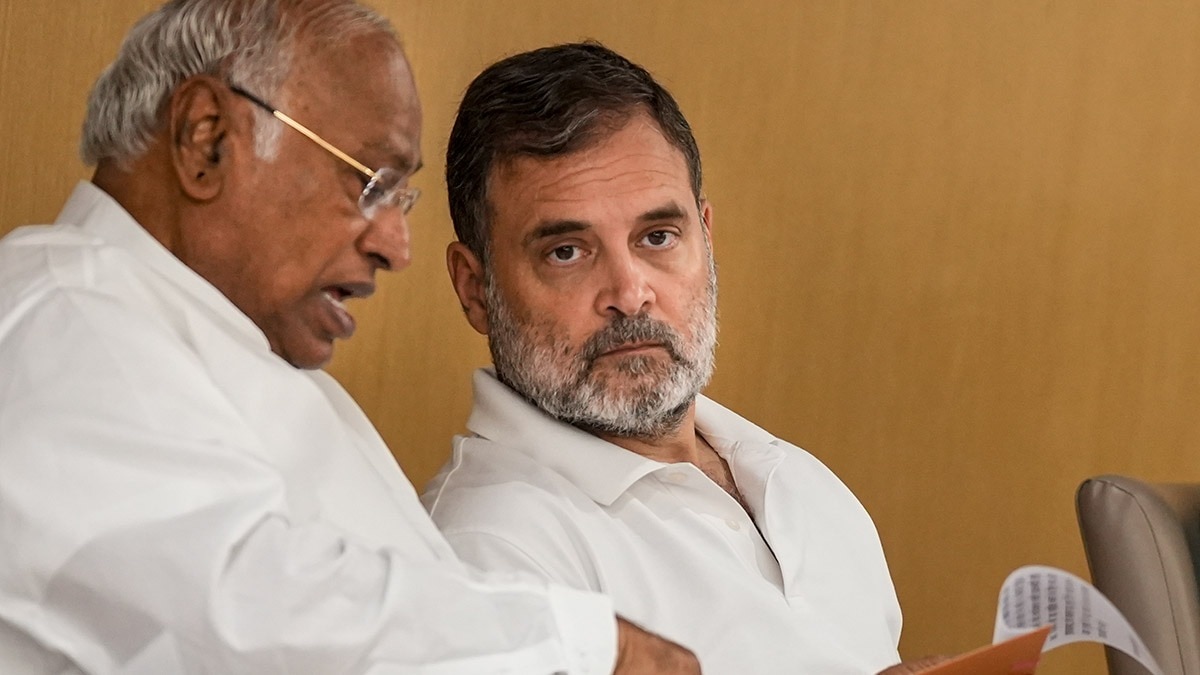
The Congress’s worst run of state election results in years has revived an old question in the Opposition camp and attached it to a single name. After the assembly polls this April left the party and its partners routed in Assam, West Bengal, Tamil Nadu and Puducherry, and victorious only in Kerala, much of the criticism has converged on Rahul Gandhi, the leader of the Opposition in the Lok Sabha and the Congress’s most prominent national face.
Read Full Story
The grievances surfaced most sharply at the INDIA bloc’s meeting in New Delhi on June 8. The bloc, an alliance of roughly two dozen Opposition parties formed in 2023 to contest against the BJP, met for the first time since the state poll results. The Dravida Munnetra Kazhagam (DMK) boycotted the gathering, accusing the Congress of betrayal after it abandoned their alliance once the Tamil Nadu poll verdict was out. So did the CPI(M), the leading party in Kerala’s Left Democratic Front (LDF) alliance that lost to the Congress-led United Democratic Front (UDF).
Inside the room, Samajwadi Party (SP) president Akhilesh Yadav and Rashtriya Janata Dal (RJD) leader Tejashwi Yadav took aim at the Congress for acting unilaterally and attacking allies during the campaign. Outside, historian Ramachandra Guha went further, contending that the Congress must move beyond the Gandhis altogether if it hoped to challenge the BJP.
Then came the salvo from Pinarayi Vijayan, the CPI(M) veteran who was Kerala’s chief minister until this year’s polls and is now the state’s Leader of the Opposition. In his June 8 speech, Rahul had said he could not politically “hug” Vijayan because the two were locked in an active fight in Kerala. Vijayan hit back by reminding Rahul of his own embrace of Prime Minister Narendra Modi on the floor of Parliament and argued that his brand of politics was weakening the INDIA bloc and, in effect, helping the BJP.
The ‘chargesheet’, taken together, folds two distinct failures into one. The first is the Congress’s electoral decline, for which Rahul bears real responsibility. The second is the fraying of the INDIA bloc, for which he largely does not. The two have become difficult to separate in the recriminations of the past fortnight, and perhaps in search of a villain.
On the first count, the case against Rahul is strong. A leader presiding over the loss of an overwhelming majority of elections across a decade cannot escape scrutiny. Under his watch, the party has failed to build organisation, to nurture a credible bench of state leaders or to fashion a message that travels in assembly election contests. The steady erosion of the Congress’s footprint outside a shrinking set of states is the clearest evidence of that failure.
advertisement
The second count is where the blame misfires, because in most of the states that went to the polls there was no functioning alliance to break. West Bengal is the clearest illustration. There was no INDIA arrangement there to betray. Trinamool Congress chief Mamata Banerjee, the state’s chief minister, had ruled out any tie-up with the Congress well before the election and had held no negotiations with it. The Congress contested alongside the Left, while the Trinamool fought alone. An alliance that was never formed cannot be said to have collapsed.
Kerala makes the point more starkly still. The Congress-led UDF and the CPI(M)-led LDF have been direct adversaries there for decades, alternating power. No INDIA bloc understanding was ever on the table nor could one have been. The Congress fought the Left and defeated it, ending Vijayan’s tenure. To frame that contest as a breakdown of Opposition unity is to misread a rivalry that predates the bloc by a generation.
advertisement
Tamil Nadu is the case the DMK presses hardest, and even there the sequence does not bear out the accusation. The Congress entered the election as the DMK’s junior partner, and Rahul held to that alliance through the campaign, overruling aides who had detected the surge behind actor Vijay’s Tamilaga Vettri Kazhagam (TVK) and wanted to switch sides early. Only after the DMK was routed did the Congress pivot towards the TVK. The break came after the verdict, not before it. The DMK’s anger reflects the wound of defeat rather than evidence that the Congress engineered its loss.
Puducherry’s collapse was self-inflicted but local. Congress rebels defied the seat-sharing pact and filed nominations against DMK candidates, prompting smaller allies to revolt. The fracture grew from factional indiscipline on the ground, not any directive issued in Delhi. Assam, for its part, had no INDIA front to begin with: the Congress’s old grand alliance there had disintegrated in 2021, and nothing cohesive replaced it.
A consistent pattern runs through all five states. Where the alliance frayed, it frayed on decisions taken by regional leaders or on rivalries older than the bloc itself. The deeper truth is that the INDIA bloc’s strength has always derived from how its constituent parties perform in their own states, not from any unity manufactured at a Delhi conference table. When the DMK lost Tamil Nadu and the Trinamool lost Bengal, the bloc lost two of its strongest pillars. That is arithmetic, not treachery.
advertisement
It is also why the reflex to assign collective failure to one figure is counterproductive. Vijayan blames Rahul for weakening the bloc. Rahul, in his June 8 speech, faulted allies for clinging to the illusion that elections under the present dispensation remain free and fair. Both arguments contain some truth and neither advances the Opposition’s cause. An alliance is only as effective as the electoral partnerships and shared narratives its members can construct, and only as durable as the respect they extend to one another’s grassroots cadres. Searching for a scapegoat at a moment of crisis substitutes for that work without doing any of it.
This is where the criticism of Rahul ought to be redirected. The Congress’s central weakness is not that he has failed to manage Mamata Banerjee or M.K. Stalin. It is that the party cannot stand on its own in the states that decide national power.
advertisement
The five states sending the most members to the Lok Sabha—Uttar Pradesh, Maharashtra, West Bengal, Bihar and Tamil Nadu—together account for 249 of the chamber’s 543 seats, close to half of Parliament. The Congress holds just 32 of them, and most of those rest on alliances with the DMK, SP, RJD, Shiv Sena (Uddhav Balasaheb Thackeray) and Nationalist Congress Party (Sharadchandra Pawar). The picture in the assemblies is bleaker. Those five states contain 1,462 assembly seats. The Congress holds 72. No coalition assembled months before an election can compensate for a party that is thin on the ground in the country’s electoral heartland.
A revival, on this evidence, has to begin with the patient rebuilding of the Congress’s own base in these states rather than with the courting of regional stalwarts to counter the BJP by proxy. The instinct to outsource the fight to allies is precisely what has left the party dependent and exposed.
The second problem lies within Rahul’s own political space, and he is better placed to deal with it. Even where the Congress remains competitive, its state units are at war with themselves. In Karnataka, the party has just replaced chief minister Siddaramaiah with his long-standing rival D.K. Shivakumar, a transition it managed but whose underlying feud it has not resolved. In Kerala, the question of leadership was settled while the wounds were left open. In Rajasthan, the rivalry between Ashok Gehlot and Sachin Pilot has reignited. In Telangana, the party’s central observer Meenakshi Natarajan and chief minister A. Revanth Reddy are at odds. The party remains a divided house in poll-bound Punjab.
These are conflicts Rahul is positioned to settle because they fall within the party’s own structure rather than that of the alliance. Making peace with Vijayan or the DMK may not bring Rahul immediate political gains, but bringing order to a divided state unit is vital if the Congress is to survive, recover and grow.
So, the honest verdict is, therefore, a divided one. Rahul owns the Congress’s decline in the states. He does not own the disintegration of an alliance that was never assembled in these elections to begin with. Conflating the two absolves him of the failure that is genuinely his while burdening him with one that belongs to a dozen regional leaders. The revival the party will not arrive with another alliance announced before a national contest. It will come from the slow work of helping the Congress find its own feet again.
Subscribe to India Today Magazine
- Ends