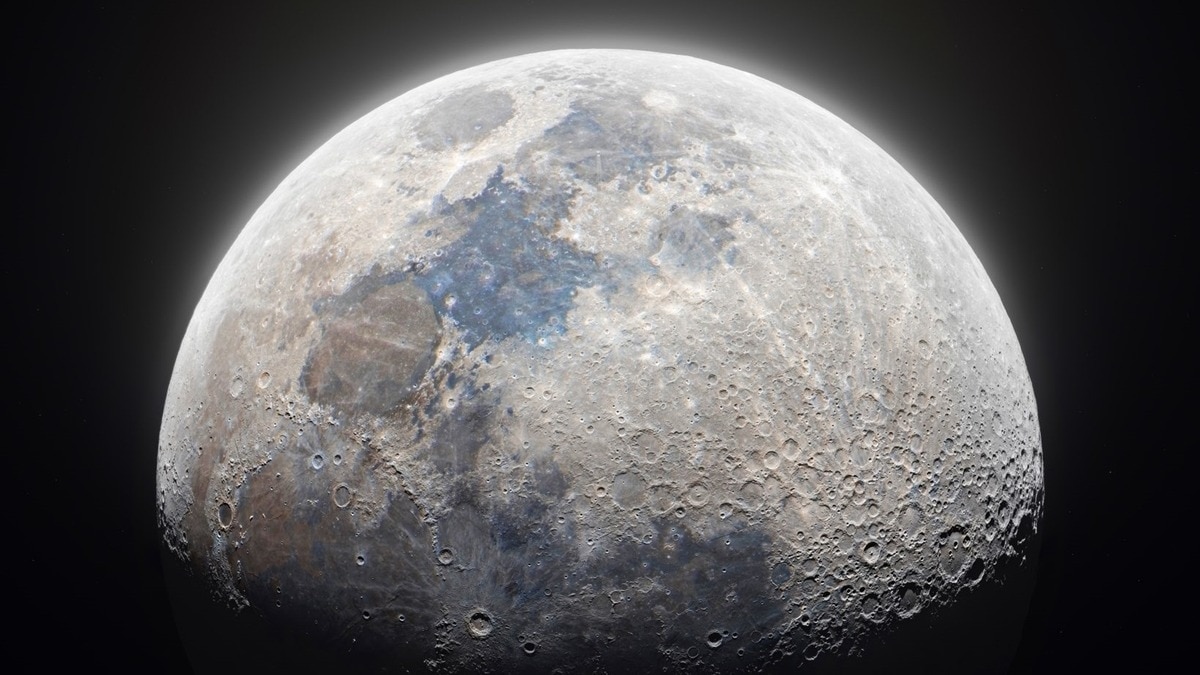
A new study of ancient rocks collected from the Moon's far side has revealed that asteroid impacts did not occur in one catastrophic burst, as many scientists had believed for decades.
Instead, the bombardment gradually declined over billions of years, offering fresh clues about why the Moon is covered in craters and what the young Earth may have experienced.
"The Moon is like a time capsule," said co-author Dr Fred Jourdan from Curtin University's School of Earth and Planetary Sciences.
Since the Earth and Moon formed together around 4.5 billion years ago, major impacts recorded on the Moon likely reflect conditions experienced by the young Earth.
With a new era of lunar exploration underway, researchers believe future Moon samples could reveal even more about the violent beginnings of both the Moon and Earth.
The Moon's crater-filled surface has fascinated humanity for centuries, and now scientists say those scars are helping rewrite the history of the early Solar System.
A new study of ancient rocks collected from the Moon's far side has revealed that asteroid impacts did not occur in one catastrophic burst, as many scientists had believed for decades.
Instead, the bombardment gradually declined over billions of years, offering fresh clues about why the Moon is covered in craters and what the young Earth may have experienced.
Read Full Story
The research, led by the State Key Laboratory of Deep Earth Processes and Resources at the Chinese Academy of Sciences, analysed samples returned by China's Chang'e-6 mission, the first spacecraft to bring back rocks from the Moon's far side.
Unlike Earth, where wind, rain, volcanoes and moving tectonic plates constantly reshape the landscape, the Moon has remained largely unchanged for billions of years. Every asteroid or comet that struck its surface left behind a crater that has been preserved like a page in a history book.
"The Moon is like a time capsule," said co-author Dr Fred Jourdan from Curtin University's School of Earth and Planetary Sciences.
"It has preserved a record of events that have been erased from Earth by erosion, plate tectonics and other geological processes."
The researchers studied tiny fragments of lunar rock dating from 4.33 billion to 1.13 billion years ago, allowing them to reconstruct more than three billion years of impact history.
Their findings challenge the long-held idea of a brief period known as the Late Heavy Bombardment, when scientists believed the Moon and inner planets were struck by an intense wave of asteroids about four billion years ago. Instead, the new evidence suggests the number of impacts slowly declined over time.
The far side of the Moon proved especially valuable because it has experienced fewer geological changes than the side that permanently faces Earth, preserving a cleaner record of ancient impacts.
The study also sheds light on Earth's own history. Since the Earth and Moon formed together around 4.5 billion years ago, major impacts recorded on the Moon likely reflect conditions experienced by the young Earth.
Scientists say understanding when and how often these asteroid collisions occurred could help explain how the early environment of our planet evolved and whether those impacts influenced the conditions that eventually allowed life to emerge.
With a new era of lunar exploration underway, researchers believe future Moon samples could reveal even more about the violent beginnings of both the Moon and Earth.
- Ends