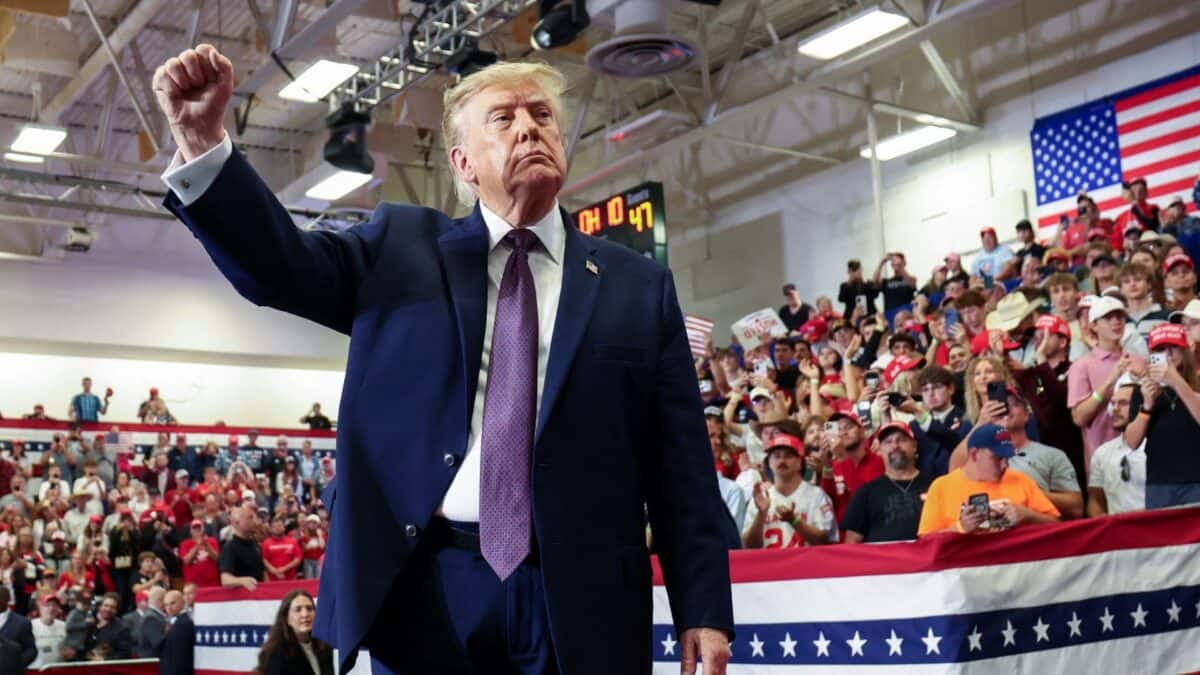
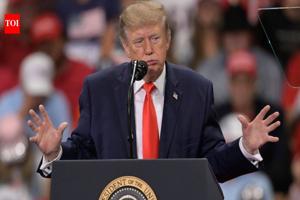
ExplainersWith Democrats favoured to win the House and challenging Republicans in the Senate, US President Donald Trump has refused to guarantee that he will accept the 2026 US midterm election results.
Asked by a reporter whether he would respect the results whatever happens, Trump answered that he would "if they're honest elections," according to the Washington Post.
Before the 2016 election, Trump said he would accept the result if he won.
Trump has continued to describe the 2020 election as rigged, a claim for which courts, recounts and audits found no supporting evidence.
And 61 per cent of Americans are confident Democratic leaders would accept the results if their party lost, compared with 28 per cent for Trump.
Explainers
With Democrats favoured to win the House and challenging Republicans in the Senate, US President Donald Trump has refused to guarantee that he will accept the 2026 US midterm election results. From Justice Department lawsuits to federal poll monitors, here is what could happen if Trump disputes the outcome
See more of our coverage in your search results.
With Democrats favoured to win the House and the Senate within reach, United States President Donald Trump says he will accept the outcome only if the elections are "honest".
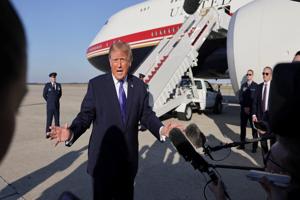
The latest flashpoint came on Tuesday, October 27, at Joint Base Andrews in Maryland, as the president prepared to fly to Texas for campaign rallies.
Asked by a reporter whether he would respect the results whatever happens, Trump answered that he would "if they're honest elections," according to the Washington Post. He did not say who would decide whether an election was honest, or what standard he would apply.
In the same exchange, Trump was asked how he would work with Democrats if they take control of the House. He replied that the country would "figure a way" and pointed to his veto power, a signal that he is already preparing for the possibility of divided government.
Advertisement
Advertisement
The remark echoed earlier statements. In a February interview with NBC, Trump said he would trust the midterm results if the elections are honest, and added that if states could not run elections honestly and on time, "something else has to happen."
He also pushed back on the reaction to his earlier call for Republicans to "nationalise" voting. White House Press Secretary Karoline Leavitt said at the time that the president was endorsing the SAVE Act, a bill requiring documentary proof of citizenship to register to vote, rather than seeking to strip states of their authority over elections.
The pattern is familiar. Before the 2016 election, Trump said he would accept the result if he won. Before 2020, he said he would have to see what happened, and he later refused to concede to Joe Biden, filing dozens of unsuccessful lawsuits.
Ahead of the 2024 election, he said he would accept the outcome if it was fair and legal. Trump has also declined, in an interview with Time, to rule out declaring a state of emergency in connection with the midterms.
The White House says the criticism is misplaced. Spokesperson Lauren Bis told Newsweek that Trump wants free and fair elections and accused Democrats of eroding public confidence by opposing voter ID and citizenship verification.
Advertisement
Advertisement
How Trump has already laid the groundwork
Critics say Trump's answer on Tuesday cannot be separated from the campaign of doubt that has surrounded it.
A Washington Post analysis published October 27 found that during his second term, Trump has made nearly 300 statements in speeches, press remarks, and online questioning the integrity of elections, including claims that past elections were rigged, that noncitizens are voting and that mail-in ballots enable fraud.
The Post found that he has mentioned voter ID and mail-in ballot claims six times more often in 2026 than in 2025.
The same analysis identified nearly 600 high-profile right-wing social media accounts, podcasts and other outlets that have published content questioning the election and telling Trump's supporters to expect cheating.
Themes about noncitizen voting and mail-in fraud are about twice as prevalent as they were in the 2024 cycle, the Post reported. Former Trump adviser Steve Bannon has argued on his podcast that Democrats have to cheat to win.
On Monday, October 26, Trump announced on Truth Social that anyone reporting voter fraud in past elections or the 2026 midterms would be paid $1 million upon the arrest and conviction of those responsible. The offer was amplified by the White House and allies.
The factual record is important context. Voting by noncitizens is illegal and, according to the Post's reporting, rare, as is fraud involving mail ballots; documented cases typically involve small numbers of votes rather than the large totals needed to change an election outcome.
The conservative Heritage Foundation had recorded 24 instances of noncitizen voting in US elections between 2003 and 2023. Trump has continued to describe the 2020 election as rigged, a claim for which courts, recounts and audits found no supporting evidence.
Attitudes inside the president's own coalition reflect the effect of the messaging. A Pew Research Center survey this month found that only 45 per cent of Republican-leaning voters are confident that noncitizens will be prevented from casting ballots, compared with 90 per cent of Democratic-leaning voters.
Can a president reject midterm results? What the law says
Unlike a presidential contest, there is no Electoral College and no national certification. The process is run by states and, at the end, by Congress.
Here is how it works. Local officials count the ballots and certify to the state. State officials then certify the winners of the 435 House races and the Senate races, with most states required to complete certification by late November or early December.
Advertisement
Advertisement
The Constitution, in Article I, makes each chamber the judge of the elections, returns and qualifications of its own members. The new Congress convenes on January 3, 2027, when members whose credentials have been certified are sworn in.
The Brennan Center for Justice wrote in an October 16 report that authority over elections clearly lies with the states and Congress, and that even an emergency declaration would not hand the president control of the process.
Many experts also agree that a national emergency declaration would not give the president constitutional authority to take over election administration, which remains largely a state responsibility.
Presidential power does exist at the margins. The Justice Department can file lawsuits, as it has in Alaska and California. The administration can use its platform to dispute outcomes, and the president can veto legislation that a new Democratic majority might pass in response.
Trump's first attempt to impose election rules by executive order was blocked by a federal court last year in a lawsuit brought by the League of Women Voters. The SAVE Act, which Trump has urged Congress to pass, faces a 60-vote filibuster hurdle in the Senate.
What Republican leaders are saying
House Speaker Mike Johnson addressed the concern directly on Tuesday during a campaign stop in Orangeburg, New York, with Rep Mike Lawler.
Asked to commit to a peaceful transfer of power, Johnson said there would be one, called suggestions to the contrary absurd, and said that on January 3 he would swear in everyone whose election has been certified by their state.
He also predicted Republicans would keep the majority, so that, in his words, nothing would be transferring.
The statement matters because Johnson played a prominent role in Republican efforts to contest the 2020 presidential election, and because the Speaker's office has operational control over the early steps of organising a new House.
Advertisement
Advertisement
It does not resolve how Republicans would act if the margin were razor-thin, or if a state's certification were itself disputed.
Blanche, for his part, has said he shares Trump's view that the 2020 election was rigged, a position that distinguishes him from several predecessors, and that the department's intention is not to improperly interfere with the process.
What the public thinks
Americans are sceptical about the president's willingness to accept defeat, though largely confident in the voting system.
A Washington Post-ABC News-Ipsos poll conducted October 9 to 13 found that 70 per cent of Americans are not confident Trump would accept a Republican loss, including half who are not at all confident.
Only 28 per cent are confident. The doubt spans party lines. 94 per cent of Democrats and 77 per cent of independents lack confidence, as do 36 per cent of Republicans, although 63 per cent of Republicans say they are confident he would accept it.
The same poll found that 70 per cent of Democrats and 67 per cent of Republicans are confident the midterms will be conducted fairly and accurately. And 61 per cent of Americans are confident Democratic leaders would accept the results if their party lost, compared with 28 per cent for Trump.
The backdrop is a political environment that favours Democrats.
How states and Democrats are preparing
Election officials in several states say they are war-gaming scenarios once considered remote. Maine Secretary of State Shenna Bellows told The New York Times it is the first time her office has had to plan for possible federal interference in elections.
Democratic governors, mayors and attorneys general have reportedly held tabletop exercises on scenarios such as immigration enforcement agents appearing at polling places or ballots and voting equipment being seized, according to AP.
Democratic groups say they have prepared petitions asking courts to compel certification, a standard remedy if an official refuses.
Advertisement
Advertisement
Republicans, meanwhile, are mounting their own election integrity operation, which Trump has promised will be much bigger than in previous cycles, including congressional observers sent to cities such as Atlanta, Detroit, Milwaukee, Philadelphia and Madison.
What happens after election day
Most outcomes will be known on election night or within days, though close races in states that count mail ballots slowly, and Alaska's ranked-choice tabulation, can take longer.
Automatic recounts, canvass periods and certification deadlines then vary by state.
If Trump disputes the results, the first signals would likely come in the hours after polls close.
The next test comes during state certification in late November and early December, when any local refusal to certify would likely be met by emergency court petitions. The final test is January 3, when Congress organises itself.
Even if Trump never formally concedes, the practical consequence may be limited. Winners who are certified by their states take office regardless of whether the president acknowledges them.
The more realistic risk, experts say, is prolonged litigation, intimidation of election workers, and a deeper erosion of public trust in the process.
If Democrats win either chamber, experts have noted that the president and his administration would face two years of congressional investigations, and a third impeachment vote would be possible.
They argue that this gives the president a strong incentive to undermine the election outcome, even though the Supreme Court has ruled that presidents enjoy immunity for most official acts.
With input from agencies