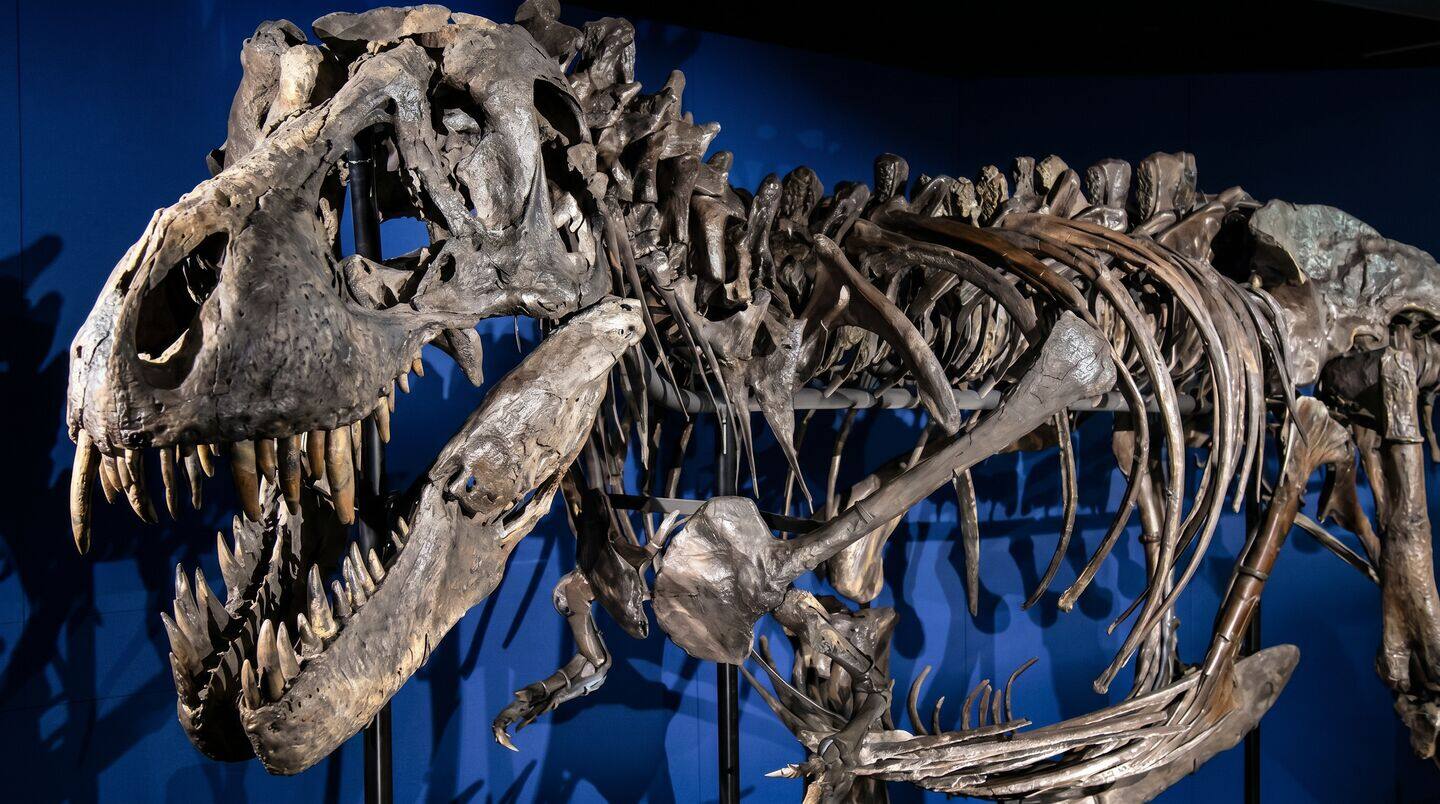
The mystery of Tyrannosaurus rex's disproportionately small arms may have finally been unraveled by a new study.
The research, published in the journal Proceedings of the Royal Society B, suggests that these tiny forelimbs were an evolutionary trade-off for a larger skull.
Evolutionary insight Evolutionary trade-off Charlie Roger Scherer, a doctoral student at University College London and the study's lead author, explained that evolution often prioritizes one feature over another.
This suggests that as dinosaurs evolved stronger skulls for hunting larger prey, their forelimbs became less important and eventually shrank.
Methodology Measuring limbs and skulls The researchers measured the forelimbs and skull bones of 82 dinosaur species, using fossils and data from existing scientific literature.
The mystery of Tyrannosaurus rex's disproportionately small arms may have finally been unraveled by a new study. The research, published in the journal Proceedings of the Royal Society B, suggests that these tiny forelimbs were an evolutionary trade-off for a larger skull. The study analyzed 82 dinosaur species and found a correlation between strong skulls and smaller forelimbs across five different groups of dinosaurs.
Evolutionary insight Evolutionary trade-off Charlie Roger Scherer, a doctoral student at University College London and the study's lead author, explained that evolution often prioritizes one feature over another. He said, "If you want to focus on using your head to bring down large prey, you don't really want to be putting much effort in keeping your arms long and with claws." This suggests that as dinosaurs evolved stronger skulls for hunting larger prey, their forelimbs became less important and eventually shrank.
Methodology Measuring limbs and skulls The researchers measured the forelimbs and skull bones of 82 dinosaur species, using fossils and data from existing scientific literature. They also developed a new way of quantifying skull strength by looking at factors such as overall size, how the bones fit together, and bite force. This allowed them to rank every skull on a scale. Not surprisingly, T. rex topped the list with its massive head.
Advertisement
Evolutionary pattern Shrinking limbs across species The study's findings suggest that shrinking limbs were not a one-off occurrence, but an evolutionary trait observed across different, unrelated species over a long period. The process varied among groups with some dinosaurs first reducing the size of their fingers while others focused on shortening the forearm. Scherer said, "There's always a common driver of it," which was these dinosaurs preying on animals that required more force to bring down.
Advertisement