View image in fullscreen Gitali Phukon in flood water outside her house on 28 July, a week after the village was flooded.
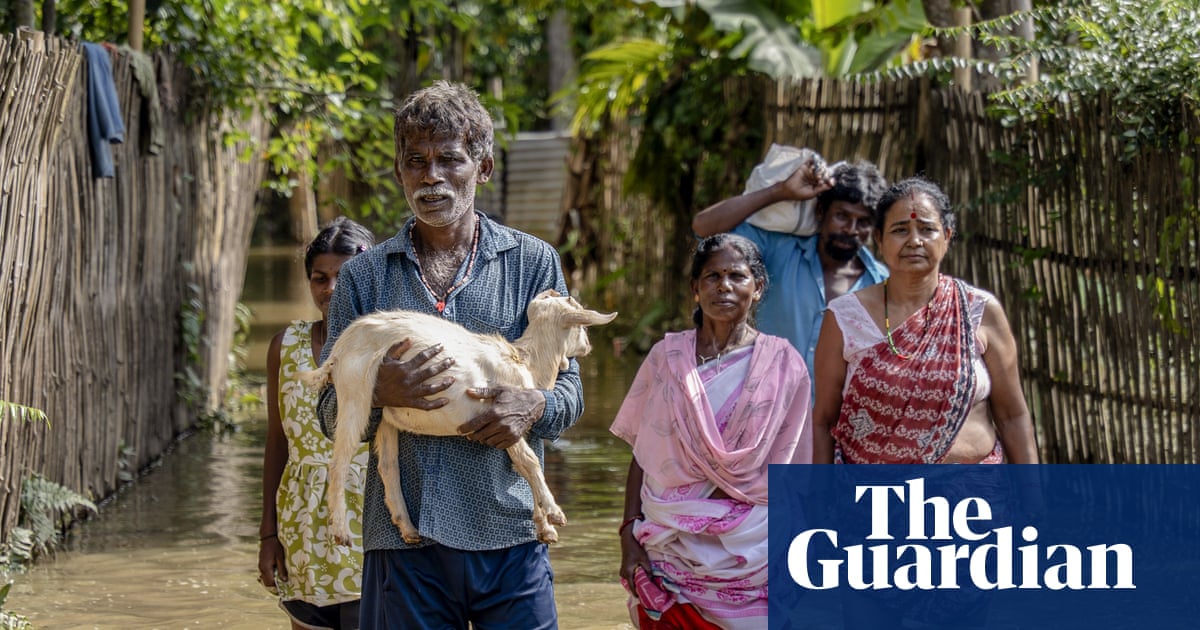
View image in fullscreen Thick mud and flood water, dotted with drowned cars or dead cows, cover much of Assam’s Sivasagar district.
Eight years ago, Mintu Hazarika, 30, left Kosumari village in Sivasagar district for the IT hub of Bengaluru (formerly known as Bangalore).
View image in fullscreen A girl and her grandfather travel on a raft through flood waters in Sivasagar district.
Those that remain are filled with polokh [alluvial silt or sediment left behind by flood waters].
It was a normal July morning in the Indian state of Assam. After finishing her chores and eating breakfast, Gitali Phukon, a resident of the town of Gaurisagar, left her home to buy groceries. After two days of rainfall that had made the unpaved roads muddy and slippery, the sun was shining.
But less than an hour later, she returned home to a nightmare: the Mitong River, which runs through the town, was overflowing and water was gushing through the streets.
“I could not believe my eyes. The water came with great force. It quickly rose to waist level,” she says. She had seen the surrounding paddy fields flood in the past, but never before on this scale.
As evening approached, flood waters entered most of the homes in her neighbourhood. The rain resumed, and darkness descended. Standing on her veranda with a candlestick in her hand, Phukon watched as her neighbours moved to their rooftops or the elevated highway to escape the rising water.
View image in fullscreen Gitali Phukon in flood water outside her house on 28 July, a week after the village was flooded. Photograph: Gitali Phukon/The Migration Story
They waved at each other, signalling they had survived. No one slept that night. “We feared we would all be drowned,” she says. Along with mosquito bites, they had endured a foul smell emanating from the flood waters.
The next morning, the situation worsened. Most villages in Assam depend on wells. “People were thirsty; they were crying for water. But there was no water to drink as the groundwater was contaminated,” says Phukon.
“Thankfully, I had some stored water, and I shared that with my neighbours,” says Phukon. People ate biscuits and puffed rice for at least three days until the water started to recede.
People in the Sivasagar district of Assam, as well the neighbouring districts of Charaideo and Jorhat on the southern bank of the mighty Brahmaputra River, reported similar experiences.
The Sivasagar village of Nepalikhuti, about 60 miles west of Gaurisagar, lies in ruins. As far as the eye can see, there is thick mud and silt. Drowned cars, dead cows and the broken walls of a house demonstrate the scale of the calamity. There is no sign of any cattle, goats or other livestock, the main means of support for the residents.
At least 10 people from the village of 3,000 people have died, and many remain missing. Villagers say they have seen several unidentified dead bodies floating on the Dikhou River.
Assam, in the far northeastern corner of India, is one of the most flood-prone regions in the country. About 40% of its land is vulnerable to inundation from the Brahmaputra and Barak rivers and other smaller rivers, and it sees at least two or three major floods annually.
According to official figures, about 2,690 villages in 25 districts have been flooded this year, affecting more than 1 million people. As of 11 August, 101 people have lost their lives. The death toll is likely to rise, officials fear.
In 2025, the death toll due to floods and landslides was 36. The year before, when all 35 districts of the state were affected by floods, at least 110 people died.
View image in fullscreen Thick mud and flood water, dotted with drowned cars or dead cows, cover much of Assam’s Sivasagar district. Photograph: Anadolu/Getty
According to Partha Jyoti Das, a specialist in water and climate hazards with the environmental organisation Aaranyak, the current disaster was inevitable. The climate crisis has led to heavier rainfall, and changes to the landscape made flooding more likely.
“It’s a much-abused landscape, turning into a burial ground,” he says. Had it been just flood waters, the damage would have been less, but the rain brought with it debris, mud, silt and soil from the hills of Nagaland.
“These areas have seen mining and quarrying, both legal and illegal, for several years. From coal, sand or boulder mining, everything happens in these places. The whole landscape has been changed by large-scale deforestation, encroachment and excavation,” he says.
By 11 August, flood waters had receded in several villages, leaving behind heavy layers of mud and silt. However, low-lying areas of Sivasagar, Jorhat and Charaideo districts are still flooded, including the well-known Jokaichuk paddy field, a vast stretch of agricultural land shaped like a jokai, or bamboo fishing tool, near Gaurisagar.
View image in fullscreen Jorhat, in Assam, after heavy monsoon rains on 22 July. Photograph: Anadolu/Getty
“The floods have ruined 95% of the farmland across Sivasagar,” says Himadrijyoti Dutta, who works with farmers in the district through his non-profit organisation, Krishak Nyas, and has been visiting different villages to provide relief materials.
“The flood waters have washed away all the hard work and financial investments of the farmers. They have all been left poorer and desperate.”
Kalyan Das, a geography professor at Guwahati’s Cotton University, says the latest disaster will trigger a wave of migration. “Assam is already witnessing a serious crisis of out-migration of people from every block. There are many factors – primarily land degradation – making farming unsustainable,” he says.
skip past newsletter promotion Free newsletter | Every fortnight Sign up to Global Dispatch Get a different world view with a roundup of the best news, features, opinion and photography, curated by our global development team Enter your email Sign up after newsletter promotion
Employment-driven migration from Assam rose from 16.3% in 1991 to 24.4% by 2011, according to a 2022 study. In rural areas, floods and soil erosion were the primary causes, the study said. “The latest floods have destroyed homes and agricultural fields. The villagers will be forced to migrate in search of livelihood opportunities,” Das says.
Eight years ago, Mintu Hazarika, 30, left Kosumari village in Sivasagar district for the IT hub of Bengaluru (formerly known as Bangalore). He earns 25,000 rupees (£195) a month by working double shifts as a security guard in Bengaluru’s Marathahalli suburb and sends half his earnings home.
“My father is a farmer, so is my elder brother,” says Hazarika. “They tend paddy fields, but it is not financially viable. So they also work as daily wage earners in nearby urban areas to supplement the household income.
On 22 July, Hazarika received a call from his father. He was told that the floods had destroyed their family’s two-hectare paddy field. “I don’t know how my family is going to survive. My elder brother is planning to come to Bengaluru to find work. There are already so many men from Sivasagar and other parts of Assam working in Bengaluru,” he says.
View image in fullscreen Relief supplies being distributed from a truck on 4 August 4 in Sivasagar district. Photograph: Ritesh Shukla/Getty Images
Bitupan Raidongia, district president of Sivasagar for the Bharatiya Janata party, the ruling party in Assam, says the authorities are providing support for affected communities. “Our government is doing its best to rescue marooned people. We are also reaching out to affected families by providing them with food items, clothes and other essentials.”
Sivasagar’s district commissioner, Mridul Yadav, adds that the local administration was making a coordinated effort to address the flood situation. “Various departments are working together on rescue, relief distribution, and damage assessment. Health camps, essential medicines, drinking water, livestock fodder and relief kits are being provided. Several relief camps remain operational to support affected families and restore essential services,” he adds.
But the authorities’ response has been criticised as too little, too late. In a video that went viral, the Assam-based singer Nilotpal Bora said thousands more people would have died were it not for the intervention of local charities and individuals.
“You people [the government] had a delayed response in reaching out to the affected people. If common people had not distributed relief, at least 3,000 people from flooded areas would have died because of hunger and thirst,” he said in response to a comment from Assam’s chief minister, Himanta Biswa Sarma, that “the situation was under control”, and the public should not raise money to help flood victims.
Meanwhile, local groups and people are doing what they can to help. About 40 bikers from One Northeast Motorcycle Club are travelling to affected areas to distribute food, clothing, sanitary items, candles, matchboxes and other essentials. “It’s a heartbreaking sight,” says the club’s founder, Chow Sureng Rajkonwar.
View image in fullscreen A girl and her grandfather travel on a raft through flood waters in Sivasagar district. Photograph: Biju Boro/AFP/Getty Images
“Hundreds of people across villages have become homeless. Their homes were destroyed and flattened to the ground. Those that remain are filled with polokh [alluvial silt or sediment left behind by flood waters]. All their belongings were destroyed or washed away with the water. It will take months to rebuild those houses,” he says, adding that people are living in tents made of plastic sheets and tarpaulins on roads or higher ground near their villages.
Phukon was one of the luckier ones. Although the water level was more than 1.5 metres (5ft) high in her courtyard, it did not enter her house, which is built on higher ground.
For almost a week now, she has been providing relief aid to flood victims after getting distress calls from family, friends and acquaintances. “I decided to leave my home and reach out to people who need food, clothing, and other essentials. Everyone I know has been affected by floods.”
Maitreyee Boruah is a contributor to the Migration Story, where this story was first published