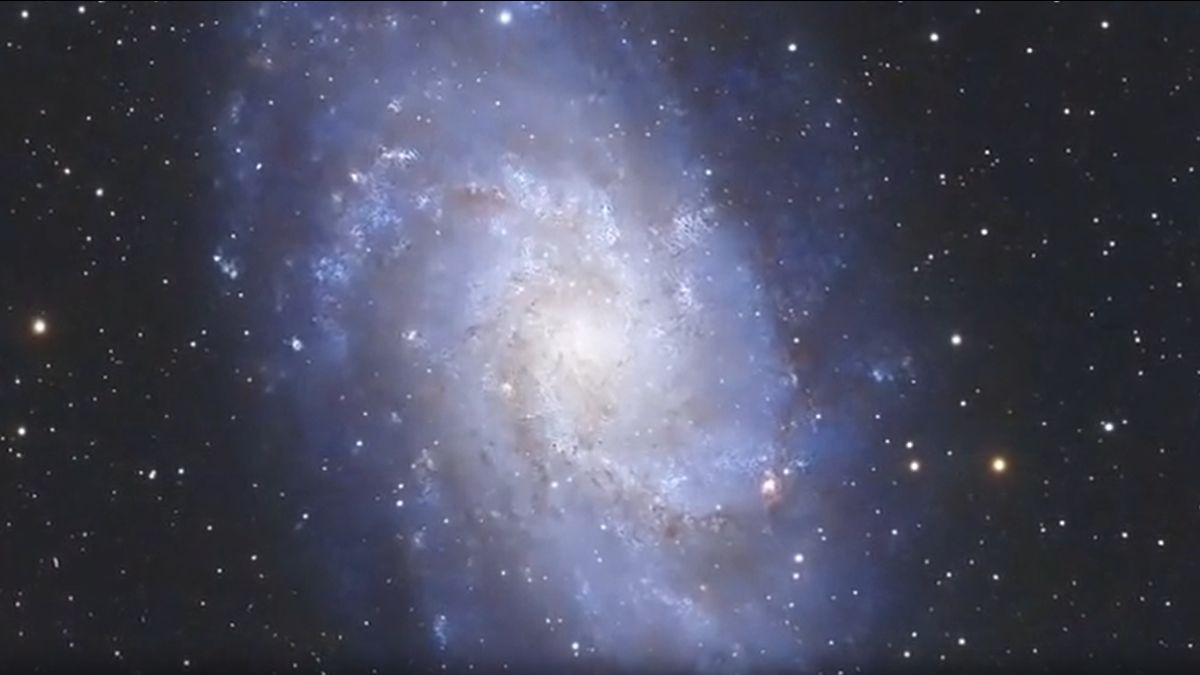
His subject was the Triangulum Galaxy, also known as Messier 33 or NGC 598.
An Indian astrophotographer captured a galaxy 2.7 million light-years away from his Himalayan village using a compact telescope.
WHAT IS THE TRIANGULUM GALAXY?
The vivid pink patch inside the Triangulum Galaxy is NGC 604, a star-forming region spanning roughly 1,500 light-years across.
The Triangulum Galaxy is likely to be swept into this vast cosmic event.
There is a village in Tehri Garhwal, Uttarakhand, perched high in the Himalayas, where the skies are dark enough to see galaxies with the naked eye. Amateur astrophotographer Ramesh Bhadri did not just see one. He photographed it.
His subject was the Triangulum Galaxy, also known as Messier 33 or NGC 598. An Indian astrophotographer captured a galaxy 2.7 million light-years away from his Himalayan village using a compact telescope. The light in the image left M33 before early humans existed on Earth. (Photo: @pahadi_astro / Instagram)
Read Full Story
The light in his image did not come from a studio or a screen. It left that galaxy approximately 2.7 million years ago, when early humans were barely walking upright on Earth, and finally landed on his camera sensor in a Himalayan village.
That is not science fiction. That is just physics.
WHAT IS THE TRIANGULUM GALAXY?
The Triangulum Galaxy is the third-largest galaxy in what astronomers call the Local Group, a cluster of roughly 50 galaxies that includes our own Milky Way and the nearby Andromeda Galaxy. Think of it as our cosmic neighbourhood.
It is a spiral galaxy with sweeping arms that curl outward from a bright central core, much like a pinwheel, which is also its popular nickname. The vivid pink patch inside the Triangulum Galaxy is NGC 604, a star-forming region spanning roughly 1,500 light-years across. It is among the largest known stellar nurseries in the entire Local Group of galaxies. (Photo: NASA / ESA / Hubble)
Sitting roughly 2.7 to 3 million light-years from Earth (one light-year equals about 9.46 trillion kilometres, and is the distance travelled by light in one year in a vacuum), it contains an estimated 40 billion stars.
Our own Milky Way, by comparison, holds between 100 and 400 billion.
A STELLAR NURSERY BIGGER THAN IMAGINATION
One of the most spectacular features inside M33 is NGC 604, a colossal star-forming region spanning roughly 1,500 light-years across.
The famous Orion Nebula, visible on clear winter nights even without a telescope, is only about 24 light-years wide.
NGC 604 is among the largest known regions of active star birth in the entire Local Group.
These regions glow pink and red in astrophotography images because of a process called hydrogen-alpha emission.
Young, massive stars blast intense ultraviolet radiation into surrounding hydrogen gas, ionising it, which means stripping electrons away from hydrogen atoms.
When those electrons snap back into place, they release light at a specific wavelength of 656.3 nanometres, producing that unmistakable reddish glow.
HOW RAMESH CAPTURED IT FROM A HIMALAYAN VILLAGE
Ramesh used a Redcat 51 telescope, a compact and portable instrument, paired with a ZWO ASI533MC Pro camera and an L-Pro filter.
advertisement
The filter blocks artificial light from cities and streetlights, letting fainter cosmic signals reach the sensor uninterrupted.
Because the Earth rotates, long exposures require precise sky tracking. The Triangulum Galaxy is the third-largest member of the Local Group, the gravitationally bound cluster of approximately 50 galaxies that includes the Milky Way and the Andromeda Galaxy. (Photo: NASA)
Over hours, the camera accumulates photons, which are individual particles of light, building enough signal to reveal the galaxy's spiral arms, glowing nebulae, and dust lanes.
From a dark Himalayan sky with minimal light pollution, even modest equipment can reach extraordinary depths.
A GALAXY ON A COLLISION COURSE
In approximately 4 to 5 billion years, the Milky Way and Andromeda are expected to merge into a single massive galaxy, informally called Milkomeda.
The Triangulum Galaxy, gravitationally bound to Andromeda, is likely to be pulled into this collision too. In roughly 4 to 5 billion years, the Milky Way and Andromeda are expected to collide and merge into a single elliptical galaxy, informally called Milkomeda. The Triangulum Galaxy is likely to be swept into this vast cosmic event. (Photo: NASA / ESA)
advertisement
The stars in Ramesh's photograph are already hurtling toward us at roughly 1,00,000 kilometres per hour.
What he captured from a Himalayan rooftop is not just beautiful. It is a galaxy already on the move.
- Ends