“We have extreme respect for the Supreme Court,” the Leader of Opposition in the Lok Sabha said .
This audit would have to be conducted by a committee under the leadership of a retired Supreme Court judge, according to their petition.
There is precedence for public pressure leading to judicial intervention in India’s recent political history, leaders of the party argue.
Back then, even ministers were compelled to resign because of the scrutiny they faced from the Supreme Court for alleged corruption.
Credit: Raghav Kakkar/ScrollEyes on 2029The Supreme Court has picked up on what the Congress is trying to do – and has reacted angrily.
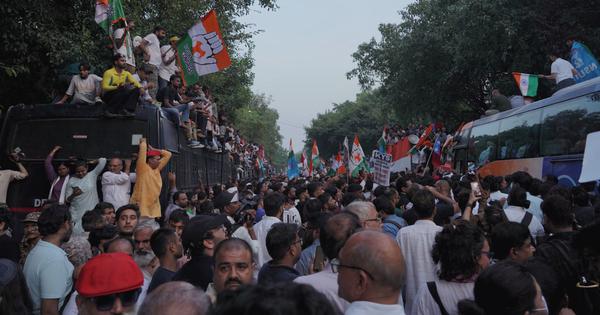
In a show of strength on October 12, the Congress party and its allies led tens of thousands of protesters in a procession that was meant to culminate outside the Supreme Court of India.
The choice of destination was not arbitrary. Several Congress leaders told Scroll that the grand old party is trying to put public pressure on the judiciary through street protests demanding the resignation of Chief Election Commissioner Gyanesh Kumar.
The party’s intention is not limited to getting the top court to intervene in favour of the Opposition in the case challenging the special intensive revision of voter lists. It believes that putting pressure on judges will force them to function neutrally, ending what it alleges has been the Supreme Court’s tilt towards the Modi government for the past decade.
The party is hopeful that this, in turn, would help create a level-playing field before the next Lok Sabha elections in 2029.
Politics over judiciary
Rahul Gandhi himself spoke about the judiciary at a news conference the day after the march.
“We have extreme respect for the Supreme Court,” the Leader of Opposition in the Lok Sabha said . “They have a role to play. We hope they will play that role. But we are also political people. No matter what happens, political resistance will continue.”
Protesters marching through Central Delhi on October 12. Credit: Raghav Kakkar/Scroll
It was an unusual thing to say, given that Gandhi had filed a petition in the Supreme Court asking for an audit of the roll revision exercise just the previous day. But his Congress colleagues say that this was a well-thought-out strategy to signal to the top court that the country was changing politically.
“If you have to get a decent judgement from this judiciary now, you actually have to mount public pressure,” asserted a Congress politician from South India. “There is no other way.”
This person requested anonymity to talk freely about issues which the party had not authorised him to discuss with the press, as did most other Congress leaders interviewed for this piece.
He brought up the Supreme Court’s unwillingness to intervene during the special intensive revision in West Bengal. Eventually, the names of over 91 lakh voters , many of whom had attended hearings and submitted documents, were struck off the state’s rolls, helping the Bharatiya Janata Party come to power in the state for the first time.
“People who are in power are negotiating with the judiciary through power,” the politician alleged. “But if there is public pressure, it will become difficult for the judiciary to side with the executive. Public opinion will start to act as a counterbalance to the political power and pressure put by the executive.”
A battle beyond SIR
One of the things that Gandhi and other Opposition leaders have asked of the top court is an independent audit of the roll revision exercise. This audit would have to be conducted by a committee under the leadership of a retired Supreme Court judge, according to their petition.
Congress politicians believe that if this demand were to be accepted, the public perception that Gyanesh Kumar had engaged in wrongdoing would gain more ground, making it difficult for him to continue as the chief election commissioner.
But for the party, the issue goes beyond Kumar and the special intensive revision. In its view, the Supreme Court has leaned heavily towards the Modi government during the past decade. Street protests are meant to ensure that judges function more neutrally moving forward.
“It is very important to tell them that the nation is looking at them also,” explained an MP, who is a national-level office-bearer in the Congress. “They cannot keep acting in an arbitrary way.”
The demonstrations, he pointed out, were the party’s way of “signaling” to judges that they need not “comply” with the government’s wishes.
There is precedence for public pressure leading to judicial intervention in India’s recent political history, leaders of the party argue.
The Congress-led United Progressive Alliance government, which was in power at the Centre from 2004 till 2014, had come undone partly because of the role played by the judiciary. Back then, even ministers were compelled to resign because of the scrutiny they faced from the Supreme Court for alleged corruption.
The grand old party, now in its thirteenth year out of power, is looking to recreate similar conditions for the Modi government.
Rahul Gandhi on a truck during the October 12 procession. Credit: Raghav Kakkar/Scroll
Eyes on 2029
The Supreme Court has picked up on what the Congress is trying to do – and has reacted angrily. “Nobody can browbeat the judiciary,” Chief Justice Surya Kant said on Thursday while hearing the Opposition’s petition. The next hearing is scheduled for October 27.
Congress leaders seemed undeterred, though. The MP quoted earlier bluntly stated that there could be “a lot of arrests” if the party continued to go down the path of street protests and civil disobedience. But the campaign would continue.
“Next, we will go and meet deleted voters in their villages,” he added. “That will have a much larger impact. The ‘vote chori’ narrative is making people want to remove the ‘chor’, thief, from power. That will reflect in the 2029 elections. By that time, if our organisation becomes sharper, we will fight a very good election.”
Anshul Trivedi, who is the coordinator of the Congress party’s student wing, argued that the allegations of rigging had put a question mark over the legitimacy of the prime minister itself.
“Narendra Modi uses election victories to justify all his actions,” he reasoned. “He rarely claims that his policies are legitimate on moral grounds. He seeks legitimacy only on the basis of his popularity. Now, even his electoral victories are under a cloud of suspicion. Even that last shred of legitimacy has been taken away from him.”
Graffiti drawn in Central Delhi on October 12, the day the Congress and its allies led a march to the Supreme Court. Credit: Raghav Kakkar/Scroll
Such rhetoric motivates Congress workers and volunteers who are otherwise jaded after the string of electoral defeats suffered by their party, according to another Delhi-based office-bearer of the party.
The Congress had taken up the issue of rigging in a big way ahead of the 2025 Bihar Assembly elections as well. However, the campaign did not prove to be successful at the time. The party ended up winning just six of the state’s 243 seats.
“So long as we were the only ones talking about it, few people believed us,” he complained. “This changed only after the investigation in The Indian Express.”
But he worried that the government would clamp down on Opposition protests before they could achieve their goals. “Modi and [Amit] Shah are not going to give up power easily,” he alleged.