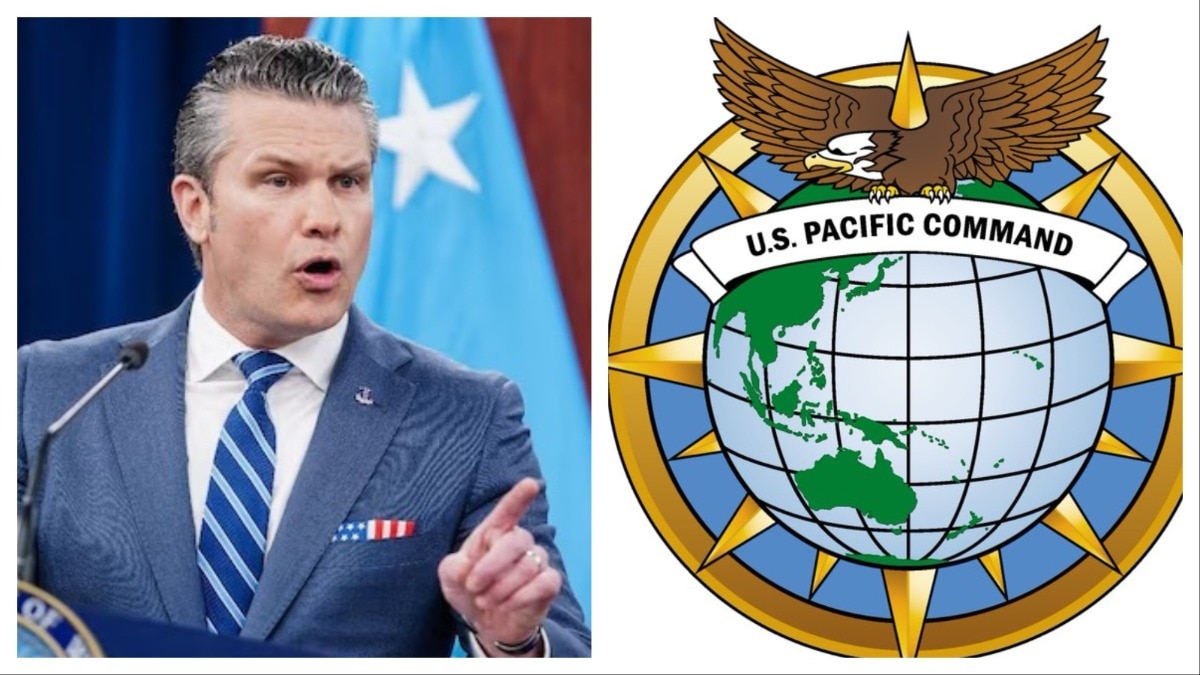
The United States Department of War has announced that the US Indo-Pacific Command (USINDOPACOM) will officially revert to its original designation — the US Pacific Command (USPACOM), restoring the name under which the military command operated for more than seven decades.
The command also displayed an incorrect map of India on its official website with regard to its operational territory in the Indo-Pacific region.
The USPACOM website showed Pakistan-Occupied Kashmir (PoK) as a part of Pakistan in its "Area of Responsibility Map" section.
Until this latest change, USINDOPACOM functioned as the principal US military command responsible for operations, planning, defence partnerships and regional security across the wider Indo-Pacific.
COMMAND RENAMED IN 2018The 2018 renaming to Indo-Pacific Command was widely viewed as more than administrative.
The United States Department of War has announced that the US Indo-Pacific Command (USINDOPACOM) will officially revert to its original designation — the US Pacific Command (USPACOM), restoring the name under which the military command operated for more than seven decades.
The command also displayed an incorrect map of India on its official website with regard to its operational territory in the Indo-Pacific region. The USPACOM website showed Pakistan-Occupied Kashmir (PoK) as a part of Pakistan in its "Area of Responsibility Map" section.
Read Full Story
The move reverses a symbolic but strategically significant change introduced in 2018, when then US Defense Secretary Jim Mattis redesignated the command as the US Indo-Pacific Command to reflect what Washington described at the time as the growing strategic importance of the Indian Ocean region and its increasing integration with Pacific security dynamics.
Announcing the latest decision, the Department of War said the restoration of the original name is intended to honour the command’s historical identity and institutional legacy.
The department said restoring the USPACOM designation "honors the command's deep historical roots, fostering a sense of pride and collective spirit among all who serve in the Pacific".
Officials also stressed that the renaming does not alter the command’s operational role, strategic mission or geographic scope.
According to the statement, USPACOM’s area of responsibility — extending from waters off the western coast of the US to India’s western boundary — remains unchanged. The department added that its commitment to maintaining a "free and open theater alongside regional allies and partners" will continue without interruption.
WHY THE COMMAND HOLDS KEY
Originally established on January 1, 1947, under President Harry S Truman, the command became one of the oldest and largest unified combatant commands in the US military system.
Over decades, it played key roles in shaping post-World War II security arrangements across Asia and coordinated joint military operations during major conflicts, including the Korean War and the Vietnam War, alongside humanitarian and disaster-response missions.
Until this latest change, USINDOPACOM functioned as the principal US military command responsible for operations, planning, defence partnerships and regional security across the wider Indo-Pacific.
Headquartered in Hawaii, the command oversees an enormous strategic zone covering the Pacific Ocean, much of the Indian Ocean, East Asia, Southeast Asia, Australia and parts of South Asia.
Its responsibilities extend across deterrence and defence readiness, military exercises with partner nations, maritime security operations, disaster response and contingency planning.
COMMAND RENAMED IN 2018
The 2018 renaming to Indo-Pacific Command was widely viewed as more than administrative. It signalled Washington’s acknowledgement that developments in the Indian Ocean and South Asia had become increasingly interconnected with security outcomes in the Pacific.
For India, USINDOPACOM emerged as an important institutional channel for expanding defence cooperation with the US.
The command became closely associated with growing India–US military engagement through joint exercises, maritime coordination, information sharing and wider strategic cooperation under the broader Indo-Pacific framework.
advertisement
Its area of responsibility and strategic approach also aligned with expanding regional conversations around securing sea lanes, ensuring freedom of navigation and maintaining balance across one of the world’s most important maritime corridors.
SHASHI THAROOR TAKES VEILED DIG
The development has also sparked political reactions in India.
Congress MP Shashi Tharoor responded to the announcement on social media with a brief but pointed remark, "One more nail in the coffin of the Quad?", while sharing screenshots of the order issued by the Department of War.
One more nail in the coffin of the Quad? https://t.co/7QauDO0a3s— Shashi Tharoor (@ShashiTharoor) June 17, 2026
Tharoor’s reaction reflected concerns among some observers that removing "Indo" from the command’s title could be interpreted as a shift in messaging around Washington’s Indo-Pacific strategy and the role of groupings such as the Quad.
However, US officials have maintained that the decision is limited to nomenclature and historical continuity, insisting that the command’s structure, responsibilities and regional commitments remain intact.
Whether the symbolic shift influences regional perceptions or future strategic signalling remains to be seen, but the renaming is likely to continue drawing attention across Indo-Pacific capitals in the weeks ahead.
- Ends
Published By: Vivek Published On: Jun 17, 2026 10:12 IST