Its magnetic field is tilted again, by nearly 60 degrees relative to the rotation axis and offset from the centre.
Uranus is slightly more than sidewaysNASA gives Uranus an axial tilt of 97.77 degrees.
Uranus has gone nearly eight degrees past that point, so its rotation is conventionally classified as retrograde.
In Uranus’s case, an off-centre collision could transfer enough angular momentum to turn the young planet’s spin axis towards its present position.
A giant impact explains the 98-degree tilt plausibly and can produce a tilted debris disc from which moons form.
Uranus is usually described as the planet that was knocked over.
Its spin axis is tilted by 97.77 degrees relative to its orbit, so its equator is almost perpendicular to the plane in which the planet travels around the Sun. The popular explanation is that a planet-sized body struck the young Uranus off-centre and left the ice giant rolling around the Sun like a ball.
It may also be right. But “most likely” is not the same as “known”, and the entire Uranian system makes the mystery harder than a single angle suggests.
The planet’s rings and regular moons share its sideways orientation. Its magnetic field is tilted again, by nearly 60 degrees relative to the rotation axis and offset from the centre. A successful origin story has to explain more than why one blue planet leans.
Uranus is slightly more than sideways
NASA gives Uranus an axial tilt of 97.77 degrees. An angle of zero would mean its axis stood perpendicular to the orbital plane. At 90 degrees, the axis would lie directly in that plane. Uranus has gone nearly eight degrees past that point, so its rotation is conventionally classified as retrograde.
Venus is the important exception to claims that every other planet rotates upright. Its obliquity is close to 177 degrees, meaning its axis is nearly upright but its rotation is effectively upside down and backwards. Uranus remains unique because its axis itself lies almost along its orbital plane.
A day on Uranus lasts about 17 hours, while a year lasts 84 Earth years. The planet spins quickly, but the direction of that spin makes it look less like a top and more like a wheel circling the Sun.
A giant impact is the leading explanation for good reasons
The early Solar System contained planetary embryos large enough to change one another permanently. Earth itself is widely thought to have gained the Moon after a giant impact. In Uranus’s case, an off-centre collision could transfer enough angular momentum to turn the young planet’s spin axis towards its present position.
NASA cautiously says the tilt “may” result from a collision with an Earth-sized object. More detailed three-dimensional impact simulations published in 2020 found that a grazing collision can tip a proto-Uranus while limiting how deeply the impactor mixes the planet’s interior.
That geometry could connect the tilt with another Uranian puzzle. I recently wrote about Uranus releasing far less internal heat than Neptune. Researchers have proposed that an oblique impact altered the planet’s deep structure or energy transport, although neither the tilt nor the weak heat flow proves that scenario.
The impact idea is persuasive because it can explain several oddities at once. That efficiency is also a reason to be careful. A theory that accommodates many clues is not necessarily the only history capable of producing them.
The moons are evidence, but not a confession
Uranus’s major regular moons do not orbit in the Solar System’s general plane. Miranda, Ariel, Umbriel, Titania and Oberon circle close to the planet’s tilted equator, as do the main rings.
If those moons formed from a disc of material thrown out by an early collision, their shared orientation follows naturally. A 2020 model in Nature Astronomy found that an impact-generated disc rich in vaporised water could spread, cool and condense into an icy satellite system with properties resembling the moons observed today.
But the masses and orbits of the moons place tight demands on any simulation. Some impact models create a disc that is too compact or too massive. Other models begin with moons formed alongside the planet and ask how the entire system could later reach its present arrangement.
The shared tilt is therefore powerful circumstantial evidence. It shows that whatever changed Uranus also reshaped, replaced or carried along its inner satellite system. It does not identify the culprit.
A vanished moon could have done most of the tipping slowly
A 2022 study in Astronomy & Astrophysics explored a different route. A substantial ancient moon migrating outwards could have changed the rate at which Uranus’s spin axis precessed, allowing the planet to become trapped in a gravitational resonance.
In the simulations, a moon with only a small fraction of Uranus’s mass could pull the planet towards an obliquity of 90 degrees over millions of years. The system would then become unstable, and the moon could collide with Uranus, leaving no surviving satellite to identify.
This scenario still ends with an impact, but not the traditional random strike by a passing planet-sized body. Most of the tipping happens gradually through gravity, with the lost moon’s final collision fixing the result. NASA’s Hubble overview of Uranus’s seasons lists this alongside giant impacts and resonant torques from other giant planets.
There is something satisfying about the collision story because it gives the planet’s posture a single dramatic cause. The moon scenario is messier: a long resonance, a destabilised orbit and a missing body. Planetary history does not owe us the cleaner plot.
The tilt turns an 84-year orbit into extreme seasons
At a Uranian solstice, one pole points towards the Sun while the other points away. NASA describes the result as roughly 21 years of dark winter for one side, followed by long transitional seasons and then the opposite solstice. Parts of a hemisphere can go without sunlight for much longer.
The rings rotate into radically different viewing angles over the same orbit. They appeared close to edge-on around the 2007 equinox and will become much more open as northern summer solstice approaches in 2028. The seasonal polar cap has also brightened as the northern pole has turned towards the Sun.
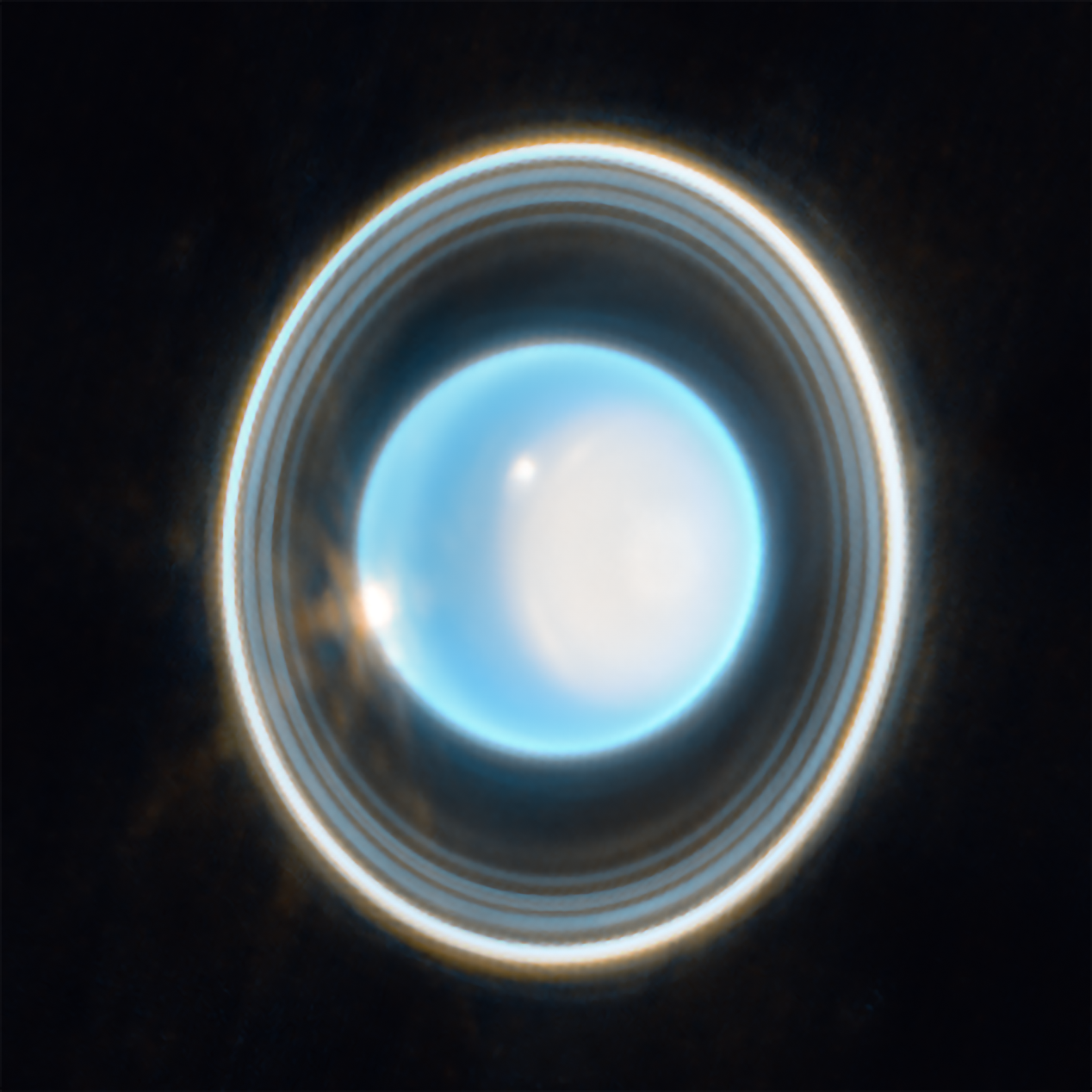
A 2023 Webb image shows that pole as a bright region and resolves 11 rings. The planet is not the featureless pale disc Voyager seemed to reveal. As I noted in my article on the true colours of Uranus and Neptune, familiar processed images can conceal as much planetary complexity as they display.
Voyager saw one season and left an entire history to infer
Voyager 2 remains the only spacecraft to have visited Uranus. It passed the planet in January 1986, when the south pole was aimed almost directly at the Sun. The encounter was an extraordinary achievement, but it sampled one geometry during one season.
I have also written about the rare planetary alignment that made Voyager 2’s four-world tour possible. The same trajectory that delivered humanity’s only close Uranus observations carried the probe onward to Neptune instead of leaving it in orbit.
NASA’s current Voyager fact sheet records the other great surprise: Uranus’s magnetic axis is tilted nearly 60 degrees from its rotation axis. Rotation twists the magnetotail into a corkscrew extending millions of kilometres behind the planet. That lopsided field may reflect processes inside the ice giant rather than the event that tipped it.
This is why the familiar collision story should remain a hypothesis. A giant impact explains the 98-degree tilt plausibly and can produce a tilted debris disc from which moons form. A migrating lost moon can also drive the planet sideways. Neither has left a surviving impactor, timestamp or unique signature that closes the case.
Uranus was not literally knocked over in the sense that it once had a universal “up”. Planets inherit spin from formation and then have that spin rewritten by collisions, migration and resonance. What makes Uranus special is that the rewriting is still visible across the whole system: in the planet, the seasons, the rings and the moons all circling on the same improbable plane.