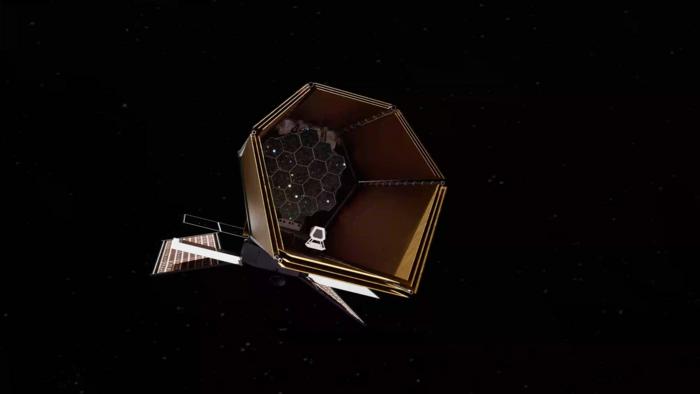
How can the UK Space Agency contribute to NASA’s highly anticipated Habitable Worlds Observatory (HWO) mission?
This is what a recent study presented at the Royal Astronomical Society's National Astronomy 2026 Meeting hopes to address as the UK Space Agency discussed how it could contribute to HWO.
As part of the conference update, the team announced the UK Space Agency has awarded them an additional £3million ($3.99 million) to further develop the instrument.
"This UK Space Agency funding is a significant step forward in securing the UK's place at the heart of one of the most ambitious space science missions ever conceived,” said Dr. Caroline Harper, who is the Head of Space Science at the UK Space Agency.
How will the UK Space Agency contribute to HWO in the coming years and decades?
How can the UK Space Agency contribute to NASA’s highly anticipated Habitable Worlds Observatory (HWO) mission? This is what a recent study presented at the Royal Astronomical Society's National Astronomy 2026 Meeting hopes to address as the UK Space Agency discussed how it could contribute to HWO. This study has the potential to expand the global contributions to HWO, the latter of which is slated to launch in the 2040s.
For the study, the UK researchers updated the scientific community on the status of two developing an instrument that could prove vital on HWO, including the High Resolution Imager (HRI) and Multi-Object Spectrograph (MOS). As part of the conference update, the team announced the UK Space Agency has awarded them an additional £3million ($3.99 million) to further develop the instrument. While this instrument has been in development for some time, this additional funding enables the researchers to scale up previous designs and prototypes.
"This UK Space Agency funding is a significant step forward in securing the UK's place at the heart of one of the most ambitious space science missions ever conceived,” said Dr. Caroline Harper, who is the Head of Space Science at the UK Space Agency. “Habitable Worlds Observatory is being designed to answer whether we are alone in the universe and will require technological advances as well as scientific breakthroughs. That's why we're backing UK scientists and engineers to lead one of its core instruments."
As noted, HWO is slated to launch sometime in the 2040s with the primary mission objective to directly image Earth-like exoplanets. Specifically, it will use spectroscopy to study the light that passes through exoplanet atmospheres during star transits to detect biosignatures. Along with exoplanets, HWO will also be tasked with observing stars, galaxy growth, and cosmic structures with unprecedented detail and resolution.
How will the UK Space Agency contribute to HWO in the coming years and decades? Only time will tell, and this is why we science!
As always, keep doing science & keep looking up!
Sources: Royal Astronomical Society's National Astronomy 2026 Meeting, EurekAlert!
Featured Image Credit: NASA