News explainers Tunnel Rescue Teams, DNA Experts & More: How India Is Helping Its Neighbour Nepal In Its Worst HourTunnel Rescue Teams, DNA Experts & More: How India Is Helping Its Neighbour Nepal In Its Worst HourPublished By :,Last Updated: September 03, 2026, 10:20 ISTIndia has so far sent five relief flights, around 74 tonnes of assistance, doctors and paramedics, specialised tunnel rescuers and much more to flood-ravaged Nepal.
According to the Ministry of External Affairs, the latest tranche took India’s assistance to around 74 tonnes of relief material.
The supplies sent across the border have included emergency medical material and other essential relief supplies intended for communities whose homes and basic infrastructure have been destroyed.
The Indian team shifted its base from Trishuli to Syabrubesi to cut travel time to Chilime.
The teams have also explored creating an improvised road approach to the tunnel so that heavier rescue equipment can be taken closer to the site.
News explainers Tunnel Rescue Teams, DNA Experts & More: How India Is Helping Its Neighbour Nepal In Its Worst Hour
Tunnel Rescue Teams, DNA Experts & More: How India Is Helping Its Neighbour Nepal In Its Worst Hour
Published By :
,
Last Updated: September 03, 2026, 10:20 IST
India has so far sent five relief flights, around 74 tonnes of assistance, doctors and paramedics, specialised tunnel rescuers and much more to flood-ravaged Nepal.
Rapid Read
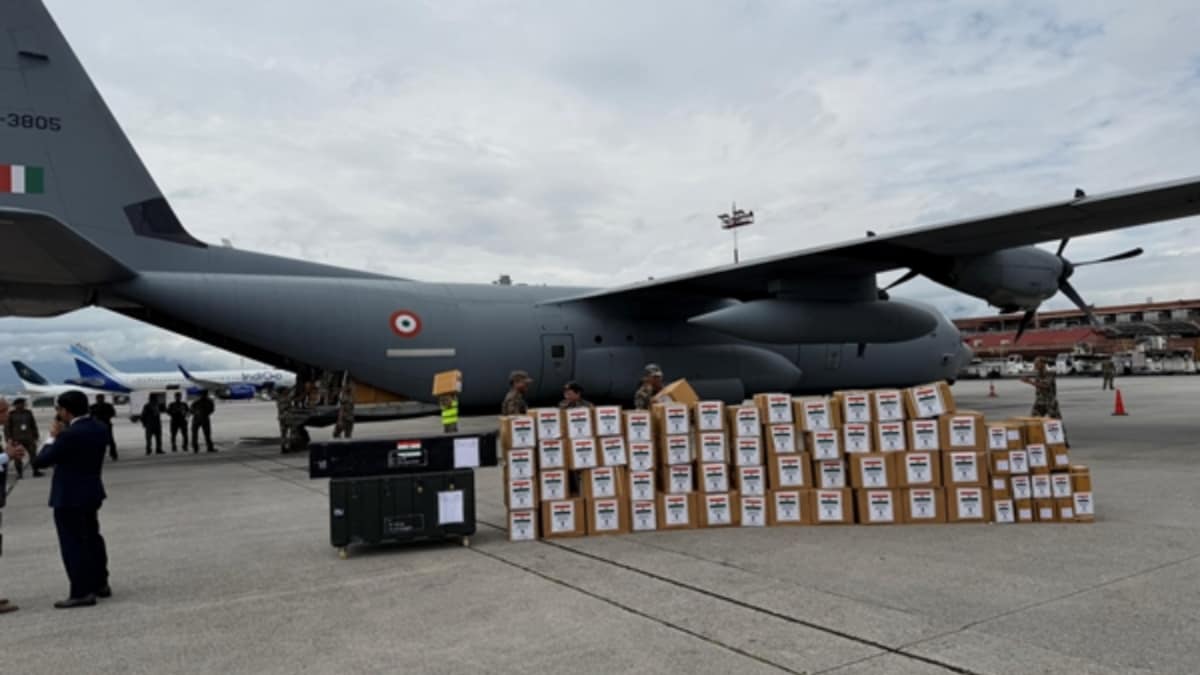
India has so far sent five aircraft carrying relief and rescue materials to Nepal since August 26. (Image: newsonair.gov.in)
Nepal Prime Minister Balendra ‘Balen’ Shah has thanked India for its swift assistance after devastating flash floods swept through the Himalayan nation, killing more than 1,200 people and leaving thousands missing. Addressing Parliament on Wednesday, Shah said the support from countries including India had played an important role in the continuing rescue and relief operations.
His acknowledgement comes as India’s response has expanded from emergency supplies to highly specialised operations on the ground. India was among the first countries to physically send assistance after the August 26 disaster, deploying Indian Air Force aircraft, rescue specialists, medical supplies, forensic experts and equipment to a country struggling to reach communities cut off by destroyed roads and bridges.
Read More: ‘I Have No Hope, But…’: A Father, A Daughter And Nepal’s Desperate Hunt For The Missing
The response has now entered another phase: helping Nepal begin rebuilding what the floods destroyed.
Here is a look at how India is helping its neighbour.
1. Sending Aid Within Hours Of The Disaster
India’s response began almost immediately after the Bhote Koshi River disaster struck on August 26. Prime Minister Narendra Modi spoke to Shah that day and assured him of India’s “full support" and “all possible humanitarian assistance". The first tranche of relief was dispatched soon afterwards.
Much of the worst-hit region was inaccessible by road, while floodwaters, landslides and destroyed bridges made movement extremely difficult. India’s initial assistance was therefore sent by air, allowing essential supplies to reach Kathmandu while rescue agencies concentrated on reaching isolated communities.
The operation was carried out under India’s broader humanitarian assistance and disaster relief framework and reflects the country’s stated “Neighbourhood First" approach.
2. Five IAF Flights Have Carried Relief To Nepal
India has continued to send assistance rather than treating the first consignment as a one-off response. The fifth Indian Air Force aircraft departed for Nepal on September 2 with an 11-member specialised rescue team and 5.5 tonnes of essential medicines. The medical supplies included antibiotics, analgesics, surgical items and other medicines required in the aftermath of a major disaster. More than six tonnes of specialised rescue equipment also accompanied the team.
According to the Ministry of External Affairs, the latest tranche took India’s assistance to around 74 tonnes of relief material.
The supplies sent across the border have included emergency medical material and other essential relief supplies intended for communities whose homes and basic infrastructure have been destroyed.
3. Tackling The Most Difficult Rescue Operations: The Hydropower Tunnels
Some of the most difficult rescue work is taking place underground. Workers are believed to have been trapped inside hydropower tunnels in the Chilime area after the floods and mudslides struck. Reaching them is extraordinarily difficult because sections of the tunnels are blocked by deep mud and debris, while the surrounding terrain itself has been badly damaged.
India has sent a specialised tunnel-rescue team to assist the Nepali Army. The Indian team shifted its base from Trishuli to Syabrubesi to cut travel time to Chilime. Working alongside Nepali personnel, the team has been pushing through deep slush and blockages inside the tunnel. By September 2, it had advanced approximately 100 metres.
The teams have also explored creating an improvised road approach to the tunnel so that heavier rescue equipment can be taken closer to the site.
An additional 11-member Indian rescue team arrived with specialised equipment and moved towards the Trishuli Bazaar area, where it was expected to begin operations alongside the Nepali Army.
This is among the most technically demanding components of India’s assistance because the mission is no longer simply about delivering supplies, it involves entering unstable, debris-filled underground infrastructure in the hope of finding missing workers.
4. Forensic Experts Helping Nepal Identify The Dead
Nepal has recovered hundreds of bodies, but many remain unidentified. Authorities have said only a fraction of the recovered victims have so far been identified and handed over to their families. India has sent a 19-member forensic team to help.
The team began DNA analysis in Kathmandu in cooperation with Nepalese forensic experts. It is working across two laboratories, including Nepal’s forensic facilities, to speed up the identification process.
For families whose relatives remain missing, DNA identification can finally establish whether a recovered body belongs to them. Nepal’s authorities have also been preserving DNA samples and other evidence from unidentified victims so that identification remains possible even when bodies cannot be recognised visually.
5. Supplying Doctors, Paramedics And Medicines
India has sent doctors and paramedics to Nepal alongside repeated consignments of medicines. The latest shipment included antibiotics, painkillers, surgical supplies and other essential medical material.
6. Helping Nepal Restore Connectivity
The floods did not just destroy homes. They cut through the physical infrastructure needed to reach survivors. At least 35 motorable bridges, 45 suspension bridges and around 40 km of black-topped roads have been affected, according to local authorities.
India has responded with bridge-building assistance and equipment. Among the material sent to Nepal are components for a 230-foot single-lane modular steel bridge, with trucks carrying the equipment reaching the country.
Nepal has also sought assistance for dozens of Bailey bridges to restore road connectivity in flood-hit areas. For disaster-hit communities, such infrastructure can be as important as food or medicine. A bridge can determine whether an ambulance can enter a village, whether rescue equipment can reach a tunnel or whether relief supplies can be delivered without relying entirely on helicopters.
7. Rescued Indian Nationals Caught In The Disaster
India’s response has also involved evacuating Indian citizens stranded in the affected region. The MEA said 166 Indian nationals had been rescued, including three on September 2.
The wider regional crisis also affected Indians travelling through Tibet. On September 2, 410 Indian nationals who had been visiting the Tibet Autonomous Region for pilgrimage or other activities left China.
8. Helping Nepal Rebuild A School Destroyed By Floods
India’s assistance is no longer restricted to rescue and relief. India has pledged support for the complete reconstruction of Tribhuvan Trishuli Secondary School in Bidur, Nuwakot, which was severely damaged by the floods.
The school carries particular significance in the India-Nepal relationship. Its earlier history is linked to Indian development assistance, while its newer building was constructed with grant support under India’s High Impact Community Development Programme. Its destruction therefore represents more than the loss of a school building. It is also a reminder of how deeply the two countries’ development efforts are intertwined.
The school became a symbol of survival during the disaster after its principal, Rajendra Dawadi, evacuated more than 1,600 students when warnings indicated that the flood threat was imminent. India’s assistance is now set to help bring the school back.
9. PM Modi’s Message Of Solidarity
When PM Modi spoke to Balen Shah on the day of the disaster, he conveyed India’s willingness to provide “all possible humanitarian assistance".
The message has since translated into a multi-layered operation: military aircraft carrying relief, specialist rescuers entering tunnels, forensic scientists working on DNA identification, medical teams treating the affected and engineers helping restore connectivity.
It is the kind of response that matters particularly in the first days after a disaster, when a neighbouring country can mobilise people and equipment much faster than assistance arriving from farther away.
The Indian response to Nepal’s floods can now be measured in much more than tonnes of relief material. It is five relief flights, around 74 tonnes of assistance, doctors and paramedics, specialised tunnel rescuers, more than six tonnes of rescue equipment in the latest mission, a 19-member forensic team working on DNA identification, assistance for restoring bridges and roads, the rescue of Indian nationals and a commitment to rebuild a school swept away by the disaster.
For Nepal, however, the hardest phase may only be beginning. That is why Shah’s acknowledgement of India’s timely assistance is significant as it comes at a moment when Nepal needs both immediate help to deal with a catastrophe and long-term partnerships to rebuild what the floods took away.
News18 Newsletter Handpicked stories, in your inbox A newsletter with the best of our journalism submit
Quick Answers Powered by Ask News18 What other countries are assisting Nepal after the devastating floods? Alongside India, China has pledged immediate financial assistance and offered relief supplies to support Nepal's flood response. Additionally, the United States has pledged $500,000 in aid to the country. Powered by Ask News18
About the Author Pragati Ratti Pragati is a News Editor at news18.com. Having headed the Business and Viral sections, Pragati now ideates, writes and edits long-form features and articles on national and global affairs. She ensures... Read More
First Published: September 03, 2026, 10:20 IST
Disclaimer: Comments reflect users’ views, not News18’s. Please keep discussions respectful and constructive. Abusive, defamatory, or illegal comments will be removed. News18 may disable any comment at its discretion. By posting, you agree to our Terms of Use and Privacy Policy Loading comments...