More than a century later, a scientist has asked whether its "Evil Twin" could return on Halloween 2026.
His abstract, "Will Tunguska's Evil Twin Return on Halloween 2026?
The paper does not point to Halloween 2026 as a time of special danger.
So what should a skywatcher take from Halloween 2026?
Unverified: that a dark companion of the Tunguska object will return around Halloween 2026, an idea Boslough himself calls "pure speculation."
Getting your audio player ready...
The Tunguska event was one of the most studied explosions of the 20th century, a blast over the Siberian forest on June 30, 1908, that flattened trees across a remote river basin. More than a century later, a scientist has asked whether its "Evil Twin" could return on Halloween 2026. But is anything actually heading toward Earth this Halloween?
A Headline Written to Scare
The question comes from Mark Boslough of the Department of Earth and Planetary Sciences at the University of New Mexico. His abstract, "Will Tunguska's Evil Twin Return on Halloween 2026? Science and Skepticism in a Clickbait World," appears in the Geological Society of America's Abstracts with Programs for 2026 and was scheduled for October 11, 2026, in a session on "Myths and Misrepresentations surrounding Cosmic Impact claims."
The opening paragraphs of the abstract are written like a tabloid story, asking whether the Tunguska object had "an unseen companion that missed the Earth in 1908" and whether this companion is "on its way back to finish the job." They describe the Taurid meteor stream, the source of the so-called "Halloween fireballs," and note that one published model places a swarm of debris in an approximate 61-year resonance with Earth.
However, the abstract then turns on itself, and Boslough explains what the reader has just been through:
"The previous paragraphs of this abstract are written in clickbait style. The idea of a dark Tunguska companion is pure speculation."
In the same abstract he adds that the Tunguska object's encounter with Earth came six years before the hypothetical swarm, and "there is no theoretical basis for it to have the same resonant period." The abstract says the presentation would weigh "arguments, pro and con, about whether we should try to exploit the clickbait industry to provide accurate scientific and skeptical information to the public."
What Happened at Tunguska in 1908
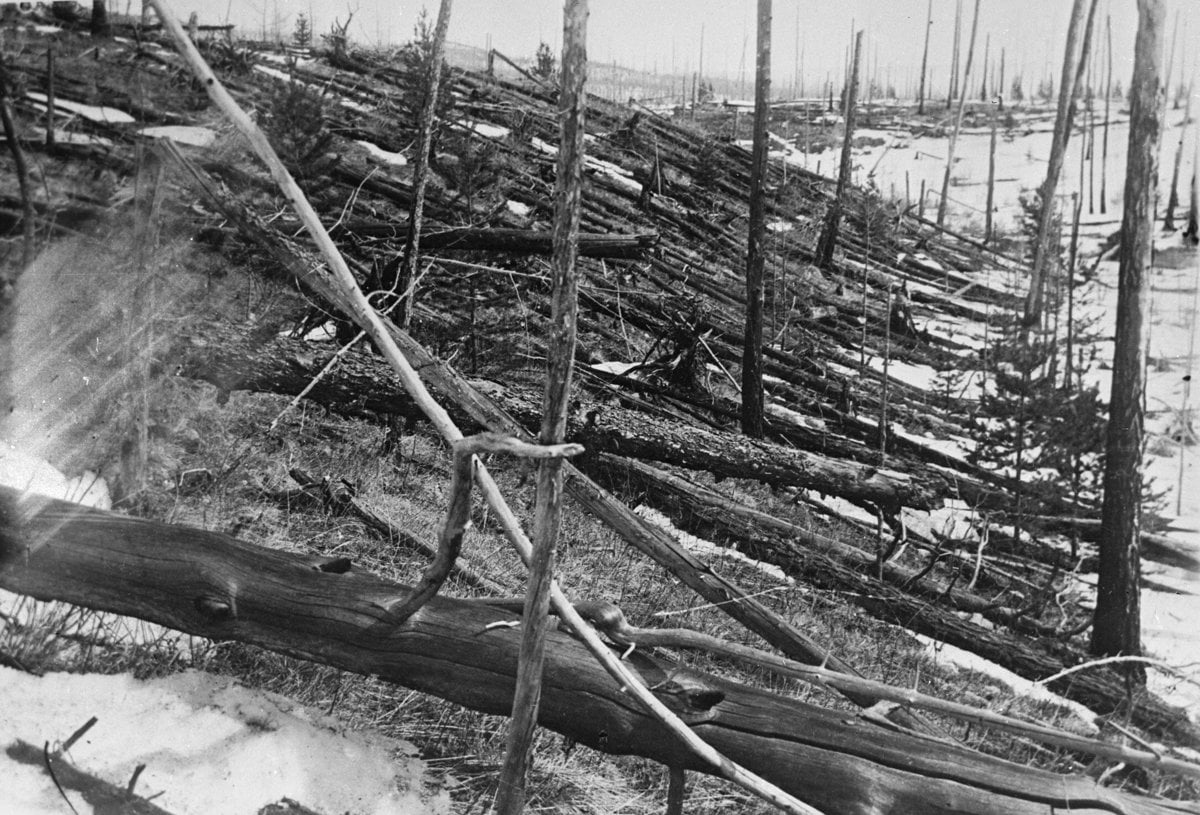
According to a NASA history article, the blast came at about 7:15 am local time. Evenki reindeer herders described "a fireball trailing smoke, then a flash brighter than the Sun, followed by a loud noise like thunder." Because the region was so sparsely populated, NASA notes that "very few human casualties resulted."
The geologist Leonid Kulik could not reach the site in 1921 and only got there in 1927. Later surveys in the 1950s and 1960s mapped a butterfly-shaped zone of damage covering 830 square miles (about 2,150 square kilometers), "with millions of trees knocked over." NASA adds that Kulik "failed to find physical evidence of the bolide," and that microparticles found by later expeditions "could not be conclusively tied to the blast."
A 2018 workshop at NASA Ames Research Center found that the leading models converged on an energy of 10 to 20 megatons released in an airburst at a height of about 10 kilometers (6 miles). If the object was a stony asteroid like the one that burst over Chelyabinsk in 2013, the report estimates it was roughly 50 to 80 meters (160 to 260 ft) across. Crucially for anyone worried about Halloween, the workshop concluded that "the interval between such events is millennia, not centuries as had been concluded previously."
The Taurids and the Halloween Fireballs
The Taurids are a real and regular part of autumn skies. NASA identifies Comet Encke as the parent of the stream and explains the nickname: "Oftentimes, this particular shower exhibits fireballs on or around Halloween, making them known as the Halloween Fireballs." Fireballs are meteors at least as bright as the planet Venus.
The Royal Observatory Greenwich lists the Southern Taurids as active from September 10 to November 20, 2026, and the Northern Taurids from October 20 to December 10, with an estimated rate of about five meteors per hour at maximum. The observatory describes the showers as providing "a sprinkling throughout the two months."
Ancient Origins has covered the Taurid meteor shower and its fireballs before. The larger question is whether the stream also hides much bigger objects.
The Swarm Question in Peer-Reviewed Work
Boslough has also tackled that question in a peer-reviewed paper. Writing in Acta Astronautica with Peter Brown, David Clark and Paul Wiegert of the University of Western Ontario and Quanzhi Ye of the University of Maryland, he assessed the "Taurid resonant swarm," a proposed cluster of debris linked to Comet Encke and held in a 7:2 resonance with Jupiter.
The team found "no evidence for objects in the Taurid stream that are above the global catastrophe threshold." However, they noted that "the possibility of a few large objects and a significant population of objects the size of the Chelyabinsk or Tunguska bodies has not been eliminated." They also argue that eyewitness accounts and airburst models "suggest that the Tunguska object was a Beta Taurid," a branch of the same stream.
The paper does not point to Halloween 2026 as a time of special danger. Instead, it says that if the swarm holds a significant number of such objects, risk would peak "in November 2032 and June 2036," and it recommends targeted telescope surveys during those passes. His GSA abstract strikes the same note: "There is no evidence for a concentration of large objects, but there is no reason not to search for them in 2032 as a precaution."
Telescope searches have so far turned up little. A survey with the Canada France Hawaii Telescope, reported by Wiegert and colleagues, found results "consistent with no Taurid Swarm members observed," while setting an upper limit on objects 34 to 76 meters across. The same team notes that meteor observations have confirmed the swarm at sizes of a meter and smaller.
When Impact Stories Go Wrong
Gizmodo has described Boslough as an outspoken critic of a different impact idea, the Younger Dryas impact hypothesis, which proposes that comet fragments struck Earth about 12,800 years ago. On August 6, 2025, the journal PLOS One published a study by Christopher Moore and colleagues reporting cometary dust and platinum anomalies in sediment cores from Baffin Bay, near Greenland. When it appeared, Boslough told Gizmodo: "I do not see anything in this new paper that overcomes the chronic and ongoing problems with their previous papers."
On February 11, 2026, the PLOS One Editors retracted the paper. Their notice lists incorrect citations "raising concerns about undisclosed use of AI tools," problems with the radiocarbon calibration that would make the layers younger and "outside the Younger Dryas," and material reported as cosmic spherule fragments that experts "identified as marine foraminifera." The notice concludes:
"In light of the above concerns that call into question the validity of the reported results and the conclusions made, the PLOS One Editors retract this article."
According to the notice, eight of the authors did not agree with the retraction and one did. Ancient Origins reported the Baffin Bay study as support for the hypothesis in an August 11, 2025, article on the Baffin Bay comet debris, which now carries an editors' note pointing readers to the retraction. Readers who want the wider picture can turn to the site's fact check on whether a comet ended the Ice Age and its longer look at the Younger Dryas impact debate.
The Acta Astronautica paper makes the link between the two topics explicit. Its authors write that skepticism toward swarm risk in the planetary defense community stems partly from "misinformation, misunderstandings, and misinterpretations associated with the Younger Dryas impact hypothesis." Still, they argue that the swarm idea "is testable and should not be dismissed just because it has been invoked in association with unsupported claims."
Reading the Next Scary Headline
Boslough's abstract also points out that the scare has an old pedigree. The familiar claim that Tunguska would have destroyed St. Petersburg had it arrived 4 hours and 47 minutes later was, he writes, "a playful, but incorrect, idea first published by astronomer I.S. Astapowitsch in a 1934 version of modern-day clickbait."
So what should a skywatcher take from Halloween 2026? The Taurids will be up there, and a bright fireball is a fine reward for a clear night. However, the sources cited here give no sign of a dark twin of Tunguska returning this week, and the scientists studying the swarm are looking ahead to 2032 and 2036 for their best chance to test it. How many large bodies the Taurid stream really holds is still an open question.
How we label claims
Established: the Tunguska airburst of June 30, 1908, and the annual Taurid meteor showers linked to Comet Encke. Established: PLOS One retracted the Baffin Bay paper on February 11, 2026. Disputed: the Younger Dryas impact hypothesis. Disputed: that the Tunguska object was a Beta Taurid. Unverified: that the Taurid stream holds a significant swarm of Tunguska-sized objects. Unverified: that a dark companion of the Tunguska object will return around Halloween 2026, an idea Boslough himself calls "pure speculation."
Trees knocked down by the Tunguska explosion, photographed in May 1929 during Leonid Kulik's expedition, nearly 21 years after the blast. Public domain, via Wikimedia Commons
By Aris Manus
Sources